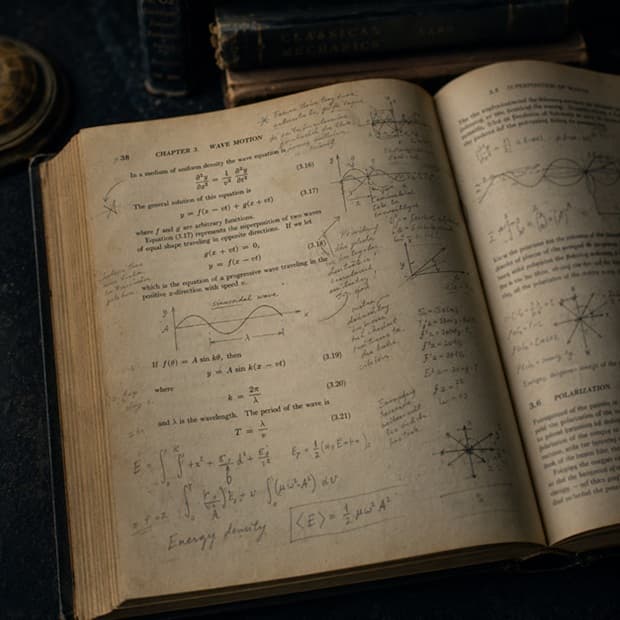
What is a Fourier Transform?
In the realm of physics and engineering, the Fourier transform serves as a powerful mathematical tool that allows us to analyze functions or signals in a different domain. It transforms a time-domain signal into its frequency-domain representation, providing insights into the frequency components th
What is a Fourier Transform?
In the realm of physics and engineering, the Fourier transform serves as a powerful mathematical tool that allows us to analyze functions or signals in a different domain. It transforms a time-domain signal into its frequency-domain representation, providing insights into the frequency components that make up that signal. This concept, rooted in the work of Jean-Baptiste Joseph Fourier, is fundamental in various fields including signal processing, optics, and quantum mechanics.
Understanding the Basics of Fourier Transforms
To grasp the idea of the Fourier transform, we first need to understand what we mean by “signals.” In physics, a signal can be anything that varies with time, such as sound waves, light waves, or even electrical signals. The Fourier transform exploits the principle that any signal can be represented as a sum of simpler sinusoidal waves (sines and cosines) of different frequencies, amplitudes, and phases.
The Mathematical Definition
The Fourier transform of a continuous function is defined mathematically as:
In this equation:
- is the Fourier transform, which represents the signal in the frequency domain.
- is the original signal in the time domain.
- is the angular frequency, related to the frequency by .
- is a complex exponential, which can be expressed in terms of sine and cosine using Euler's formula.
The inverse Fourier transform allows us to retrieve the original signal from its frequency components:
This duality between time and frequency domains is a hallmark of Fourier analysis.
Intuitive Understanding
Imagine you are listening to a musical chord played on a piano. The chord consists of multiple notes played simultaneously, each note corresponding to a specific frequency. If you were to analyze this chord using Fourier transform, you would decompose it into individual sine waves of different frequencies, revealing the presence of each note. This way, the complex signal becomes more understandable by expressing it in terms of its frequency content.
Applications of Fourier Transforms
The Fourier transform is not merely a theoretical construct but has numerous practical applications across various fields.
Signal Processing
In signal processing, Fourier transforms are utilized to filter signals, compress data, and analyze frequency components. For instance, when you use an equalizer on a music track, you are essentially manipulating the frequency components of the signal.
Image Processing
In the realm of image processing, the Fourier transform helps in tasks such as image compression and enhancement. By transforming images into the frequency domain, we can apply filters that enhance or suppress certain features based on their frequencies.
Quantum Mechanics
In quantum mechanics, the Fourier transform plays a crucial role in the analysis of wave functions. The probability density associated with a particle can be described in both position and momentum space, and the Fourier transform enables the transition between these two descriptions.
Properties of Fourier Transforms
Understanding some key properties of Fourier transforms can enhance your grasp of this concept:
-
Linearity: The Fourier transform of a linear combination of functions is the same linear combination of their Fourier transforms. Mathematically, if and are functions, then:
where and are constants.
-
Time Shifting: If a function is shifted in time, its Fourier transform experiences a corresponding phase shift:
-
Frequency Shifting: If the frequency of a signal is shifted, its Fourier transform is also altered:
-
Convolution: The Fourier transform of the convolution of two functions is the product of their Fourier transforms:
Common Misconceptions
-
Fourier Transform is Just for Periodic Functions: While the Fourier series is specifically for periodic functions, the Fourier transform applies to a broader class of signals, including non-periodic functions.
-
Frequency Domain is Just About Sound: Many associate the Fourier transform solely with audio signals. However, it applies to any signal that can be described mathematically, including light, electrical signals, and even image data.
-
Complex Numbers are Just a Mathematical Trick: Many learners find complex numbers perplexing. However, they offer a neat way to encapsulate both amplitude and phase information in a signal, simplifying calculations significantly.
Suggested Follow-Up Questions
- How does the Fourier transform help in noise reduction in audio signals?
- What are the differences between the Fourier transform and the discrete Fourier transform (DFT)?
- Can you explain how the Fourier transform is used in image compression algorithms like JPEG?
- What real-world phenomena can be modeled using Fourier transforms beyond sound and light?