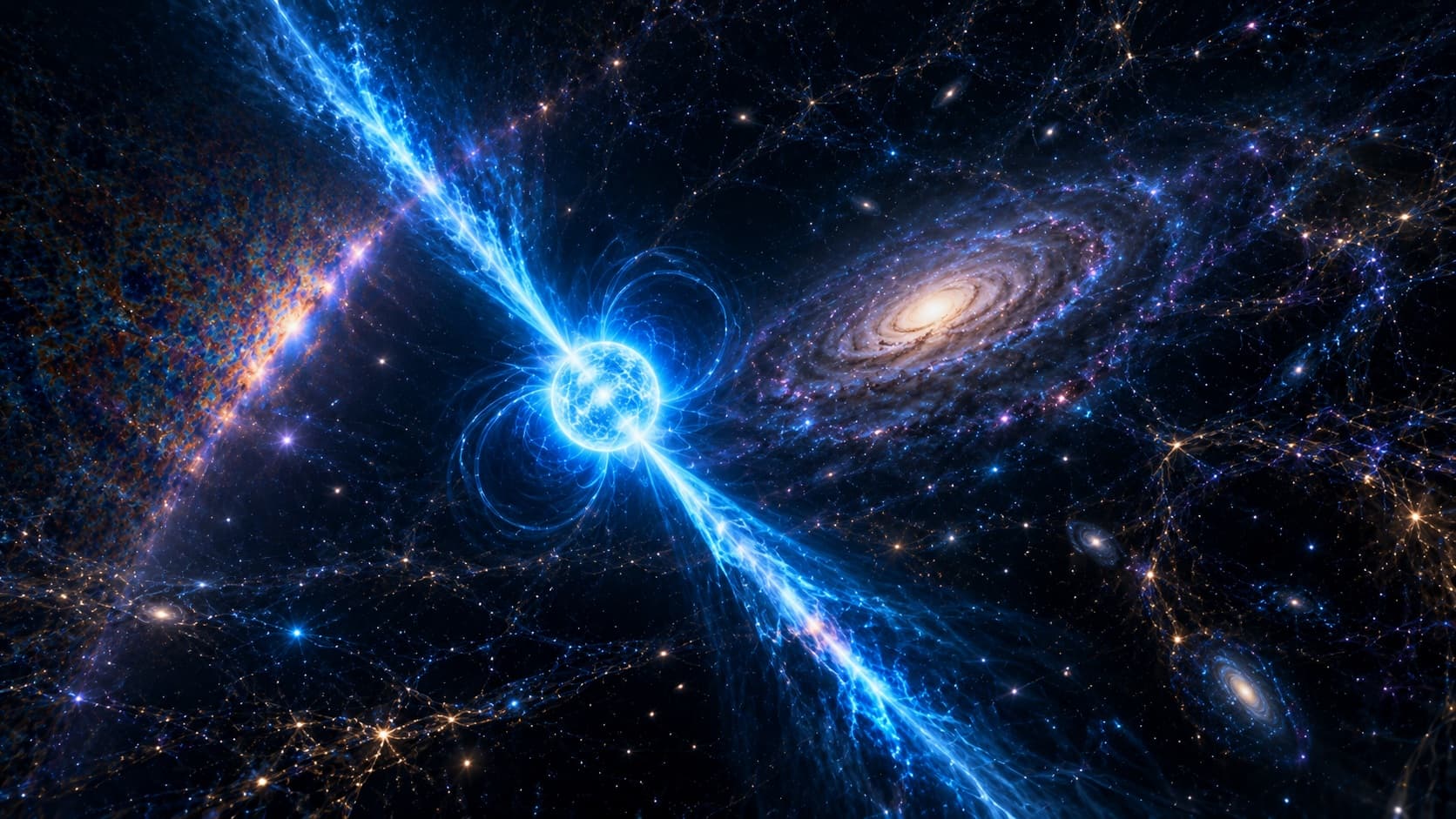
Astrophysics and Cosmology
PHYS 501
From stars and black holes to the Big Bang: explore how physics explains the structure and evolution of the universe, dark matter, dark energy, and the cosmic microwave background.
Physics at the Largest Scales
Astrophysics and cosmology apply the tools of physics — mechanics, thermodynamics, electromagnetism, special and general relativity, quantum mechanics — to the largest structures in the universe. This is physics without walls, labs, or instruments you can hold: it is physics done by observing the sky.
Stars
Stars are spheres of plasma held together by gravity and supported against gravitational collapse by the pressure produced by nuclear fusion. The Sun fuses 600 million tons of hydrogen into helium every second, converting mass to energy via E = mc².
The life cycle of a star is determined by its mass. Low-mass stars like the Sun become red giants and then white dwarfs. High-mass stars become supernovae and leave behind neutron stars or black holes.
The Hertzsprung-Russell Diagram
The H-R diagram plots stars by luminosity versus surface temperature. Most stars lie on the main sequence — a diagonal band corresponding to hydrogen-burning stars. The H-R diagram is one of the most powerful tools in stellar astrophysics.
Black Holes
A black hole forms when a massive object is compressed to within its Schwarzschild radius — the event horizon. Inside the event horizon, not even light can escape. Black holes are predicted by general relativity and confirmed by direct observation (the Event Horizon Telescope images of M87 and Sgr A*).
Galaxies
Stars form galaxies — gravitationally bound systems containing billions to trillions of stars. The Milky Way is a barred spiral galaxy about 100,000 light-years across. Galaxies group into clusters and superclusters, forming the large-scale structure of the universe.
The Expanding Universe and the Big Bang
Edwin Hubble discovered in 1929 that distant galaxies are receding from us with velocities proportional to their distances. The universe is expanding. Running the expansion backward in time leads to the Big Bang — a hot, dense initial state approximately 13.8 billion years ago.
The cosmic microwave background (CMB) is the afterglow of the Big Bang — thermal radiation from when the universe cooled enough for atoms to form. The CMB is the most precisely measured blackbody spectrum in physics and contains a wealth of information about the early universe.
Dark Matter and Dark Energy
Galaxies rotate too fast for the gravity of visible matter to hold them together. Something else provides the gravity — dark matter. It makes up about 27% of the universe's energy content. What dark matter is remains one of the great open questions in physics.
The expansion of the universe is accelerating. The energy driving this acceleration is called dark energy. It makes up about 68% of the universe's energy content. Its nature is perhaps the deepest mystery in contemporary physics.
What you will learn
- Explain stellar fusion and the life cycles of stars
- Interpret the Hertzsprung-Russell diagram
- Describe the formation and properties of black holes
- Explain Hubble's law and the expanding universe
- Describe the Big Bang and the cosmic microwave background
- Explain the evidence for dark matter and dark energy
- Describe the large-scale structure of the universe
Major topics
Why this course matters
Astrophysics shows that the same physics operating in a laboratory applies across the entire observable universe. It answers humanity's oldest questions about origins, structure, and fate. Dark matter and dark energy remind us that 95% of the universe is still unknown — physics is far from finished.
Course modules
Celestial Mechanics
This module applies Newtonian gravity to planets, moons, spacecraft, and extended bodies. Students derive Kepler's laws, study orbital energy, learn transfer maneuvers, and examine tidal forces and the Roche limit.
Stellar Physics
This module explains how stars form, shine, and evolve. Students study hydrostatic equilibrium, nuclear fusion, the Hertzsprung-Russell diagram, and the life cycles of stars of different masses.
Compact Objects
This module explores the extreme remnants of stellar evolution. Students study white dwarfs, neutron stars, black holes, and the conceptual quantum-gravity idea of Hawking radiation.
Galaxies and Dark Matter
This module examines galaxies as gravitational systems and introduces the evidence for unseen matter. Students study the Milky Way, galaxy types, rotation curves, clusters, and the cosmic web.
The Expanding Universe
This module introduces the observational basis of modern cosmology. Students study Hubble's law, redshift, distance measurements, the cosmic microwave background, and dark energy.
Big Bang Cosmology
This module studies the universe's early history and long-term future. Students learn the Big Bang model, inflation, primordial nucleosynthesis, and possible cosmic fates.
Common misconceptions
The Big Bang was an explosion in space — it was an expansion of space itself
Black holes suck everything in — they are no more gravitationally dangerous than equivalent-mass stars at the same distance
The universe has a center — every point looks like the center from its own vantage point
Dark matter is anti-matter — dark matter does not interact electromagnetically; anti-matter does
Ask your AI physics guide
Ask anything about Astrophysics and Cosmology, or choose a suggested question below.
AI responses are educational and may not be perfectly accurate. Press Enter to send, Shift+Enter for new line.
Related courses
Special Relativity
Einstein's revolutionary theory of space and time. Covers the postulates, time dilation, length contraction, spacetime diagrams, relativistic energy and momentum, and E = mc².
Quantum Mechanics
The physics of the very small: wave-particle duality, wavefunctions, Schrödinger equation, superposition, measurement, uncertainty, tunneling, spin, and entanglement.
Thermodynamics and Statistical Mechanics
Explore heat, temperature, entropy, and the laws that govern energy transformation. Connect macroscopic thermodynamics to the statistical behavior of atoms and molecules.