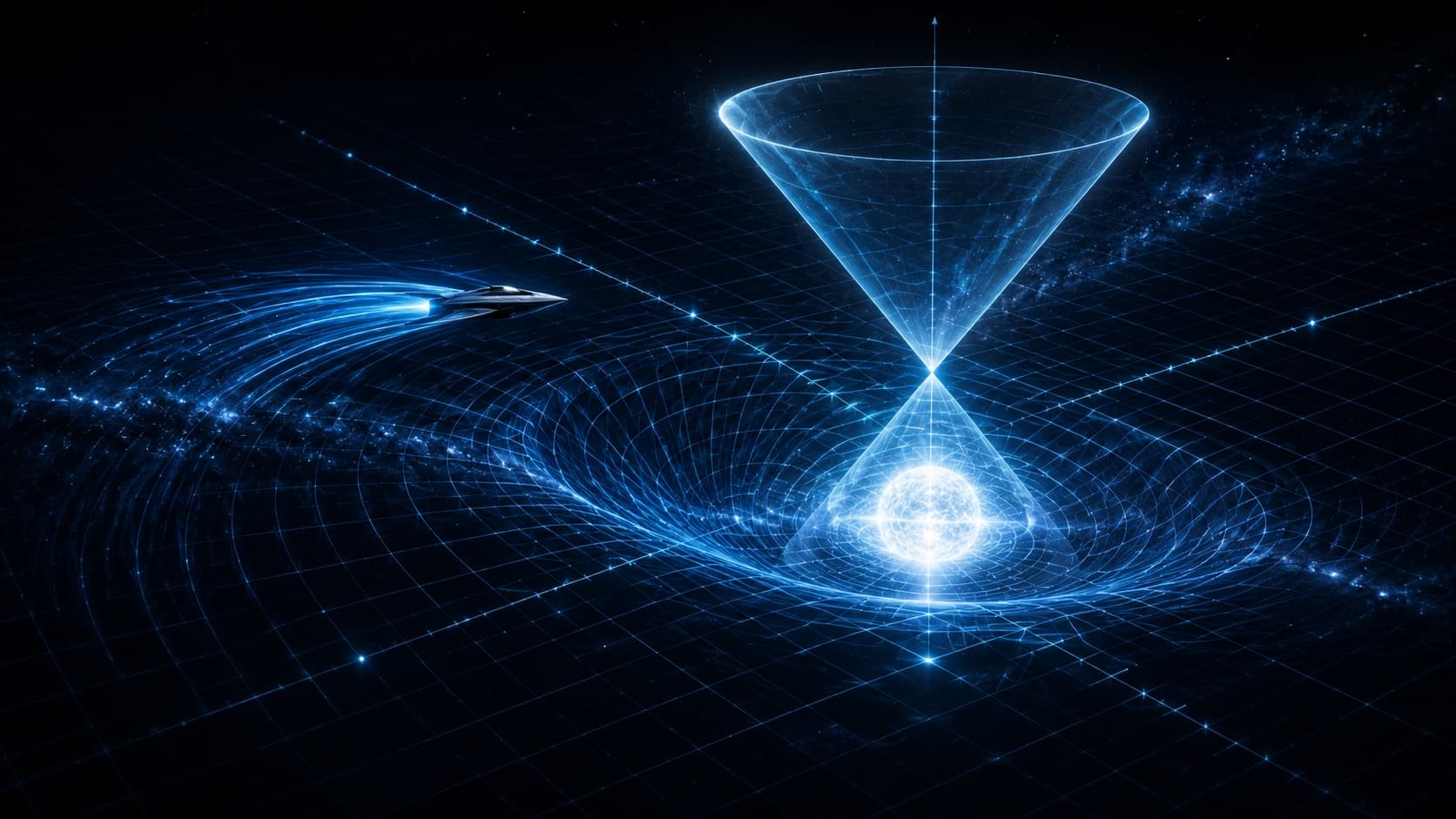
Special Relativity
PHYS 401
Einstein's revolutionary theory of space and time. Covers the postulates, time dilation, length contraction, spacetime diagrams, relativistic energy and momentum, and E = mc².
When Common Sense Fails
In 1905, Albert Einstein published a paper that changed everything. Starting from two simple postulates, he derived a new understanding of space and time that was completely at odds with Newton's classical picture — and completely consistent with experiment.
Special relativity is not a theory about things moving fast. It is a theory about the structure of spacetime itself.
The Two Postulates
Einstein's special relativity rests on two postulates:
- The principle of relativity: The laws of physics are the same in all inertial reference frames.
- The constancy of the speed of light: The speed of light in a vacuum is the same for all observers, regardless of the motion of the light source or the observer.
The first postulate sounds obvious. The second sounds impossible. Yet both are correct, and together they imply a radical restructuring of our ideas about time and space.
Time Dilation
A moving clock runs slow. This is not an illusion or a technical artifact — it is a physical fact. A muon created in the upper atmosphere by cosmic rays would decay before reaching the Earth's surface based on its half-life, but time dilation allows it to survive the journey.
Time dilation is real and has been confirmed experimentally with atomic clocks on airplanes, with particle accelerators, and in GPS satellites that must correct for relativistic effects to give accurate positions.
Length Contraction
A moving object is shorter in the direction of motion, as measured by a stationary observer. This is length contraction. The object's rest length is its proper length, measured in the frame in which it is at rest.
Relativity of Simultaneity
Two events that are simultaneous in one reference frame are not simultaneous in another. This is perhaps the most counterintuitive consequence of special relativity. It means that "now" is not an absolute concept — it depends on the observer.
Spacetime
Minkowski space combines space and time into a single four-dimensional entity: spacetime. The spacetime interval between two events is invariant — the same for all observers, regardless of their motion. Spacetime diagrams (Minkowski diagrams) are powerful tools for visualizing relativistic effects.
Mass and Energy: E = mc²
Perhaps the most famous equation in physics, E = mc², says that mass and energy are equivalent. A small amount of mass corresponds to an enormous amount of energy. This is the principle behind nuclear power and nuclear weapons, and it implies that kinetic energy contributes to a particle's effective mass.
What you will learn
- State Einstein's two postulates and explain why they are radical
- Calculate time dilation and length contraction for moving objects
- Apply the Lorentz transformations between reference frames
- Draw and interpret spacetime diagrams
- Calculate the spacetime interval and identify spacelike and timelike separations
- Apply relativistic momentum and energy formulas
- Explain mass-energy equivalence and E = mc²
Major topics
Why this course matters
Special relativity is essential for particle physics, nuclear physics, astrophysics, and cosmology. GPS satellites, particle accelerators, nuclear reactors, and medical PET scans all depend on relativistic physics. Beyond its practical applications, special relativity teaches a profound lesson: our intuitions about space and time are not always correct.
Course modules
The Foundations of Relativity
This module introduces the conceptual crisis that led to special relativity. Students compare Galilean relativity with electromagnetism, examine the aether hypothesis, study the Michelson-Morley experiment, and learn Einstein's two postulates.
Time and Space
This module develops the core kinematic effects of special relativity. Students study time dilation, length contraction, relativity of simultaneity, and spacetime diagrams as tools for visualizing events.
Lorentz Transformations
This module develops the mathematical transformations connecting inertial frames in special relativity. Students derive the Lorentz transformation, study relativistic velocity addition, and learn invariant spacetime intervals and light cones.
Relativistic Dynamics
This module updates momentum, energy, and particle dynamics for speeds near light. Students study relativistic momentum, kinetic energy, rest energy, the energy-momentum relation, and massless particles.
Four-Vectors and Minkowski Spacetime
This module introduces the geometric language of special relativity. Students learn four-vectors, the Minkowski metric, proper time, and four-momentum methods for collisions.
Applications and Paradoxes
This module applies special relativity to famous thought experiments and real technologies. Students resolve the twin paradox, barn-pole paradox, Doppler shifts, and the relativistic corrections needed for GPS.
Common misconceptions
Relativity says everything is relative — the spacetime interval is absolute
Time dilation is an optical illusion — it is a real physical effect confirmed by experiment
E = mc² means mass is converted to energy — mass-energy is always conserved; the form changes
Special relativity only matters for speeds near c — relativistic corrections are detectable in precise measurements at lower speeds
Ask your AI physics guide
Ask anything about Special Relativity, or choose a suggested question below.
AI responses are educational and may not be perfectly accurate. Press Enter to send, Shift+Enter for new line.
Related courses
Classical Mechanics
A systematic treatment of motion, forces, and energy. Covers Newton's laws, work-energy theorem, momentum, rotation, gravity, oscillations, and an introduction to Lagrangian mechanics.
Electricity and Magnetism
From static charges to Maxwell's equations: understand electric and magnetic fields, circuits, electromagnetic induction, and the unification of electricity and magnetism.
Quantum Mechanics
The physics of the very small: wave-particle duality, wavefunctions, Schrödinger equation, superposition, measurement, uncertainty, tunneling, spin, and entanglement.
Astrophysics and Cosmology
From stars and black holes to the Big Bang: explore how physics explains the structure and evolution of the universe, dark matter, dark energy, and the cosmic microwave background.