Time and Space
PHYS 401 · Module 2
This module develops the core kinematic effects of special relativity. Students study time dilation, length contraction, relativity of simultaneity, and spacetime diagrams as tools for visualizing events.
Lessons in this module
Time dilation
Time dilation means moving clocks are measured to run slow. This lesson derives the effect with a light clock and explains proper time, muons, and experimental confirmation.
Length contraction
Length contraction means moving objects are measured shorter along the direction of relative motion. This lesson defines proper length and explains how contraction follows from relativistic timing.
Simultaneity and its relativity
Events simultaneous in one inertial frame may not be simultaneous in another. This lesson explains clock synchronization, train-platform reasoning, and the role of simultaneity in time dilation and length contraction.
Spacetime diagrams
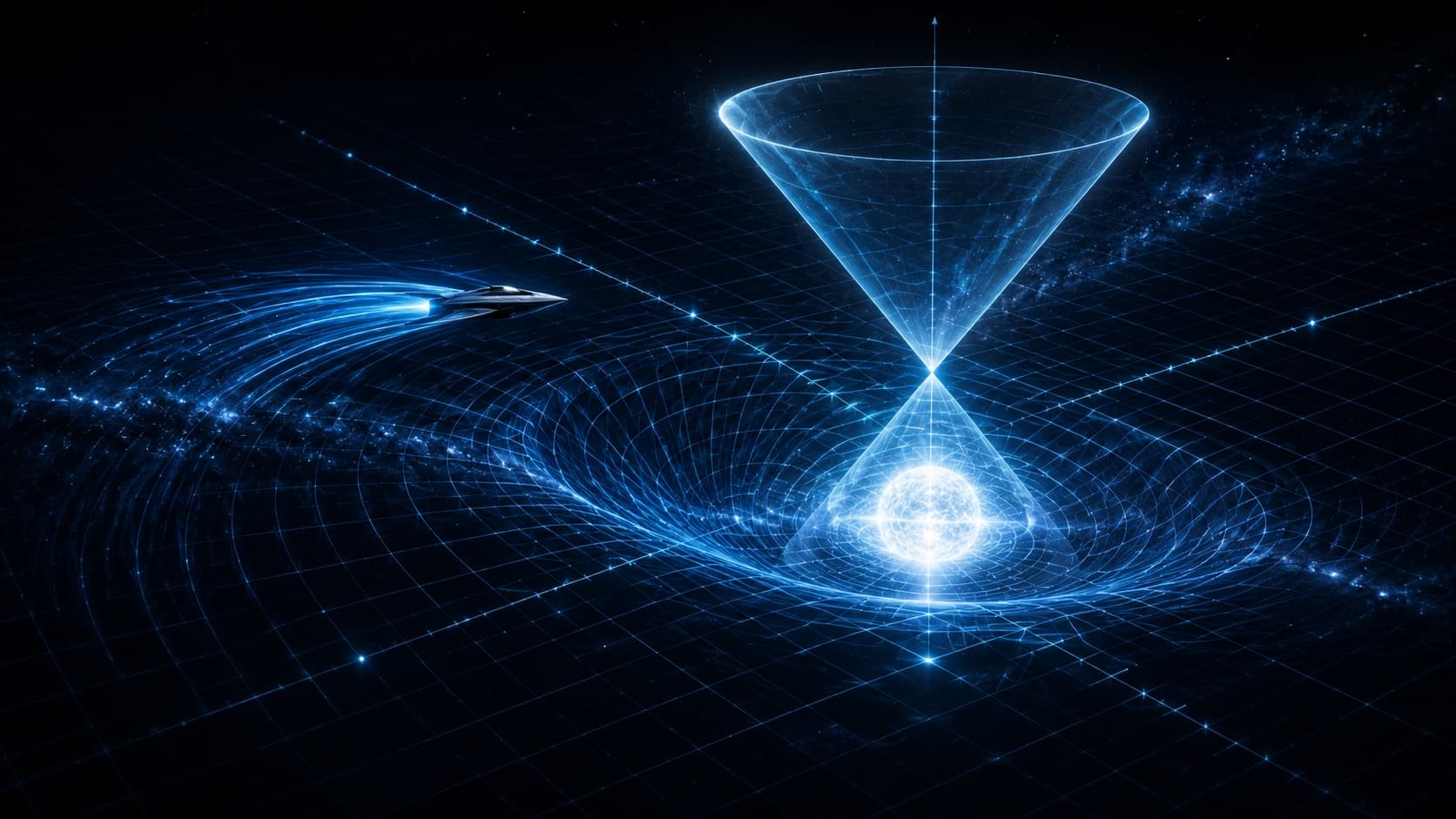
Spacetime diagrams represent events, worldlines, light rays, and simultaneity geometrically. This lesson introduces axes, light cones, slopes, and how different frames slice spacetime.
Ask your AI physics guide
Ask anything about Special Relativity — Time and Space, or choose a suggested question below.
AI responses are educational and may not be perfectly accurate. Press Enter to send, Shift+Enter for new line.