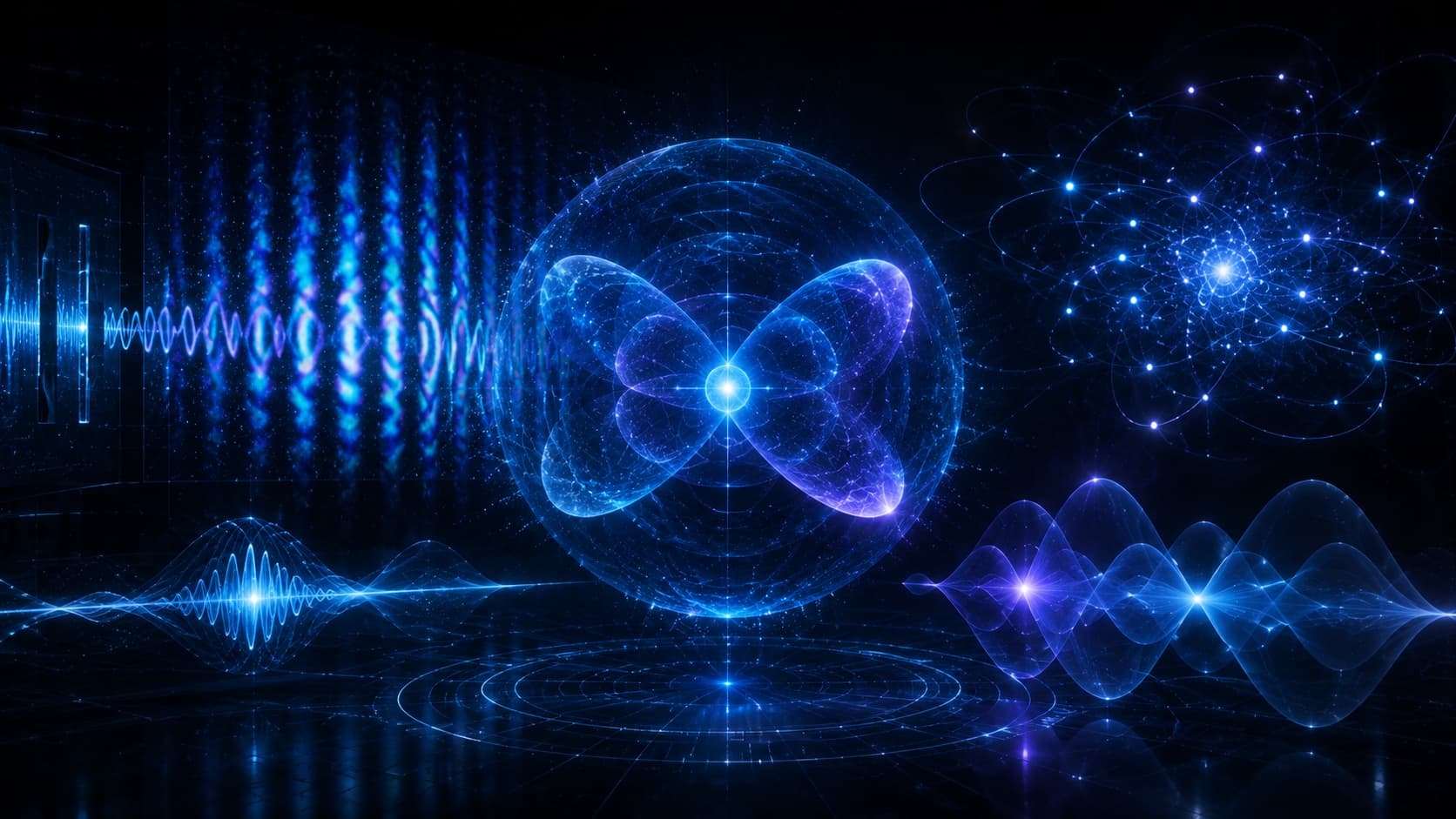
Quantum Mechanics
PHYS 410
The physics of the very small: wave-particle duality, wavefunctions, Schrödinger equation, superposition, measurement, uncertainty, tunneling, spin, and entanglement.
A New Kind of Physics
Quantum mechanics is the most accurate physical theory ever devised. It describes the behavior of electrons, photons, atoms, and all other particles at the quantum scale. It is also the most conceptually radical departure from classical physics.
Classical physics assumed that particles have definite positions and velocities at all times, and that measurement merely reads off these pre-existing values. Quantum mechanics says otherwise: particles do not have definite properties until they are measured. The act of measurement fundamentally changes what is observed.
Wave-Particle Duality
Light sometimes behaves like a wave (interference, diffraction) and sometimes like a particle (the photoelectric effect). Electrons sometimes behave like particles (they have mass and charge) and sometimes like waves (electron diffraction patterns). This is wave-particle duality.
The de Broglie wavelength associated with a particle of momentum p is λ = h/p. Every particle has a corresponding wave. This is strange but experimentally confirmed.
The Wavefunction
In quantum mechanics, a particle is described by a wavefunction ψ(x, t). The wavefunction contains all the information about the particle. Its absolute square |ψ|² gives the probability density of finding the particle at position x at time t.
The wavefunction is not a physical wave in space — it is a probability amplitude. This is a new kind of mathematical object with no classical analog.
The Schrödinger Equation
The time evolution of the wavefunction is governed by the Schrödinger equation. It is the quantum analog of Newton's second law. For a particle in a potential V(x), the time-dependent Schrödinger equation is:
iℏ ∂ψ/∂t = (-ℏ²/2m) ∂²ψ/∂x² + V(x)ψ
You will solve this for simple potentials: the infinite square well, the harmonic oscillator, and the hydrogen atom.
Superposition and Measurement
A quantum system can be in a superposition of multiple states simultaneously. When you measure it, the superposition collapses to one outcome, with probabilities given by the wavefunction. This is the measurement problem — one of the deepest unresolved questions in physics.
The Uncertainty Principle
Heisenberg's uncertainty principle states that the more precisely you know a particle's position, the less precisely you can know its momentum, and vice versa: Δx Δp ≥ ℏ/2. This is not a limitation of our measuring instruments — it is a fundamental feature of nature.
Tunneling, Spin, and Entanglement
Quantum particles can tunnel through energy barriers that classical particles cannot penetrate — this is why nuclear fusion occurs in stars. Electrons and other particles carry intrinsic angular momentum called spin. Entangled particles share a quantum state even when separated by large distances — a phenomenon Einstein called "spooky action at a distance."
What you will learn
- Explain wave-particle duality and give experimental examples
- Interpret the wavefunction probabilistically
- Solve the time-independent Schrödinger equation for simple potentials
- Apply the uncertainty principle to estimate quantum effects
- Explain quantum tunneling and give physical examples
- Describe the hydrogen atom energy levels
- Explain spin and its role in atomic structure
- Describe quantum entanglement qualitatively
Major topics
Why this course matters
Quantum mechanics underlies all of chemistry, materials science, and modern electronics. Lasers, transistors, MRI machines, solar cells, and quantum computers are all quantum devices. Without quantum mechanics, there is no periodic table, no chemistry, and no modern technology.
Course modules
Origins of Quantum Theory
This module traces the experimental crises that forced physicists beyond classical mechanics and electromagnetism. Students study blackbody radiation, the photoelectric effect, Compton scattering, and de Broglie's proposal that matter has wave properties.
The Wavefunction and Schrödinger Equation
This module introduces the wavefunction as the central object of nonrelativistic quantum mechanics. Students study the Schrödinger equation, Born rule, normalization, inner products, and the uncertainty principle.
Exactly Solvable Systems
This module develops intuition through quantum systems that can be solved analytically. Students study the infinite and finite square wells, the harmonic oscillator, and tunneling through potential barriers.
Quantum Formalism
This module develops the abstract mathematical framework of quantum mechanics. Students study Hilbert spaces, operators, eigenvalues, expectation values, and Dirac notation.
The Hydrogen Atom
This module studies the quantum mechanics of hydrogen, the most important exactly solvable atom. Students learn separation of variables, angular momentum, spherical harmonics, energy levels, orbitals, and selection rules.
Spin and Many-Particle Systems
This module introduces intrinsically quantum properties that have no classical analog. Students study spin-1/2 systems, Pauli matrices, identical particles, the exclusion principle, and entanglement.
Common misconceptions
The uncertainty principle is about measurement disturbance — it is a fundamental property of wavefunctions
Quantum mechanics only applies to electrons — it applies to all matter
Schrödinger's cat is literally half alive — it illustrates the measurement problem conceptually
Quantum entanglement allows faster-than-light communication — it does not; no information is transmitted
Ask your AI physics guide
Ask anything about Quantum Mechanics, or choose a suggested question below.
AI responses are educational and may not be perfectly accurate. Press Enter to send, Shift+Enter for new line.
Related courses
Special Relativity
Einstein's revolutionary theory of space and time. Covers the postulates, time dilation, length contraction, spacetime diagrams, relativistic energy and momentum, and E = mc².
Electricity and Magnetism
From static charges to Maxwell's equations: understand electric and magnetic fields, circuits, electromagnetic induction, and the unification of electricity and magnetism.
Astrophysics and Cosmology
From stars and black holes to the Big Bang: explore how physics explains the structure and evolution of the universe, dark matter, dark energy, and the cosmic microwave background.