Introduction to Physics
PHYS 101
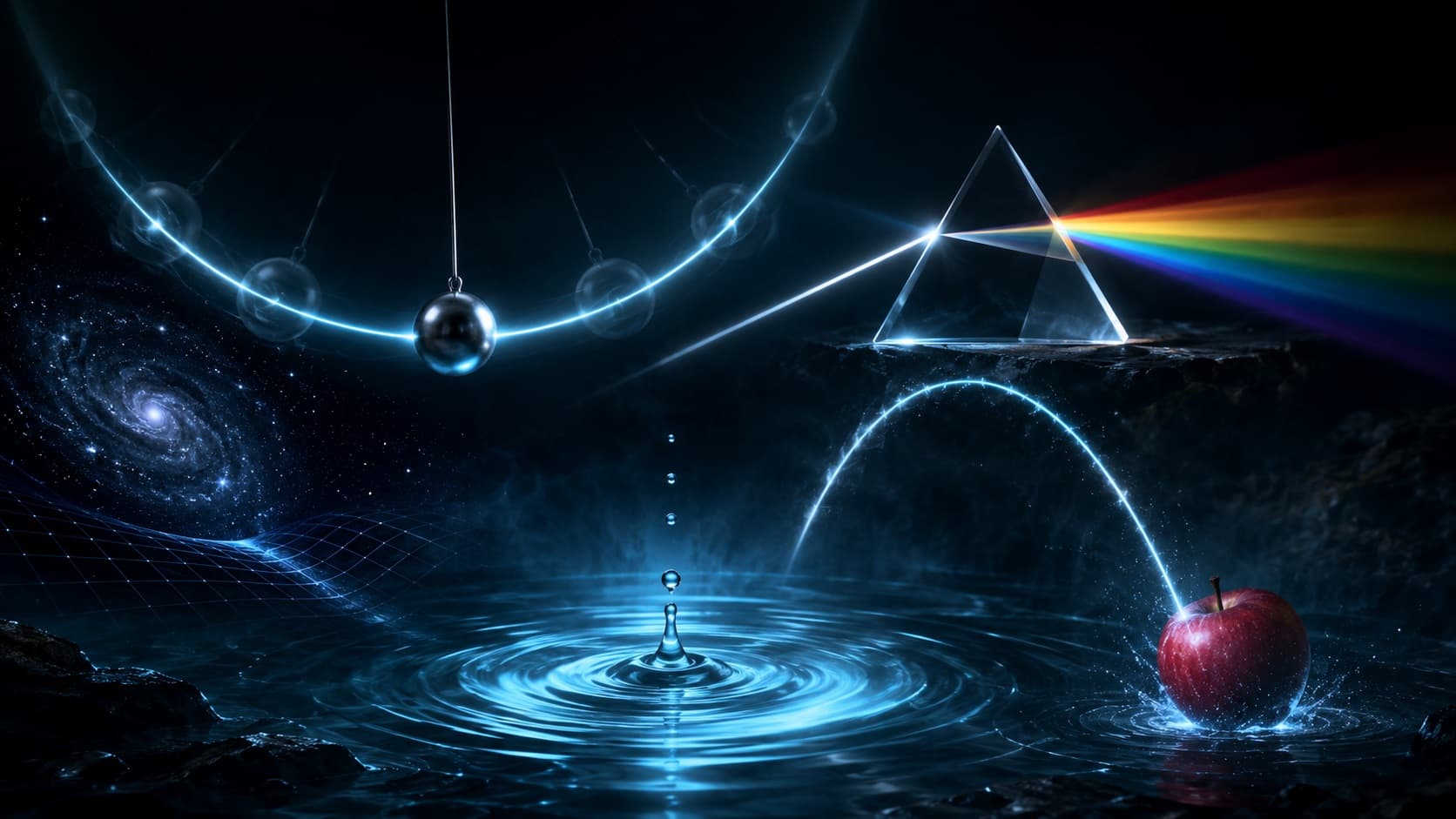
A broad, conceptual introduction to physics as a discipline. Explore motion, forces, energy, waves, light, electricity, atoms, relativity, and quantum ideas. No prerequisites required.
What Is Physics?
Physics is the study of nature at its most fundamental level. It asks questions like: What is matter made of? How does energy move? Why do objects fall? What is light? How does the universe work?
This course gives you a panoramic view of the entire field — from the motion of everyday objects to the strange behavior of subatomic particles. You do not need advanced math to begin. You need curiosity.
Starting From First Principles
Physics always begins with observation. You watch something happen, you ask why, and you build a model. A model is a simplified description that captures the important features of reality. Newton observed falling objects and built a model of gravity. Einstein observed the speed of light and built a model of spacetime.
Every course in physics follows this pattern: observe, hypothesize, model, test, refine.
The Big Ideas in Physics
A handful of ideas run through all of physics:
Conservation laws. Energy is never created or destroyed. Momentum is conserved in collisions. Charge is conserved in reactions. These conservation laws constrain what can happen and make problem-solving tractable.
Fields. Gravity and electromagnetism act through fields — invisible structures that fill space and carry forces between objects. Fields are one of the most important concepts in modern physics.
Symmetry. The laws of physics look the same everywhere in the universe, at any time, in any direction. This symmetry is profound: it directly implies the conservation laws.
Quantum behavior. At small scales, particles do not have definite positions or velocities. They are described by wavefunctions that give probabilities. This is strange, but it is how nature works.
Relativity. The speed of light is constant for all observers. This simple fact reshapes our understanding of space, time, and mass.
How This Course Is Structured
You will move from the concrete and everyday to the abstract and surprising. We start with motion — how things move and why — and build from there. Forces, energy, waves, heat, light, electricity, magnetism, relativity, and quantum mechanics each get their turn.
This course is not a shallow survey. Each topic is treated seriously enough that you will build real understanding, not just vocabulary.
Who This Course Is For
This course is for anyone who wants to understand how the physical world works. You might be a high school student preparing for AP Physics, a college student before your first physics course, a curious adult, a homeschool student, or a teacher looking to deepen your conceptual foundation.
You do not need calculus. You do not need advanced algebra. You need patience and willingness to think carefully.
What Comes Next
After this course, you will be ready for any of the specialized courses in the Guided Physics catalog. Most students move next to Mathematical Methods for Physics, which gives you the mathematical tools to work at a deeper level, and then to Classical Mechanics, which is the systematic treatment of motion and forces.
What you will learn
- Describe physics as a discipline and explain its role in science
- Apply dimensional analysis to check equations and convert units
- Explain motion using position, velocity, and acceleration
- State Newton's three laws and apply them to everyday situations
- Explain the concepts of energy, work, and conservation of energy
- Describe what waves are and how they behave
- Explain what light is and how it interacts with matter
- Describe the basic structure of atoms and the nature of electricity
- Summarize the key ideas of special relativity
- Explain why quantum mechanics was necessary and what makes it strange
Major topics
Why this course matters
Physics is the foundation of all natural science, engineering, and technology. Electricity, computing, medicine, materials science, and space exploration all rest on physical principles. Understanding physics makes you a better thinker, a better problem-solver, and a more informed citizen.
Course modules
The Nature of Physics
This module introduces physics as the study of nature at its most basic level. Students learn how physicists ask questions, measure the world, use units, and check ideas with dimensional reasoning.
Motion and Forces
This module introduces the language of motion and the forces that change motion. Students explore velocity, acceleration, Newton's laws, contact forces, friction, and gravity near Earth's surface.
Energy and Momentum
This module introduces two powerful conservation ideas: energy and momentum. Students learn how work changes motion, how stored energy becomes motion, and how collisions can be understood without tracking every detail.
Waves Light and Sound
This module introduces waves as traveling disturbances that carry energy. Students explore sound, hearing, light, the electromagnetic spectrum, color, reflection, and refraction.
Electricity and Atoms
This module connects electric charge, circuits, and atomic structure. Students learn how charges interact, how simple circuits work, and how atoms and the periodic table organize matter.
Modern Physics Preview
This module gives a conceptual preview of twentieth- and twenty-first-century physics. Students encounter relativity, quantum ideas, gravity, cosmology, and the open questions that make physics an active field.
Common misconceptions
Physics is only for math geniuses — it is accessible to anyone who reasons carefully
Heavier objects fall faster — Galileo showed mass does not affect free-fall
Quantum mechanics only applies to tiny things — its principles underlie all matter
Einstein proved Newton wrong — Newton's laws are excellent approximations at everyday speeds
Ask your AI physics guide
Ask anything about Introduction to Physics, or choose a suggested question below.
AI responses are educational and may not be perfectly accurate. Press Enter to send, Shift+Enter for new line.
Related courses
Mathematical Methods for Physics
Master the mathematical language of physics: algebra, trigonometry, vectors, calculus basics, differential equations, dimensional analysis, and more. Essential before intermediate courses.
Classical Mechanics
A systematic treatment of motion, forces, and energy. Covers Newton's laws, work-energy theorem, momentum, rotation, gravity, oscillations, and an introduction to Lagrangian mechanics.
Waves and Oscillations
From pendulums to ocean waves to quantum wavefunctions: understand oscillations, wave propagation, interference, resonance, standing waves, and the Doppler effect.