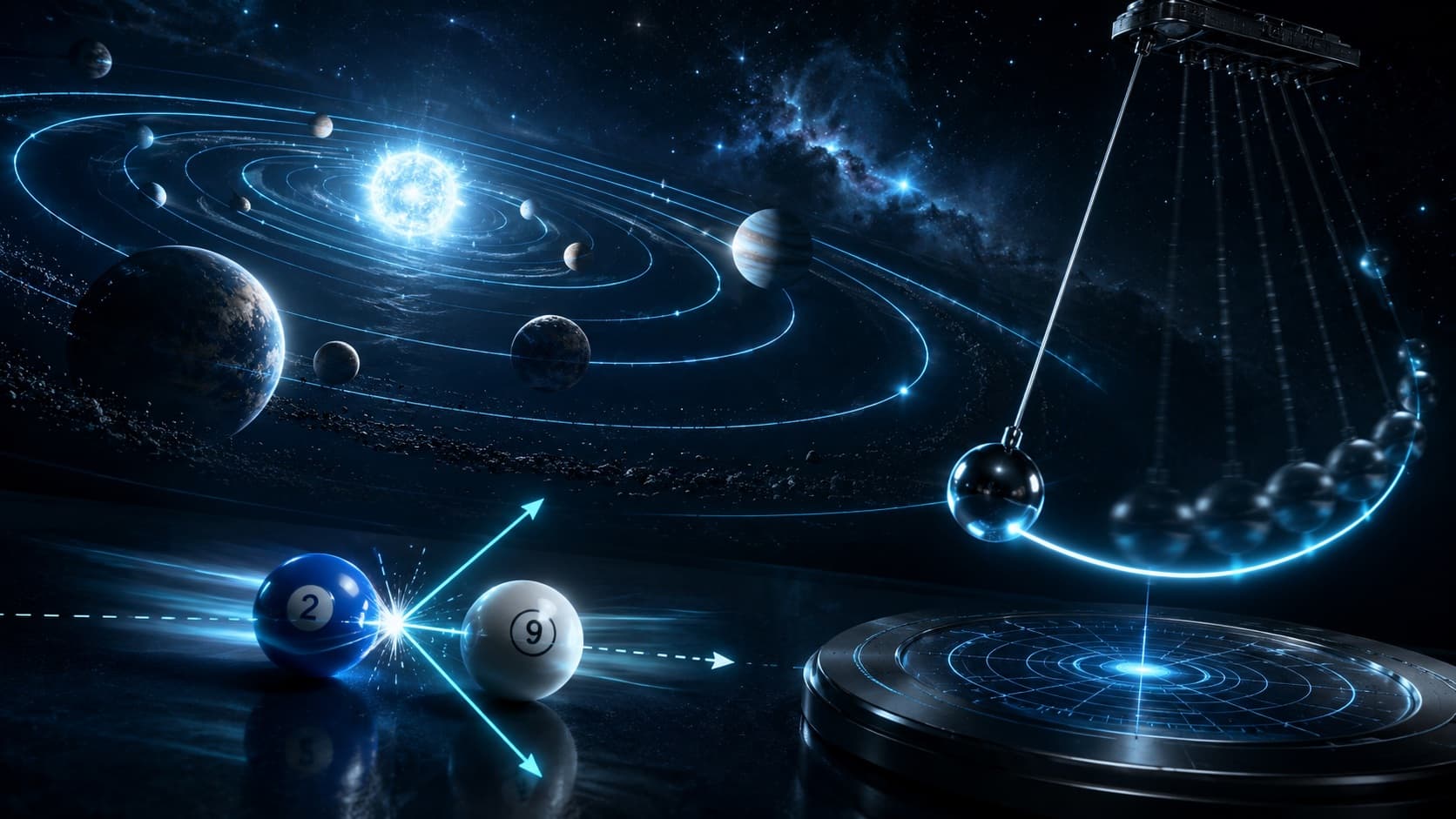
Classical Mechanics
PHYS 201
A systematic treatment of motion, forces, and energy. Covers Newton's laws, work-energy theorem, momentum, rotation, gravity, oscillations, and an introduction to Lagrangian mechanics.
The Science of Motion
Classical mechanics is the oldest and most developed branch of physics. It describes how objects move under the influence of forces. From a falling apple to a planet orbiting the sun, classical mechanics gives you the tools to predict and explain motion.
Newton's Laws
Isaac Newton's three laws of motion are the foundation of classical mechanics. The first law says that objects at rest stay at rest and objects in motion stay in motion unless acted upon by a net force. The second law says that force equals mass times acceleration: F = ma. The third law says that every force has an equal and opposite reaction.
These three laws, combined with Newton's law of universal gravitation, were revolutionary. They unified the motion of earthly objects with the motion of the planets into a single mathematical framework.
Energy and Work
Energy is conserved. This is one of the most powerful statements in all of physics. The work-energy theorem connects the work done on an object to its change in kinetic energy. Conservation of energy lets you solve problems without knowing the detailed path — only the endpoints matter.
Potential energy, kinetic energy, and the conversion between them are central to mechanics. Springs, pendulums, and orbits all involve energy transformations that conserve total mechanical energy.
Momentum
Linear momentum is also conserved when there are no external forces. This makes it invaluable for analyzing collisions and explosions. You will work through elastic and inelastic collisions and learn to use momentum conservation to find final velocities.
Rotation
Real objects rotate as well as translate. Angular velocity, angular acceleration, torque, and moment of inertia are the rotational analogs of their linear counterparts. Conservation of angular momentum explains why figure skaters spin faster when they pull their arms in.
Gravity
Newton's law of universal gravitation is an inverse-square law: the gravitational force between two masses decreases with the square of the distance between them. Kepler's three laws of planetary motion follow directly from this. You will derive them.
Oscillations
Simple harmonic motion — the oscillation of a mass on a spring or a pendulum at small angles — is ubiquitous in physics. You will find that the same differential equation describes many different physical systems and that its solution is a sinusoidal function.
Lagrangian Mechanics
At the end of this course, you will be introduced to a more powerful formulation of mechanics developed by Joseph-Louis Lagrange. Instead of forces, you work with energy. The Lagrangian approach is more general than Newton's, and it is the starting point for quantum mechanics and field theory.
What you will learn
- Solve kinematics problems in one and two dimensions
- Apply Newton's three laws to systems with multiple forces
- Use the work-energy theorem to analyze motion
- Apply conservation of energy to solve mechanical problems
- Use conservation of momentum to analyze collisions
- Calculate torque, angular momentum, and moment of inertia for rigid bodies
- Derive and apply Newton's law of gravitation
- Solve simple harmonic motion problems
- Write the Lagrangian for simple mechanical systems
Major topics
Why this course matters
Classical mechanics is the foundation of engineering, aerospace, civil engineering, and robotics. The habits of problem-solving developed here — drawing free-body diagrams, applying conservation laws, working in multiple coordinate systems — are used throughout all of physics.
Real-world application
See mechanics at work in American football
Connect force, momentum, projectile motion, friction, torque, and angular momentum to passing, running, blocking, catching, and kicking.
Read The Physics of American Football →Course modules
Kinematics
This module develops the calculus-based language of motion before asking what causes it. Students study one-dimensional motion, two-dimensional projectiles, and the role of reference frames in describing physical events.
Newton's Laws
This module connects forces to motion through Newton's laws. Students learn to draw free-body diagrams, apply Newton's second law, analyze friction, and understand circular motion as accelerated motion.
Energy Methods
This module develops energy as a powerful alternative to force-based analysis. Students learn work, kinetic energy, conservative forces, potential energy, conservation of mechanical energy, and power.
Momentum and Collisions
This module studies momentum as a conserved vector quantity. Students analyze impulse, conservation of linear momentum, elastic and inelastic collisions, and the motion of the center of mass.
Rotational Mechanics
This module extends mechanics from straight-line motion to rotation. Students learn angular kinematics, torque, rotational dynamics, moment of inertia, angular momentum, and rotational conservation laws.
Gravity Oscillations and Lagrangian
This module extends mechanics into gravitational orbits, oscillatory systems, and a first look at Lagrangian mechanics. Students connect Newtonian forces, energy methods, and generalized coordinates.
Common misconceptions
Force causes motion — force causes changes in motion, not motion itself
Heavier objects fall faster — in a vacuum, all objects fall at the same rate
The normal force always equals gravity — only true on flat horizontal surfaces
An object at rest has no forces on it — it has balanced forces (net force is zero)
Ask your AI physics guide
Ask anything about Classical Mechanics, or choose a suggested question below.
AI responses are educational and may not be perfectly accurate. Press Enter to send, Shift+Enter for new line.
Related courses
Mathematical Methods for Physics
Master the mathematical language of physics: algebra, trigonometry, vectors, calculus basics, differential equations, dimensional analysis, and more. Essential before intermediate courses.
Waves and Oscillations
From pendulums to ocean waves to quantum wavefunctions: understand oscillations, wave propagation, interference, resonance, standing waves, and the Doppler effect.
Electricity and Magnetism
From static charges to Maxwell's equations: understand electric and magnetic fields, circuits, electromagnetic induction, and the unification of electricity and magnetism.
Special Relativity
Einstein's revolutionary theory of space and time. Covers the postulates, time dilation, length contraction, spacetime diagrams, relativistic energy and momentum, and E = mc².