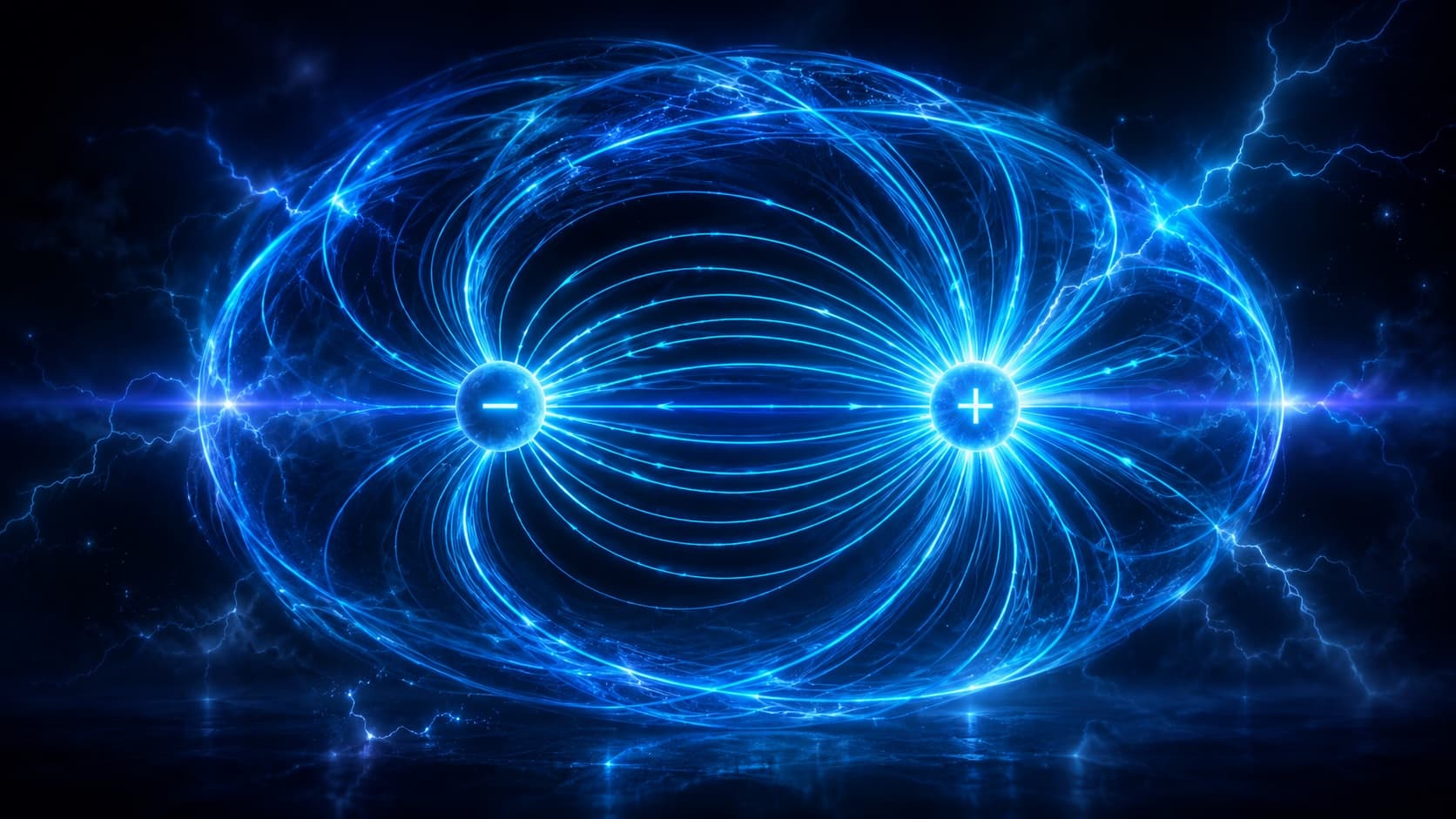
Electricity and Magnetism
PHYS 301
From static charges to Maxwell's equations: understand electric and magnetic fields, circuits, electromagnetic induction, and the unification of electricity and magnetism.
Two Forces, One Theory
Electricity and magnetism appear at first to be two separate phenomena. A charge at rest produces an electric force. A moving charge produces a magnetic force. James Clerk Maxwell unified these into a single electromagnetic theory in the 1860s — one of the greatest intellectual achievements in the history of physics.
Electric Charge and Coulomb's Law
Electric charge is a fundamental property of matter. Like charges repel; unlike charges attract. Coulomb's law gives the force between two point charges: it is an inverse-square law, just like gravity, but enormously stronger.
Electric Fields and Potential
The electric field is a vector that tells you the force per unit charge at each point in space. Gauss's law — one of Maxwell's four equations — relates the total electric flux through a closed surface to the enclosed charge.
Electric potential (voltage) is the potential energy per unit charge. Moving charges from low potential to high potential requires work. Electric field lines point from high to low potential.
Circuits
Electric current is the flow of charge. Ohm's law relates current to voltage through resistance. Kirchhoff's laws let you analyze complex circuits by applying conservation of energy and conservation of charge.
Capacitors store charge and energy in electric fields. Inductors store energy in magnetic fields. Resistor-capacitor and resistor-inductor circuits exhibit time-dependent behavior.
Magnetic Fields
Moving charges and current-carrying wires produce magnetic fields. The Biot-Savart law gives the field produced by a current element. Ampere's law — another of Maxwell's equations — relates the circulation of the magnetic field around a loop to the current passing through it.
Electromagnetic Induction
A changing magnetic field induces an electric field. This is Faraday's law. It is the principle behind generators, transformers, and inductive charging. Lenz's law tells you the direction of the induced current: it opposes the change that caused it.
Maxwell's Equations
Maxwell collected the four fundamental laws of electromagnetism, added a crucial correction term (the displacement current), and showed that they predict the existence of electromagnetic waves traveling at the speed of light. Light, radio waves, microwaves, X-rays, and gamma rays are all electromagnetic radiation.
What you will learn
- Apply Coulomb's law and Gauss's law to calculate electric fields
- Calculate electric potential and relate it to the electric field
- Analyze DC circuits using Kirchhoff's laws
- Calculate magnetic fields using Biot-Savart and Ampere's law
- Apply Faraday's law to calculate induced EMF
- State and interpret Maxwell's equations qualitatively
- Explain how electromagnetic waves are produced and described
Major topics
Why this course matters
Electricity and magnetism are the foundation of electrical engineering, electronics, and communications technology. Every motor, generator, transformer, radio, and computer relies on principles from this course. Maxwell's unification of electricity, magnetism, and light is a model of theoretical physics at its finest.
Course modules
Electrostatics
This module introduces electric charge, electric forces, electric fields, flux, Gauss's law, and electric potential. Students learn how vector fields and scalar potentials describe the influence of charges in space.
Conductors and Capacitors
This module studies how charges arrange themselves in conductors and how capacitors store charge and energy. Students examine electrostatic equilibrium, capacitance, dielectrics, and energy stored in electric fields.
Current and DC Circuits
This module connects microscopic charge motion to macroscopic circuits. Students study current, resistance, Ohm's law, resistivity, circuit reduction, and Kirchhoff's rules.
Magnetostatics
This module introduces magnetic fields produced by steady currents and magnetic dipoles. Students study magnetic forces, the Biot-Savart law, Ampère's law, magnetic materials, and dipole behavior.
Electromagnetic Induction
This module explores how changing magnetic flux produces electric fields and currents. Students learn Faraday's law, Lenz's law, inductance, magnetic energy storage, and AC circuit behavior.
Maxwell's Equations
This module unifies electricity, magnetism, induction, and electromagnetic waves. Students study Maxwell's four equations, wave propagation, the speed of light, and electromagnetic energy flow.
Common misconceptions
Electrons move at the speed of light in a wire — they drift very slowly; the signal propagates quickly
Voltage and current are the same — voltage is potential difference, current is charge flow rate
Magnets only affect ferromagnetic materials — all moving charges respond to magnetic fields
Electric and magnetic fields are separate — they are two aspects of a single electromagnetic field
Ask your AI physics guide
Ask anything about Electricity and Magnetism, or choose a suggested question below.
AI responses are educational and may not be perfectly accurate. Press Enter to send, Shift+Enter for new line.
Related courses
Waves and Oscillations
From pendulums to ocean waves to quantum wavefunctions: understand oscillations, wave propagation, interference, resonance, standing waves, and the Doppler effect.
Optics and Light
Explore the nature of light and how it behaves. Covers reflection, refraction, lenses, interference, diffraction, polarization, lasers, and optical instruments.
Special Relativity
Einstein's revolutionary theory of space and time. Covers the postulates, time dilation, length contraction, spacetime diagrams, relativistic energy and momentum, and E = mc².
Quantum Mechanics
The physics of the very small: wave-particle duality, wavefunctions, Schrödinger equation, superposition, measurement, uncertainty, tunneling, spin, and entanglement.