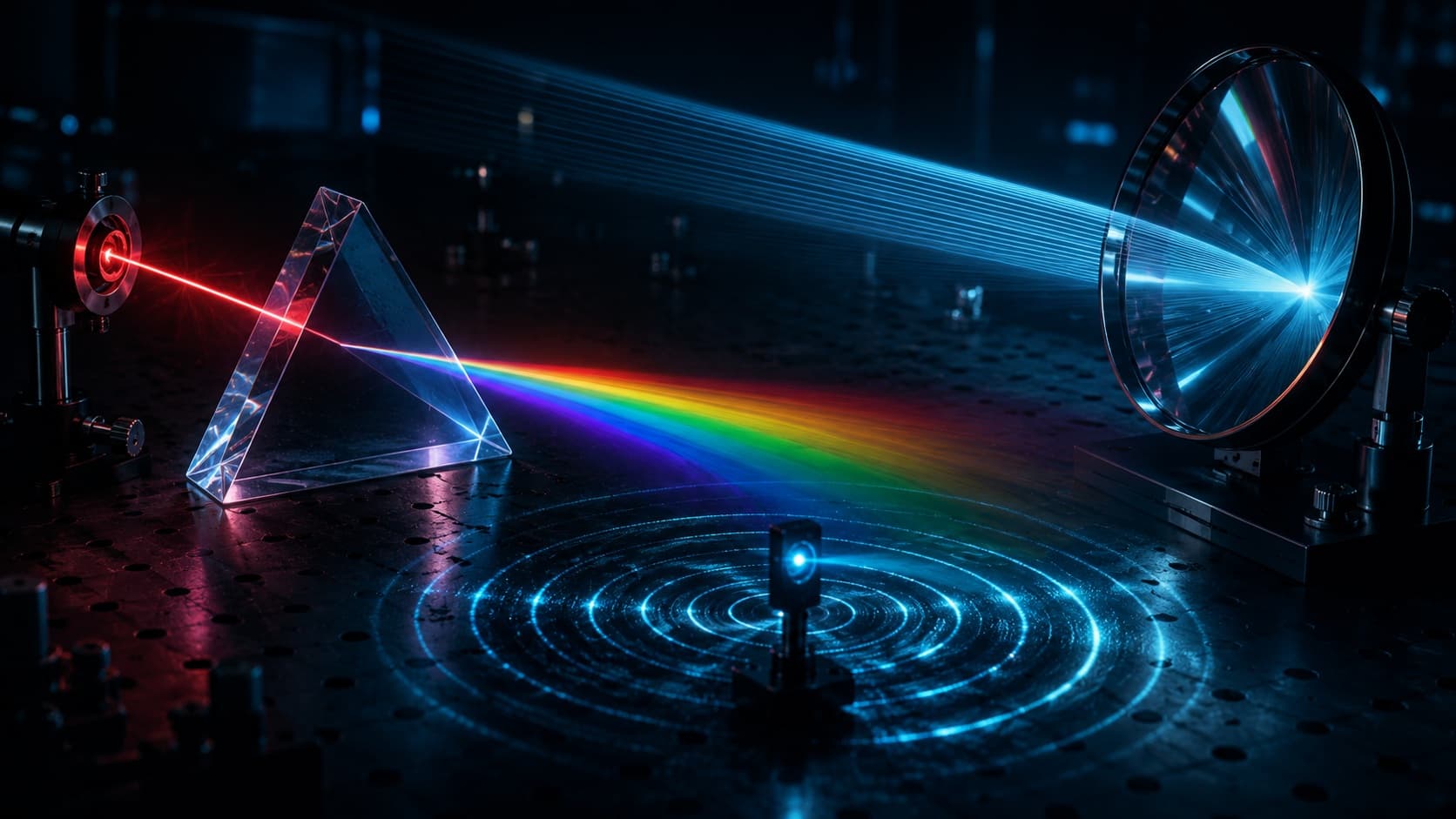
Optics and Light
PHYS 310
Explore the nature of light and how it behaves. Covers reflection, refraction, lenses, interference, diffraction, polarization, lasers, and optical instruments.
The Physics of Light
Light is an electromagnetic wave, but it also behaves as a particle (the photon). This course covers the classical wave optics in depth — reflection, refraction, interference, and diffraction — and introduces the quantum nature of light that leads into Quantum Mechanics.
Geometric Optics: Rays and Images
When light encounters surfaces much larger than its wavelength, it behaves like a ray traveling in a straight line. Reflection obeys the angle law. Refraction obeys Snell's law. Geometric optics uses these ray-tracing rules to analyze mirrors, lenses, and optical instruments.
A converging lens bends rays toward the optical axis and can form real or virtual images. Diverging lenses always produce virtual images. Cameras, telescopes, microscopes, and eyeglasses all rely on geometric optics.
Refraction and Snell's Law
When light crosses the boundary between two media with different indices of refraction, it changes direction. Snell's law gives the relationship between the angles and indices. Total internal reflection — the basis of fiber optic cables — occurs when light tries to exit a denser medium at too large an angle.
Wave Optics: Interference
When two beams of light overlap coherently, they interfere. Young's double-slit experiment demonstrated the wave nature of light definitively. Thin film interference produces the iridescent colors in soap bubbles and oil slicks.
Diffraction
Light bends around obstacles and through apertures. A narrow slit produces a diffraction pattern with bright and dark fringes. A diffraction grating — multiple closely-spaced slits — produces extremely sharp spectral lines and is the basis of spectroscopy.
Polarization
Light is a transverse wave, and its oscillation direction is its polarization. Polaroid filters select one polarization direction. Polarization is used in LCD screens, photography, stress analysis, and 3D cinema.
Lasers and Coherence
A laser produces highly coherent, monochromatic, directional light through stimulated emission. Coherence is necessary for clear interference and diffraction patterns. Lasers are used in communications, medicine, manufacturing, and scientific research.
What you will learn
- Apply the law of reflection and Snell's law to trace rays
- Use the mirror and lens equations to locate images
- Explain total internal reflection and calculate the critical angle
- Apply Young's double-slit formula to calculate fringe spacing
- Analyze thin film interference including phase shifts
- Calculate diffraction grating patterns
- Explain polarization and use Malus's law
- Describe how a laser works using stimulated emission
Major topics
Why this course matters
Optics is everywhere: in eyeglasses, cameras, fiber optics, lasers, microscopes, and telescopes. Optical instruments enabled the discovery of cells, bacteria, and distant galaxies. Fiber optic cables carry the internet. Lasers perform surgery, cut steel, and read data. Wave optics introduces the interference and diffraction that also appear in quantum mechanics.
Course modules
Geometric Optics
This module treats light as rays that travel in straight lines unless they reflect, refract, or encounter optical elements. Students study mirrors, Snell's law, total internal reflection, lenses, and curved mirrors.
Optical Instruments
This module applies geometric optics to practical image-forming systems. Students learn how cameras, eyes, microscopes, telescopes, and aberrations work.
Wave Optics
This module treats light as a wave and explains phenomena that ray optics cannot fully describe. Students study Huygens' principle, double-slit interference, diffraction gratings, and single-slit diffraction.
Interference and Coherence
This module develops interference in realistic optical systems. Students study thin films, Newton's rings, coherence length, path differences, and interferometers.
Polarization
This module studies the orientation of light's electric field. Students learn linear polarization, polarizers, Malus's law, Brewster's angle, circular polarization, and birefringence.
Modern Optics
This module surveys technologies and concepts that extend classical optics into modern science and engineering. Students study lasers, optical communication, holography, and introductory quantum optics.
Common misconceptions
Light slows down in a medium forever — it returns to c when it re-enters vacuum
A lens bends all light to one point — only parallel rays converge at the focal point
Lasers are hotter than other light sources — laser light is coherent, not necessarily hot
Diffraction only happens with waves — it happens with matter waves too (electron diffraction)
Ask your AI physics guide
Ask anything about Optics and Light, or choose a suggested question below.
AI responses are educational and may not be perfectly accurate. Press Enter to send, Shift+Enter for new line.
Related courses
Waves and Oscillations
From pendulums to ocean waves to quantum wavefunctions: understand oscillations, wave propagation, interference, resonance, standing waves, and the Doppler effect.
Electricity and Magnetism
From static charges to Maxwell's equations: understand electric and magnetic fields, circuits, electromagnetic induction, and the unification of electricity and magnetism.
Quantum Mechanics
The physics of the very small: wave-particle duality, wavefunctions, Schrödinger equation, superposition, measurement, uncertainty, tunneling, spin, and entanglement.