Waves and Oscillations
PHYS 210
From pendulums to ocean waves to quantum wavefunctions: understand oscillations, wave propagation, interference, resonance, standing waves, and the Doppler effect.
Everything Oscillates
Oscillation is one of the most universal phenomena in nature. Atoms vibrate. Strings resonate. Ocean waves travel. Sound propagates through air. Light is an oscillating electromagnetic field. Quantum particles are described by wavefunctions. Understanding oscillations and waves is not just useful — it is essential.
Simple Harmonic Motion Revisited
This course begins where Classical Mechanics left off: with simple harmonic motion. A mass on a spring, a simple pendulum at small angles, an electrical LC circuit — all obey the same equation. You will solve it analytically and understand the role of frequency, amplitude, and phase.
Damped and Driven Oscillations
Real oscillators lose energy to friction and air resistance. Damped oscillations eventually come to rest. Driven oscillators respond to an external periodic force. When the driving frequency matches the natural frequency, resonance occurs: energy builds up dramatically in the system. Resonance is beautiful and dangerous — it can shatter a wine glass or collapse a bridge.
Wave Motion
A wave is a pattern that moves through a medium without the medium itself translating. Sound is a pressure wave through air. Water waves involve surface motion. Waves on a string carry energy from one end to the other. You will learn to describe waves mathematically using the wave equation.
Superposition and Interference
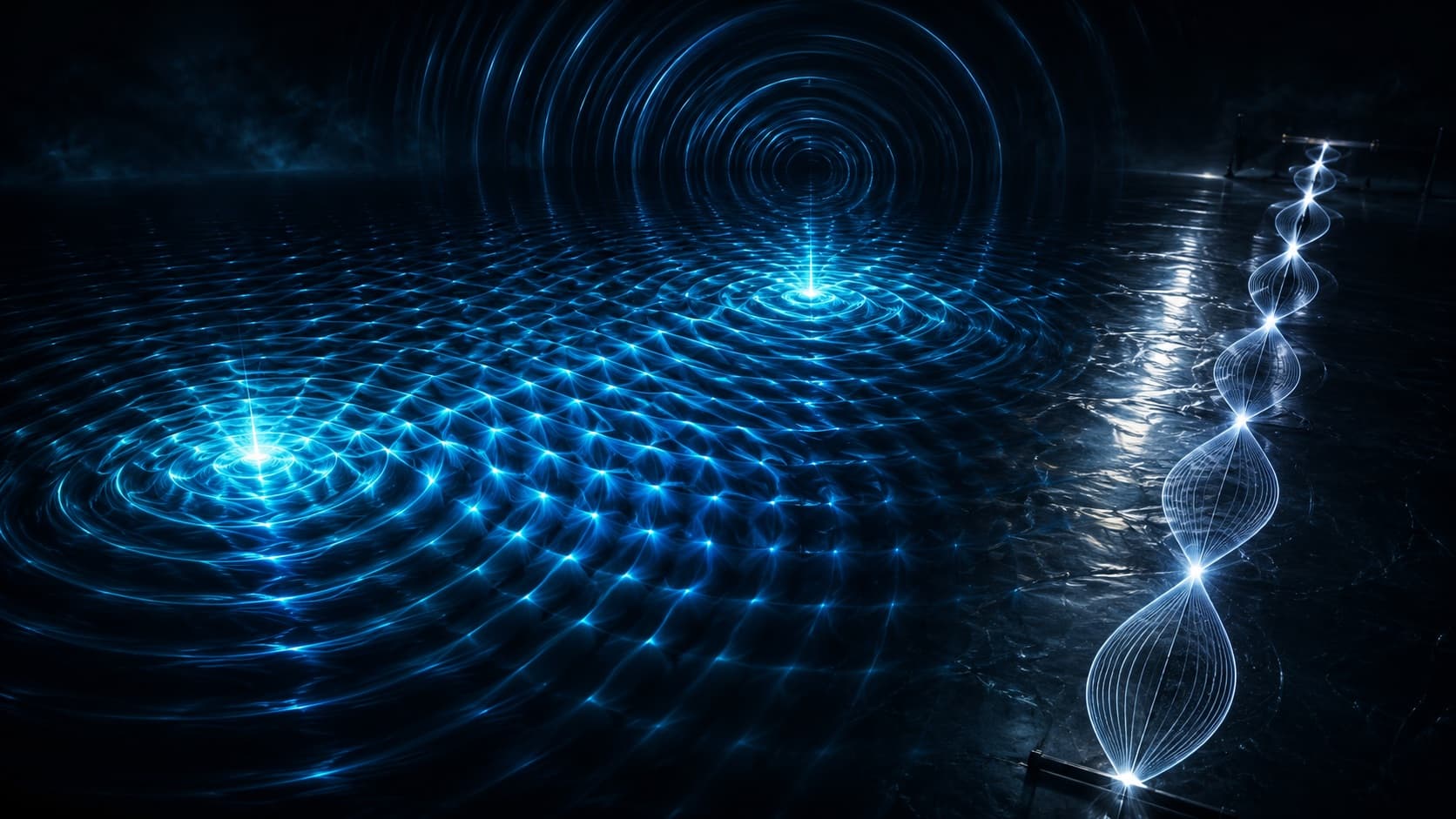
Two waves can occupy the same space simultaneously, and their amplitudes add. This is the principle of superposition. When waves add constructively, the amplitude grows. When they add destructively, they cancel. Interference is responsible for the colorful patterns in thin films, the dark and bright bands in Young's double-slit experiment, and the noise-canceling in headphones.
Standing Waves and Resonance
When a wave reflects back and forth in a bounded region, standing waves form. These are the modes of a vibrating string, a pipe organ, a microwave cavity. Only specific frequencies are allowed — those whose wavelength fits the boundary conditions. These resonant frequencies are why musical instruments produce specific pitches.
Sound and the Doppler Effect
Sound is a longitudinal pressure wave. Intensity, frequency, pitch, and the decibel scale are all explored here. When a source or observer moves relative to the medium, the observed frequency changes: this is the Doppler effect. It explains ambulance sirens, radar guns, and the redshift of distant galaxies.
What you will learn
- Solve damped and driven harmonic oscillator equations
- Explain resonance and identify resonant frequency from system parameters
- Write the wave equation and identify its solutions
- Apply the principle of superposition to interfering waves
- Determine standing wave frequencies for strings and pipes
- Calculate Doppler-shifted frequencies for moving sources and observers
- Explain beats as interference between nearby frequencies
- Apply Fourier ideas to decompose complex waveforms
Major topics
Why this course matters
Wave physics is the bridge between classical mechanics and quantum mechanics. The mathematics of waves appears everywhere: in optics, quantum mechanics, electromagnetism, and signal processing. Musical acoustics, sonar, medical ultrasound, and seismology all depend on wave physics.
Course modules
Simple Harmonic Motion
This module develops simple harmonic motion as the foundation for oscillations and waves. Students study the SHM differential equation, mass-spring systems, pendulums, and the energy exchange that makes oscillatory motion possible.
Damping and Driving
This module extends ideal oscillations to more realistic systems that lose energy or receive external energy. Students explore damped motion, driven oscillators, resonance, bandwidth, and the quality factor.
Wave Fundamentals
This module introduces waves as disturbances that carry energy and information through space and time. Students study the wave equation, wave types, wave speed, wavelength, frequency, energy, and intensity.
Superposition and Interference
This module explores what happens when waves overlap. Students study the superposition principle, constructive and destructive interference, beats, and the basic idea of Fourier analysis.
Standing Waves
This module studies waves trapped by boundaries. Students learn how standing waves form on strings and in pipes, how normal modes and harmonics arise, and why boundary conditions determine allowed frequencies.
Sound and Doppler Effect
This module applies wave concepts to sound, hearing, acoustics, loudness, and moving sources or observers. Students study sound waves, the decibel scale, Doppler shifts, and practical wave technologies.
Common misconceptions
Waves carry matter — waves carry energy and information, not matter
Resonance only happens in music — resonance occurs in bridges, buildings, and circuits
The Doppler effect changes the speed of sound — it only changes the observed frequency
Destructive interference destroys energy — energy is redistributed, not destroyed
Ask your AI physics guide
Ask anything about Waves and Oscillations, or choose a suggested question below.
AI responses are educational and may not be perfectly accurate. Press Enter to send, Shift+Enter for new line.
Related courses
Classical Mechanics
A systematic treatment of motion, forces, and energy. Covers Newton's laws, work-energy theorem, momentum, rotation, gravity, oscillations, and an introduction to Lagrangian mechanics.
Optics and Light
Explore the nature of light and how it behaves. Covers reflection, refraction, lenses, interference, diffraction, polarization, lasers, and optical instruments.
Electricity and Magnetism
From static charges to Maxwell's equations: understand electric and magnetic fields, circuits, electromagnetic induction, and the unification of electricity and magnetism.
Quantum Mechanics
The physics of the very small: wave-particle duality, wavefunctions, Schrödinger equation, superposition, measurement, uncertainty, tunneling, spin, and entanglement.