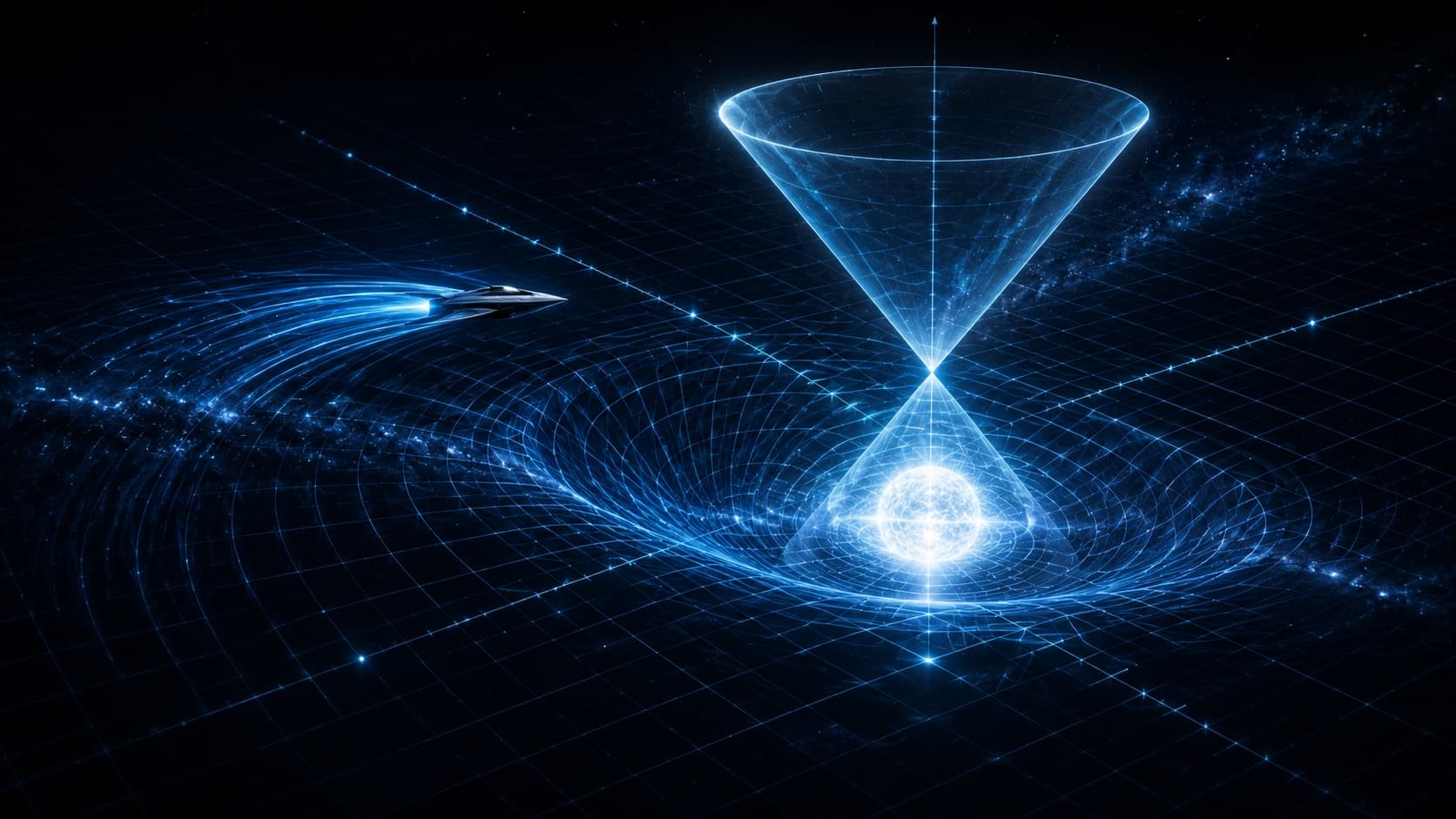
Time dilation
PHYS 401 · Time and Space
Time dilation means moving clocks are measured to run slow. This lesson derives the effect with a light clock and explains proper time, muons, and experimental confirmation.
Key equations
Delta t=gammaDelta augamma=
rac{1}{sqrt{1-v^2/c^2}}Delta au/2=
rac{L}{c}left(c
rac{Delta t}{2}
ight)^2=L^2+left(v
rac{Delta t}{2}
ight)^2Delta t=
rac{Delta au}{sqrt{1-v^2/c^2}}=gammaDelta augammaapprox1+
rac{1}{2}
rac{v^2}{c^2}Learning objectives
- Define proper time.
- Derive time dilation using a light clock.
- Apply the formula $Delta t=gammaDelta au$.
- Explain the symmetry of time dilation for inertial observers.
- Identify experimental evidence for time dilation.
Proper time
Time dilation compares time intervals measured in different inertial frames. The proper time between two events is the time measured by a clock present at both events. For example, if a clock emits two ticks, the interval between those ticks in the clock's own rest frame is proper time.
Other inertial observers, who see the clock moving, measure a longer time interval:
where
gamma= rac{1}{sqrt{1-v^2/c^2}}
Since , the moving clock is measured to run slow.
Light-clock derivation
Imagine a light clock with two mirrors separated by distance . In the clock's rest frame, light travels straight up and down. One half-tick takes
Delta au/2= rac{L}{c}
so a full tick takes .
An observer who sees the clock moving sideways at speed sees the light travel along diagonal paths. For a half-tick, the clock moves horizontally by , while the light travels distance .
The right triangle gives
ight)^2=L^2+left(v rac{Delta t}{2} ight)^2$$ Using $L=cDelta au/2$ and solving gives $$Delta t= rac{Delta au}{sqrt{1-v^2/c^2}}=gammaDelta au$$ ## Meaning of moving clocks run slow The phrase means that, according to one inertial frame, a clock moving relative to that frame accumulates less time between two events than synchronized clocks at rest in that frame. It does not mean the moving clock is broken. In its own rest frame, it behaves normally. The effect is symmetric for inertial observers. If two observers move uniformly relative to each other, each says the other's clocks run slow. This symmetry is possible because they disagree about simultaneity. ## Muon example Cosmic rays create muons high in Earth's atmosphere. Muons are unstable and have a short proper lifetime. Classically, many should decay before reaching Earth's surface. But in Earth's frame, fast muons experience time dilation, so their lifetimes are longer: $$Delta t=gammaDelta au$$ This allows many more muons to reach detectors at ground level. In the muon's frame, its lifetime is normal, but the atmosphere is length-contracted. ## Experimental confirmation Time dilation has been confirmed in particle accelerators, atmospheric muon measurements, precision atomic clocks flown on airplanes, and satellite systems. It is not speculative or merely philosophical. It is an experimentally required correction in high-speed and high-precision systems. ## Low-speed approximation For small speeds, $$gammaapprox1+ rac{1}{2} rac{v^2}{c^2}$$ The correction begins at order $v^2/c^2$, so it is tiny at ordinary speeds. At $v=0.8c$, however, $$gamma= rac{1}{sqrt{1-0.64}}= rac{5}{3}$$ so a moving clock's time interval is substantially dilated. ## The big idea Time dilation is the result of constant light speed and the geometry of spacetime. Proper time is measured by a clock present at both events, and all other inertial frames measure a longer coordinate time between those same events. Moving clocks do not malfunction; time itself is frame-dependent.Sign in to track your progress.
Ask your AI physics guide
Ask anything about Special Relativity — Time dilation, or choose a suggested question below.
AI responses are educational and may not be perfectly accurate. Press Enter to send, Shift+Enter for new line.