Spacetime diagrams
PHYS 401 · Time and Space
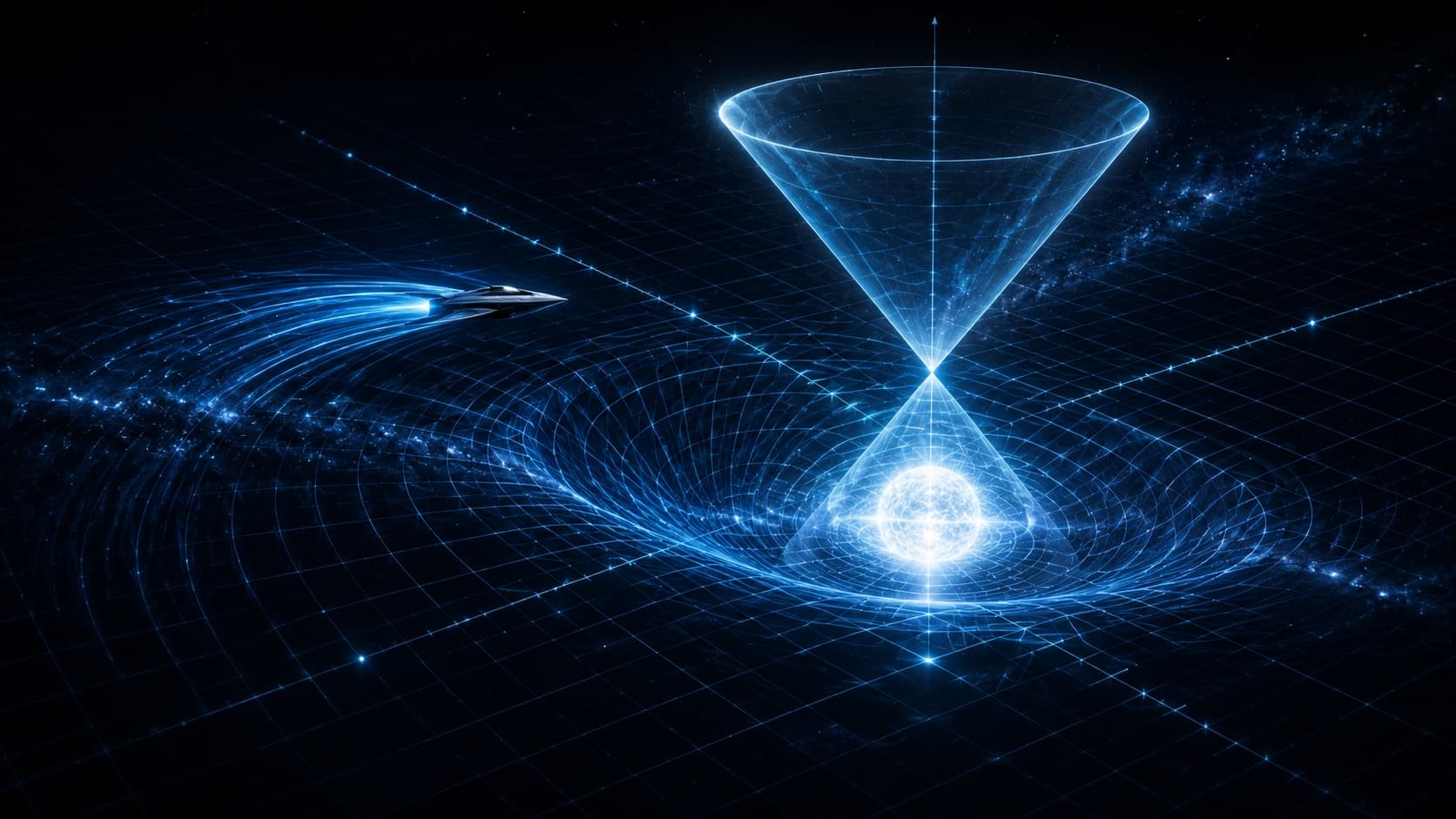
Spacetime diagrams represent events, worldlines, light rays, and simultaneity geometrically. This lesson introduces axes, light cones, slopes, and how different frames slice spacetime.
Key equations
x=ctx=-ctx=vtx=
rac{v}{c}ct|v|<cx=vtt'=gammaleft(t-
rac{vx}{c^2}
ight)t=
rac{vx}{c^2}ct=
rac{v}{c}xc^2d au^2=c^2dt^2-dx^2Learning objectives
- Represent events and worldlines on spacetime diagrams.
- Identify light rays and light cones.
- Interpret slopes as velocities.
- Draw tilted axes for moving inertial frames.
- Use spacetime diagrams to explain simultaneity and causality.
Events and diagrams
A spacetime diagram plots space and time together. Usually one spatial dimension is horizontal and time is vertical, often using instead of so both axes have units of length.
An event is a point in spacetime: something that happens at a definite place and time. A particle or observer traces a path through spacetime called a worldline.
Light rays
If the vertical axis is and the horizontal axis is , light moving in the positive x-direction satisfies
Light moving in the negative x-direction satisfies
These appear as lines at when the axes use equal scales. The light lines divide spacetime into regions of possible and impossible causal influence.
Worldline slopes
A stationary object has constant , so its worldline is vertical. A moving object has a tilted worldline. If its velocity is , then
or
x= rac{v}{c}ct
The slope relative to the vertical indicates speed. Massive objects have worldlines inside the light cone because .
Time axis of a moving frame
The time axis of a moving frame is the worldline of its origin . In frame , that origin moves as
so the axis tilts toward the light line as speed increases.
Space axis of a moving frame
The space axis of is the set of events simultaneous with . From the Lorentz transformation,
ight)$$ Setting $t'=0$ gives $$t= rac{vx}{c^2}$$ or $$ct= rac{v}{c}x$$ Thus the $x'$ axis also tilts. Moving frames have tilted time and space axes, symmetric around the light line. ## Simultaneity on diagrams In a spacetime diagram, simultaneity in a given frame is represented by lines parallel to that frame's space axis. Since different inertial frames have different space axes, they disagree about which separated events are simultaneous. This gives a powerful visual explanation of relativity of simultaneity. ## Proper time and worldlines The proper time along a timelike worldline is related to the spacetime interval. For small separations, $$c^2d au^2=c^2dt^2-dx^2$$ for one spatial dimension. A straight inertial worldline between two timelike-separated events maximizes proper time. This fact helps explain the twin paradox. ## Causal regions Events inside the future light cone can be reached by signals traveling at or below light speed. Events inside the past light cone can influence the present event. Events outside the light cone are spacelike separated and cannot be causally connected without faster-than-light signaling. ## The big idea Spacetime diagrams turn relativity into geometry. Events are points, objects trace worldlines, light travels on $45^circ$ lines, and moving frames have tilted axes. These diagrams make time dilation, length contraction, simultaneity, and causal structure easier to visualize.Sign in to track your progress.
Up next · Module 3
Lorentz Transformations
This module develops the mathematical transformations connecting inertial frames in special relativity. Students derive the Lorentz transformation, study relativistic velocity addition, and learn invariant spacetime intervals and light cones.
Ask your AI physics guide
Ask anything about Special Relativity — Spacetime diagrams, or choose a suggested question below.
AI responses are educational and may not be perfectly accurate. Press Enter to send, Shift+Enter for new line.