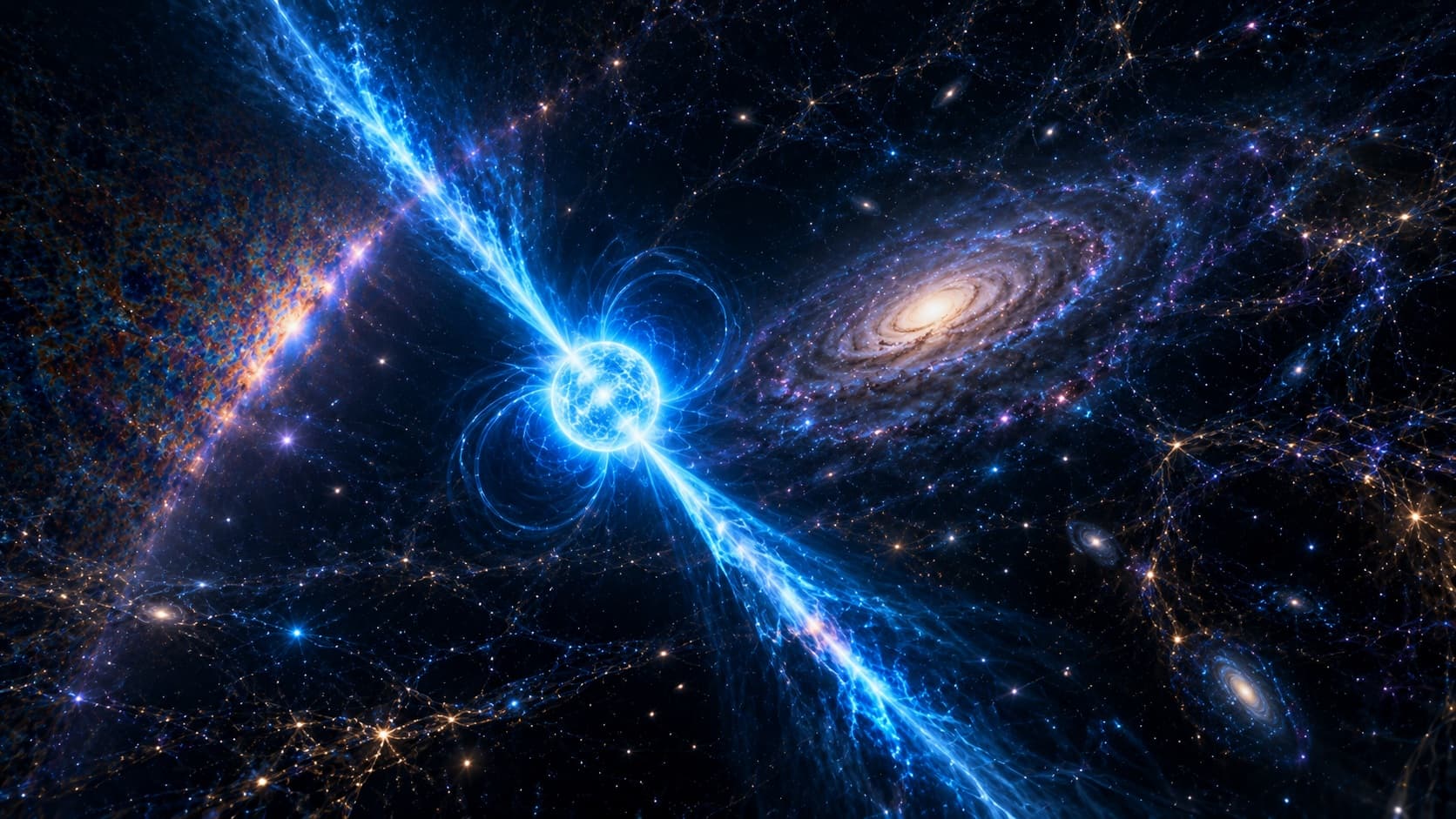
Compact Objects
PHYS 501 · Module 3
This module explores the extreme remnants of stellar evolution. Students study white dwarfs, neutron stars, black holes, and the conceptual quantum-gravity idea of Hawking radiation.
Lessons in this module
White dwarfs and the Chandrasekhar limit
White dwarfs are dense stellar remnants supported by electron degeneracy pressure. This lesson explains their structure, cooling, mass-radius relation, and the Chandrasekhar limit.
Neutron stars and pulsars
Neutron stars are ultra-dense remnants supported largely by neutron degeneracy and nuclear forces. This lesson explains their formation, structure, magnetic fields, rotation, and pulsars.
Black holes and the Schwarzschild radius
Black holes are regions where gravity is so strong that not even light can escape. This lesson introduces event horizons, Schwarzschild radius, accretion, and observational evidence.
Hawking radiation (conceptual)
Hawking radiation suggests that black holes are not completely black when quantum fields are considered. This lesson gives a conceptual introduction to temperature, evaporation, and the information puzzle.
Ask your AI physics guide
Ask anything about Astrophysics and Cosmology — Compact Objects, or choose a suggested question below.
AI responses are educational and may not be perfectly accurate. Press Enter to send, Shift+Enter for new line.