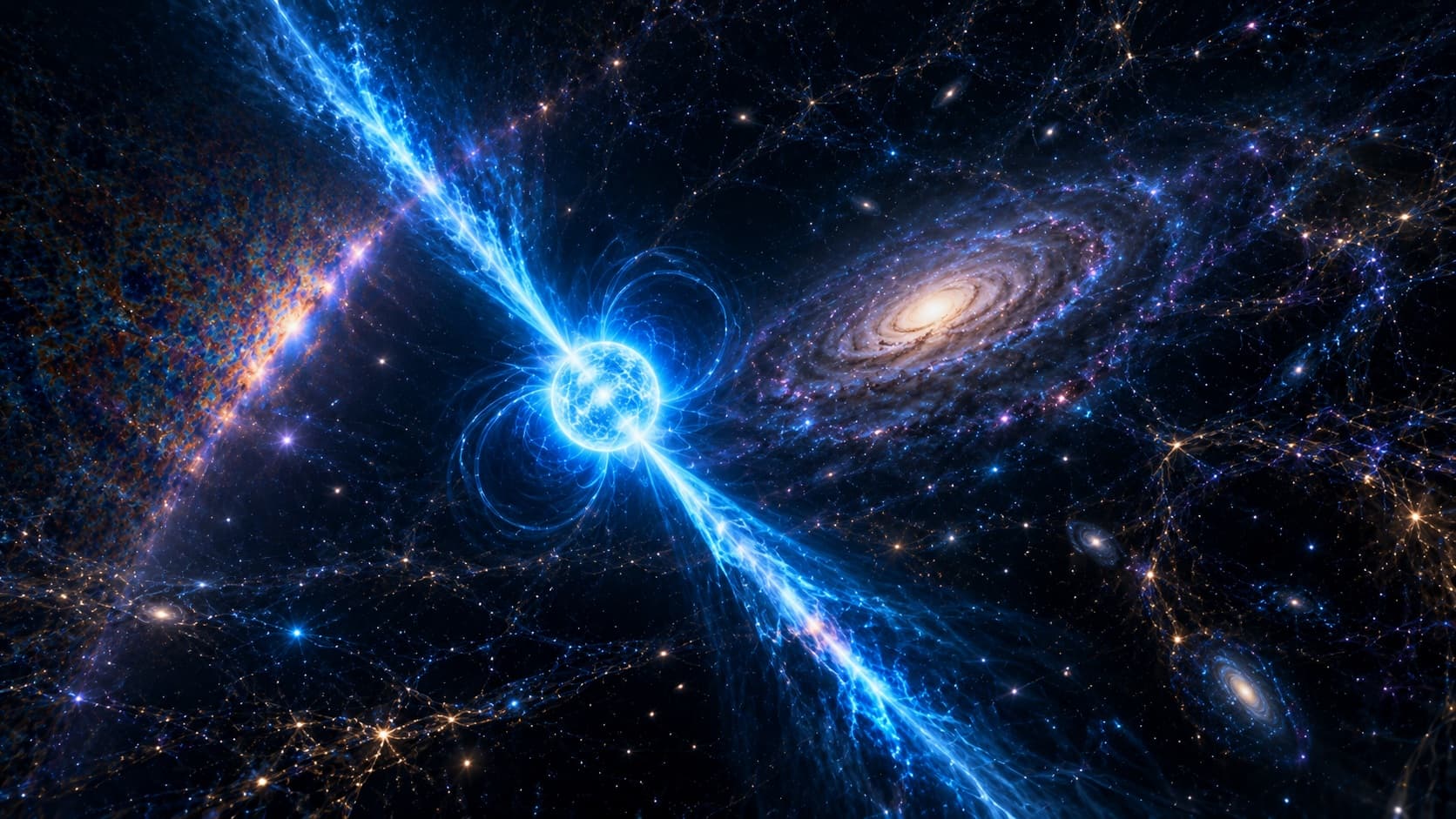
Neutron stars and pulsars
PHYS 501 · Compact Objects
Neutron stars are ultra-dense remnants supported largely by neutron degeneracy and nuclear forces. This lesson explains their formation, structure, magnetic fields, rotation, and pulsars.
Key equations
p+e^-
ightarrow n+
u_eIomega=constantIsim MR^2E_{rot}=
rac{1}{2}Iomega^2Learning objectives
- Explain how neutron stars form in core-collapse supernovae.
- Describe neutron star density and pressure support.
- Use angular momentum conservation to explain rapid rotation.
- Explain pulsars as rotating beamed neutron stars.
- Discuss why the neutron star equation of state is important.
Formation in core collapse
A neutron star forms when the core of a massive star collapses during a supernova. As density rises, electrons and protons combine through inverse beta decay:
ightarrow n+ u_e$$ The core becomes packed mostly with neutrons. The collapse halts when neutron degeneracy pressure and strong nuclear interactions resist further compression. A typical neutron star has mass around $1$ to $2M_odot$ and radius only about 10 to 12 km. ## Extreme density Neutron star density is comparable to nuclear density. A teaspoon of neutron-star material would have an enormous mass if it could exist outside the star. Gravity at the surface is extraordinarily strong, and escape speeds can be a significant fraction of light speed. General relativity is needed for precise modeling. ## Pressure support Neutron degeneracy pressure is one source of support, but nuclear interactions are also crucial. The equation of state of ultra-dense matter is not fully known. It may include exotic phases, superfluid neutrons, superconducting protons, hyperons, or quark matter depending on density. Observations of neutron star masses and radii constrain this equation of state. ## Conservation of angular momentum A collapsing stellar core spins up as its radius shrinks, much like an ice skater pulling in their arms. Angular momentum conservation gives $$Iomega=constant$$ Since moment of inertia scales roughly as $$Isim MR^2$$ shrinking $R$ greatly increases angular velocity $omega$. Neutron stars can rotate many times per second. ## Magnetic fields Magnetic flux conservation can amplify magnetic fields during collapse. Neutron stars often have extremely strong magnetic fields. Magnetars are neutron stars with especially intense fields, capable of producing powerful X-ray and gamma-ray flares. ## Pulsars A pulsar is a rotating neutron star whose radiation beams sweep across Earth like lighthouse beams. The observed pulses are extremely regular. The pulse period is the rotation period. Pulsars gradually slow down as they lose rotational energy. The spin-down power is related to changes in rotational kinetic energy: $$E_{rot}= rac{1}{2}Iomega^2$$ ## Binary pulsars Pulsars in binary systems are powerful laboratories for gravity. The Hulse-Taylor binary pulsar showed orbital decay consistent with energy loss through gravitational waves. Neutron star mergers observed through gravitational waves and light reveal heavy-element production and dense matter physics. ## Maximum mass Like white dwarfs, neutron stars have a maximum stable mass, often called the Tolman-Oppenheimer-Volkoff limit, though its exact value depends on the uncertain equation of state. Above the maximum, collapse to a black hole is expected. ## The big idea Neutron stars are compact remnants where gravity compresses matter to nuclear density. They are supported by degeneracy pressure and nuclear forces, rotate rapidly, and often have immense magnetic fields. Pulsars make neutron stars observable as precise cosmic clocks and laboratories for extreme physics.Sign in to track your progress.
Ask your AI physics guide
AI Physics Chat· Astrophysics and Cosmology — Neutron stars and pulsars
⚛
Ask anything about Astrophysics and Cosmology — Neutron stars and pulsars, or choose a suggested question below.
AI responses are educational and may not be perfectly accurate. Press Enter to send, Shift+Enter for new line.