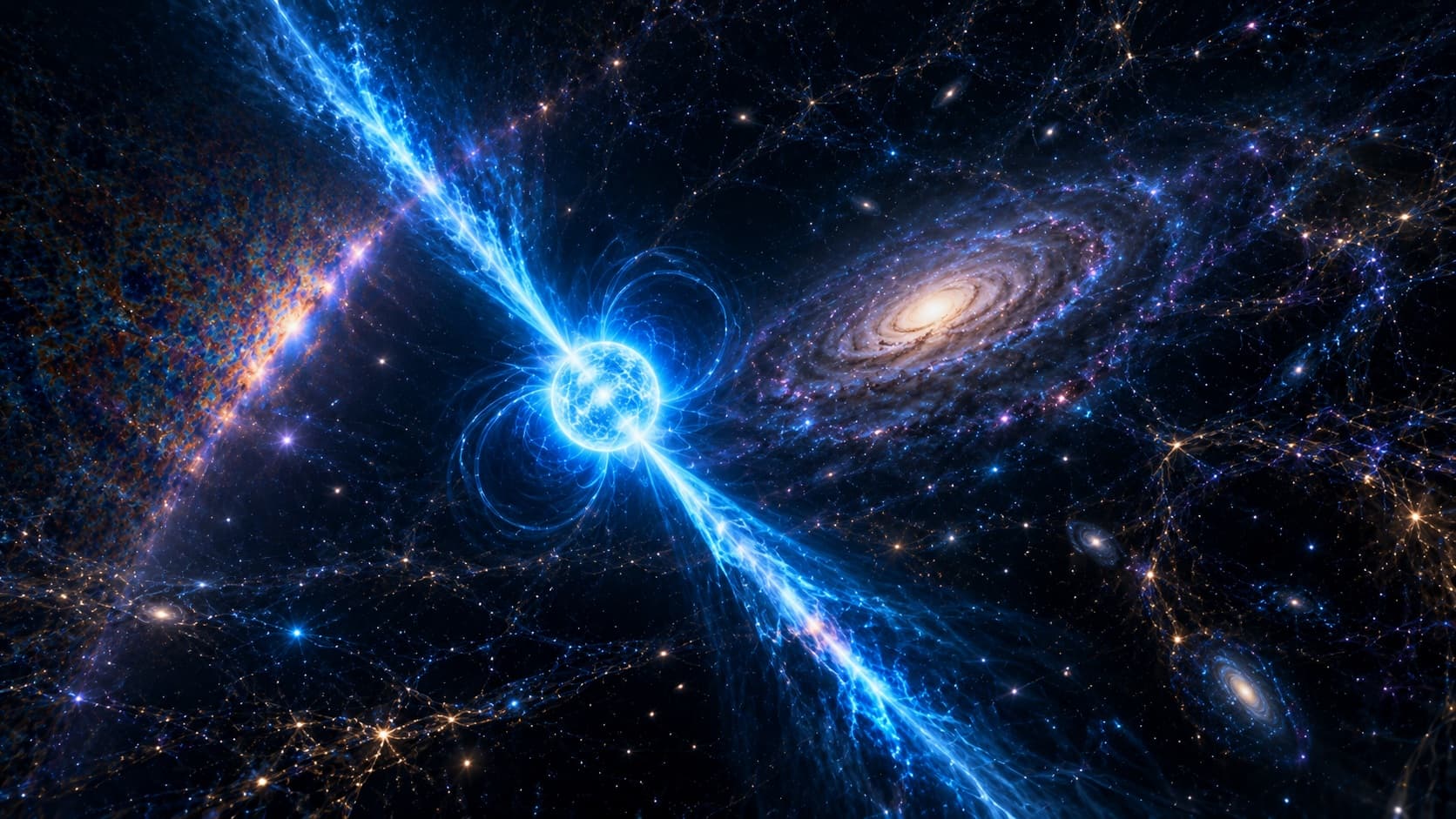
Hawking radiation (conceptual)
PHYS 501 · Compact Objects
Hawking radiation suggests that black holes are not completely black when quantum fields are considered. This lesson gives a conceptual introduction to temperature, evaporation, and the information puzzle.
Key equations
T_H=
rac{hbar c^3}{8pi GMk_B}S=
rac{k_Bc^3A}{4Ghbar}E=Mc^2Learning objectives
- Explain conceptually what Hawking radiation is.
- State how Hawking temperature depends on black hole mass.
- Describe black hole entropy and its area scaling.
- Explain black hole evaporation qualitatively.
- Describe the black hole information paradox.
Quantum fields near horizons
Classically, nothing escapes from inside a black hole's event horizon. In the 1970s, Stephen Hawking showed that when quantum field theory is considered in curved spacetime, black holes should emit thermal radiation.
This radiation is now called Hawking radiation. It is not caused by ordinary matter leaking out from inside the horizon. It arises from the quantum behavior of fields in the curved spacetime around the horizon.
A cautious picture
A popular explanation says particle-antiparticle pairs form near the horizon, one falls in, and one escapes. This picture can be useful as a metaphor, but it is not the full calculation. The real derivation involves how different observers define particles in curved spacetime.
The important result is that distant observers see black holes radiate approximately like thermal bodies.
Hawking temperature
For a nonrotating black hole of mass , the Hawking temperature is
T_H= rac{hbar c^3}{8pi GMk_B}
This temperature is inversely proportional to mass. Large black holes are extremely cold. Small black holes are hotter.
A solar-mass black hole has a Hawking temperature far below the cosmic microwave background temperature, so it absorbs more radiation than it emits in today's universe.
Black hole entropy
Black holes also have entropy proportional to horizon area. The Bekenstein-Hawking entropy is
S= rac{k_Bc^3A}{4Ghbar}
where is the event horizon area. This is remarkable because entropy scales with area, not volume.
This area scaling has deeply influenced ideas about quantum gravity and holography.
Evaporation
As a black hole radiates, it loses energy. Since energy and mass are related by
loss of energy means loss of mass. As mass decreases, temperature increases, making evaporation faster.
For astrophysical black holes, the evaporation time is vastly longer than the current age of the universe. Hypothetical tiny primordial black holes could evaporate much faster.
Information puzzle
Hawking radiation appears thermal, meaning it may carry little information about what formed the black hole. If a black hole completely evaporates, what happens to the information about the matter that fell in?
This is the black hole information paradox. It sits at the intersection of quantum mechanics, thermodynamics, and general relativity. Many physicists believe information is preserved, but the exact mechanism remains a deep issue in quantum gravity.
Why it matters
Hawking radiation has not been directly observed from astrophysical black holes because the predicted temperature is tiny for large black holes. Yet the theory is important because it combines quantum theory, gravity, and thermodynamics in a precise way.
It suggests that spacetime horizons have temperature and entropy, changing our understanding of gravity.
The big idea
Hawking radiation is the prediction that black holes emit thermal radiation due to quantum fields in curved spacetime. The temperature scales as , entropy scales with horizon area, and evaporation raises profound questions about information. It is one of the clearest clues that gravity and quantum mechanics must ultimately be unified.
Sign in to track your progress.
Up next · Module 4
Galaxies and Dark Matter
This module examines galaxies as gravitational systems and introduces the evidence for unseen matter. Students study the Milky Way, galaxy types, rotation curves, clusters, and the cosmic web.
Ask your AI physics guide
Ask anything about Astrophysics and Cosmology — Hawking radiation (conceptual), or choose a suggested question below.
AI responses are educational and may not be perfectly accurate. Press Enter to send, Shift+Enter for new line.