Galaxies and Dark Matter
PHYS 501 · Module 4
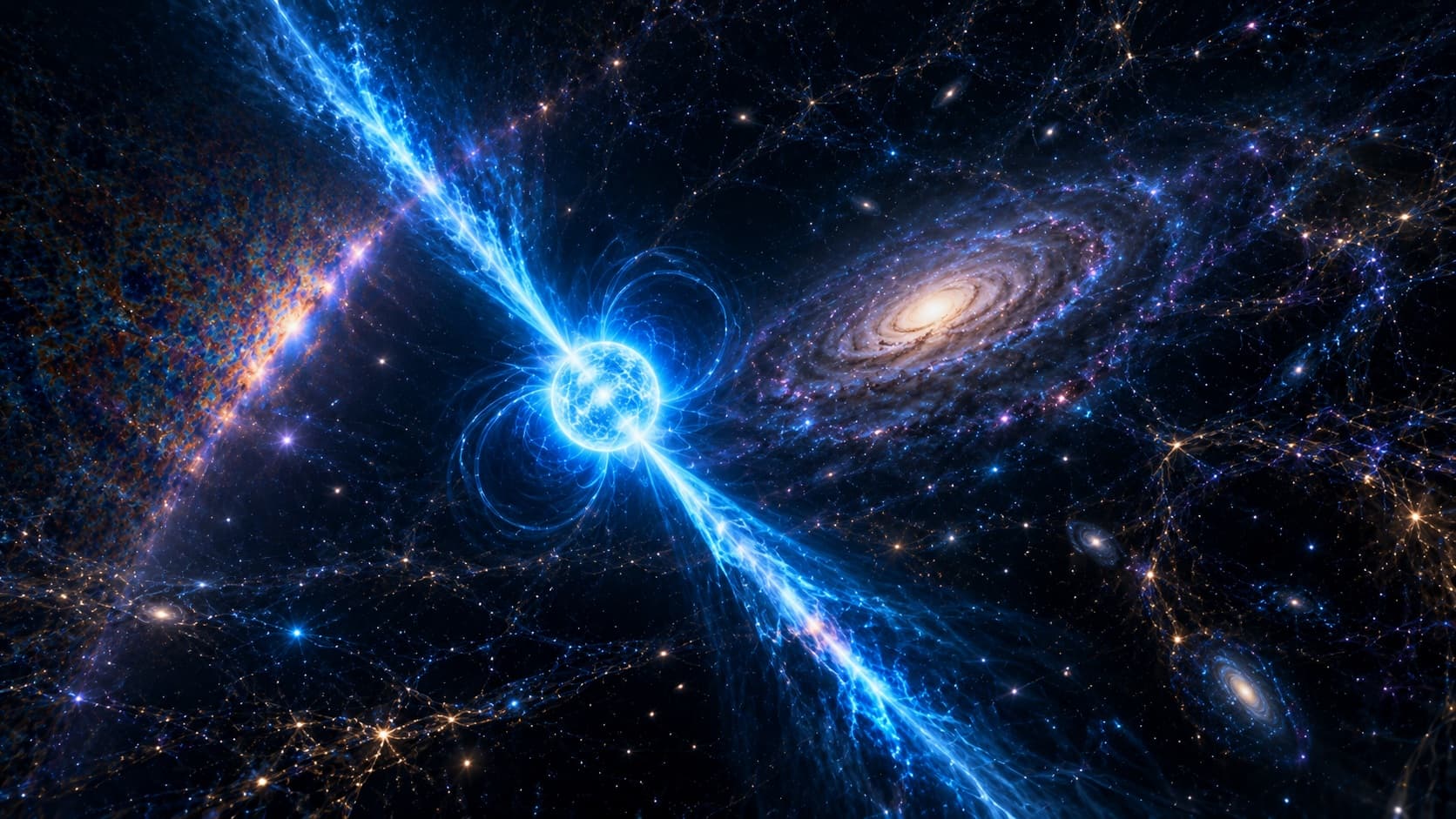
This module examines galaxies as gravitational systems and introduces the evidence for unseen matter. Students study the Milky Way, galaxy types, rotation curves, clusters, and the cosmic web.
Lessons in this module
Structure of the Milky Way
The Milky Way is a barred spiral galaxy containing stars, gas, dust, dark matter, and a central supermassive black hole. This lesson surveys its major components and evidence.
Types of galaxies
Galaxies come in spiral, elliptical, lenticular, and irregular forms. This lesson explains galaxy classification, stellar populations, gas content, star formation, and evolution.
Evidence for dark matter
Dark matter is inferred from gravitational effects that cannot be explained by visible matter alone. This lesson surveys rotation curves, lensing, clusters, and cosmological evidence.
Galaxy clusters and large-scale structure
Galaxies are organized into groups, clusters, filaments, and voids. This lesson explains cluster components, the cosmic web, gravitational growth, and large-scale surveys.
Ask your AI physics guide
Ask anything about Astrophysics and Cosmology — Galaxies and Dark Matter, or choose a suggested question below.
AI responses are educational and may not be perfectly accurate. Press Enter to send, Shift+Enter for new line.