Galaxy clusters and large-scale structure
PHYS 501 · Galaxies and Dark Matter
Galaxies are organized into groups, clusters, filaments, and voids. This lesson explains cluster components, the cosmic web, gravitational growth, and large-scale surveys.
Key equations
2K+U=0Learning objectives
- Describe groups, clusters, filaments, and voids.
- Identify the main components of galaxy clusters.
- Use the virial theorem conceptually for cluster masses.
- Explain gravitational growth of large-scale structure.
- Describe the cosmic web and baryon acoustic oscillations.
Structure beyond galaxies
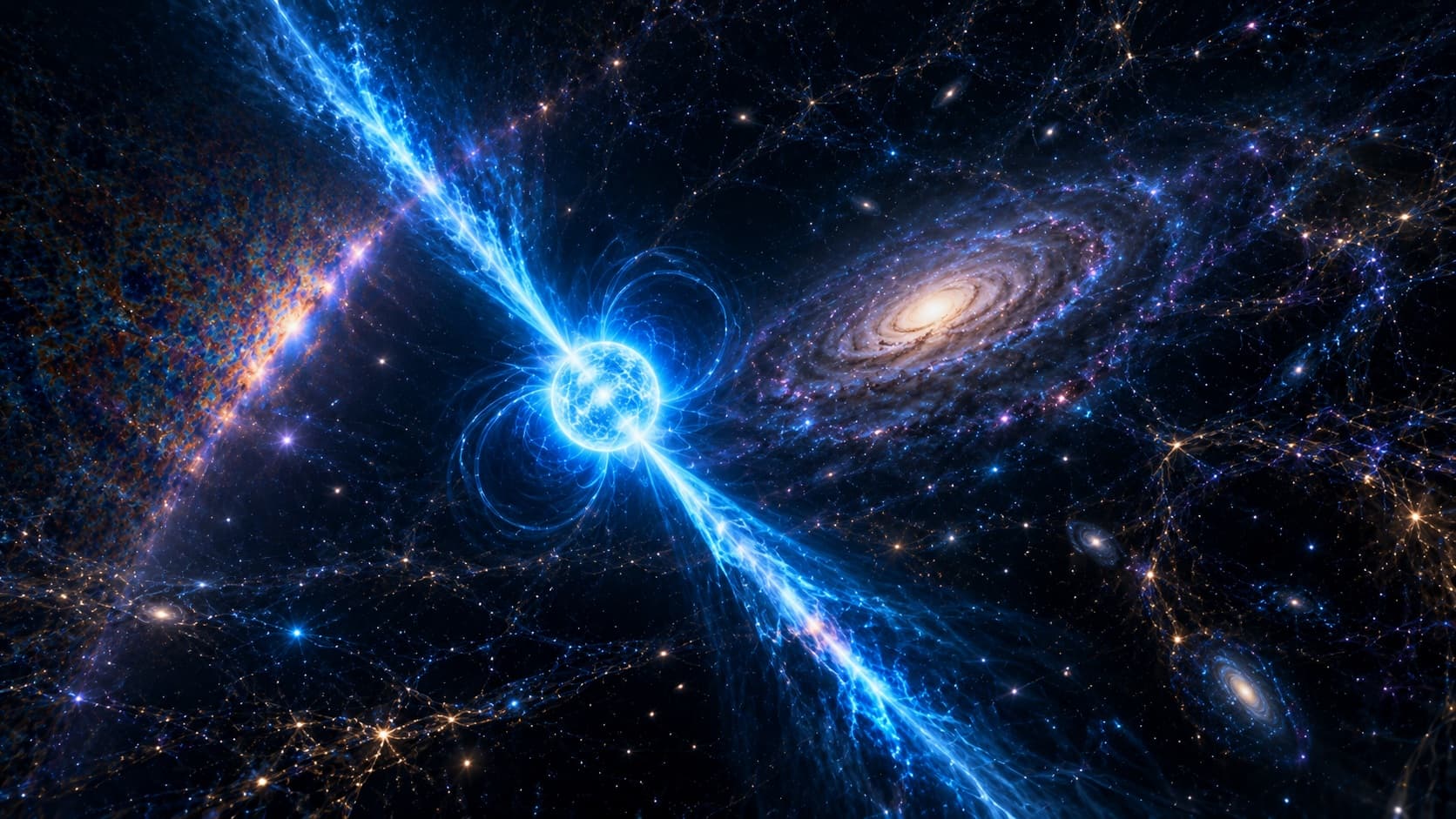
Galaxies are not scattered randomly. They form groups, clusters, superclusters, filaments, sheets, and voids. On the largest scales, the universe resembles a cosmic web, with galaxies tracing a network shaped by gravity and dark matter.
This structure grew from tiny density fluctuations in the early universe.
Galaxy groups and clusters
A galaxy group contains a few to dozens of galaxies. The Local Group, containing the Milky Way, Andromeda, and many dwarf galaxies, is an example. Galaxy clusters contain hundreds to thousands of galaxies bound together by gravity.
Clusters are the largest gravitationally bound systems in the universe.
Components of clusters
Galaxy clusters contain galaxies, hot intracluster gas, and dark matter. Surprisingly, most ordinary matter in clusters is not in stars but in hot gas between galaxies. This gas reaches millions of kelvin and emits X-rays.
Dark matter supplies most of the cluster mass. The approximate mass fractions are dominated by dark matter, then hot gas, then stars.
Virial equilibrium
Many clusters are approximately virialized, meaning their motions have settled into a gravitationally bound equilibrium. The virial theorem gives
This allows astronomers to estimate cluster mass from galaxy velocities or gas temperature.
Clusters that are actively merging may not be fully virialized, making mass estimates more complex.
Large-scale structure growth
In the early universe, matter density was nearly uniform with tiny fluctuations. Regions slightly denser than average had stronger gravity and attracted more matter. Over time, these fluctuations grew into halos, galaxies, and clusters.
Dark matter plays a crucial role because it began clumping gravitationally before ordinary matter could freely collapse. Ordinary matter later fell into dark matter potential wells.
Cosmic web
Numerical simulations show that gravitational collapse naturally produces filaments and voids. Matter drains from underdense regions into sheets, filaments, and nodes. Galaxy clusters form at dense nodes where filaments intersect.
The cosmic web is observed in galaxy redshift surveys, which map positions of millions of galaxies.
Baryon acoustic oscillations
Large-scale galaxy distributions contain a preferred scale from sound waves in the early universe. These baryon acoustic oscillations provide a standard ruler for cosmology. The characteristic scale helps measure the expansion history of the universe.
This connects galaxy surveys to dark energy and cosmological parameters.
Gravitational lensing and structure
Weak gravitational lensing maps the mass distribution, including dark matter, across large cosmic volumes. Comparing lensing maps with galaxy maps shows how visible galaxies trace the underlying matter field, though not perfectly.
The big idea
Large-scale structure is the cosmic web produced by gravitational growth from early density fluctuations. Galaxy clusters are massive nodes containing galaxies, hot gas, and dark matter. Surveys of clusters, filaments, voids, and lensing maps reveal the matter content and expansion history of the universe.
Sign in to track your progress.
Up next · Module 5
The Expanding Universe
This module introduces the observational basis of modern cosmology. Students study Hubble's law, redshift, distance measurements, the cosmic microwave background, and dark energy.
Ask your AI physics guide
Ask anything about Astrophysics and Cosmology — Galaxy clusters and large-scale structure, or choose a suggested question below.
AI responses are educational and may not be perfectly accurate. Press Enter to send, Shift+Enter for new line.