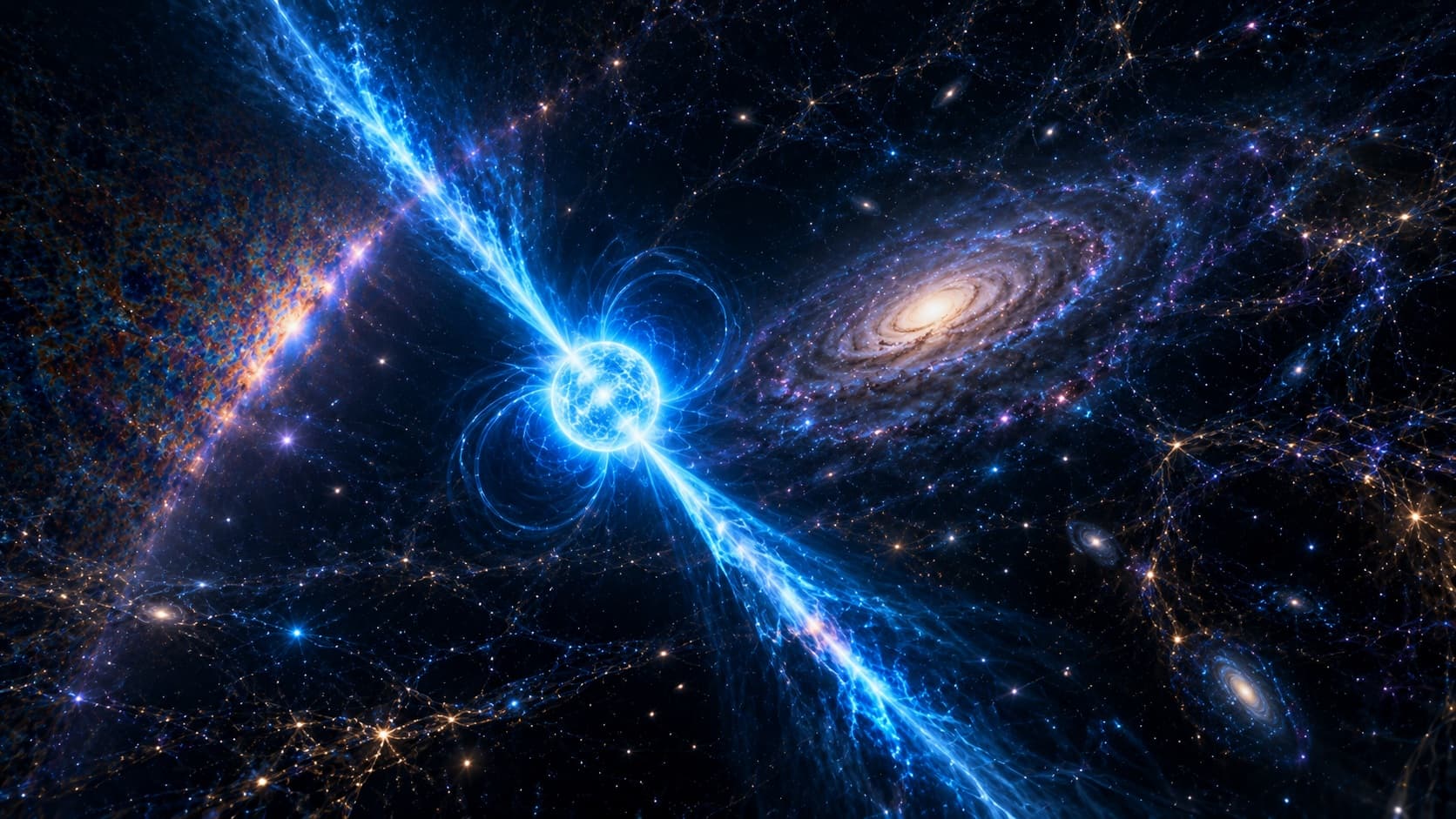
Structure of the Milky Way
PHYS 501 · Galaxies and Dark Matter
The Milky Way is a barred spiral galaxy containing stars, gas, dust, dark matter, and a central supermassive black hole. This lesson surveys its major components and evidence.
Key equations
1 pcapprox3.26 lyv_c^2=
rac{GM(r)}{r}M(r)propto rLearning objectives
- Identify the major components of the Milky Way.
- Explain why mapping the Milky Way is difficult from inside.
- Describe spiral arms as star-forming structures.
- Explain the role of the interstellar medium.
- Connect the Milky Way rotation curve to dark matter.
Our galaxy from the inside
The Milky Way is the galaxy that contains the Sun and Solar System. Because we live inside it, mapping its structure is challenging. Dust blocks visible light along many lines of sight, so astronomers use radio, infrared, optical, and other observations to build a full picture.
The Milky Way is a barred spiral galaxy with a disk, spiral arms, a central bulge and bar, a stellar halo, globular clusters, interstellar gas and dust, dark matter, and a central supermassive black hole.
Galactic disk
The disk contains most of the Milky Way's gas, dust, and young stars. It is flattened and rotating. The Sun lies in the disk about 8 kiloparsecs from the Galactic center.
A parsec is defined by parallax and equals about
A kiloparsec is 1000 parsecs. Galactic distances are commonly measured in kiloparsecs.
Spiral arms
The Milky Way has spiral structure traced by young massive stars, ionized gas regions, molecular clouds, and radio emission. Spiral arms are not rigid material arms. They are better understood as density wave patterns or recurrent structures where gas is compressed and star formation is enhanced.
Massive blue stars mark spiral arms because they are short-lived and remain near their birthplaces.
Bulge and bar
The central region contains a bulge and a bar-shaped distribution of stars. The bar affects gas motion and may help funnel material toward the inner galaxy. The central stellar population is generally older and more metal-rich than many halo stars.
At the center lies Sagittarius A*, a supermassive black hole with mass about four million solar masses.
Stellar halo and globular clusters
The stellar halo is a roughly spherical, sparse population of old stars surrounding the disk. It contains globular clusters: dense, ancient clusters with hundreds of thousands of stars.
Halo stars often have low metallicity, meaning they contain fewer elements heavier than helium. This makes them clues to early Galactic history.
Interstellar medium
The space between stars contains gas, dust, cosmic rays, and magnetic fields. Cold molecular clouds form stars. Hot ionized gas fills large regions. Supernovae stir and enrich the interstellar medium, while stellar winds and radiation shape nearby gas.
The star-gas cycle connects stellar evolution to galaxy evolution.
Dark matter halo
The Milky Way's rotation curve suggests much more mass exists than is visible in stars and gas. Stars far from the center orbit faster than expected from visible matter alone. This implies an extended dark matter halo.
The circular speed satisfies roughly
v_c^2= rac{GM(r)}{r}
A flat rotation curve, where stays nearly constant, implies
over a large range of radii.
The big idea
The Milky Way is a barred spiral galaxy with a rotating disk, spiral arms, central bulge and bar, stellar halo, interstellar medium, dark matter halo, and central black hole. Its structure records the history of star formation, mergers, chemical enrichment, and gravitational dynamics.
Sign in to track your progress.
Ask your AI physics guide
Ask anything about Astrophysics and Cosmology — Structure of the Milky Way, or choose a suggested question below.
AI responses are educational and may not be perfectly accurate. Press Enter to send, Shift+Enter for new line.