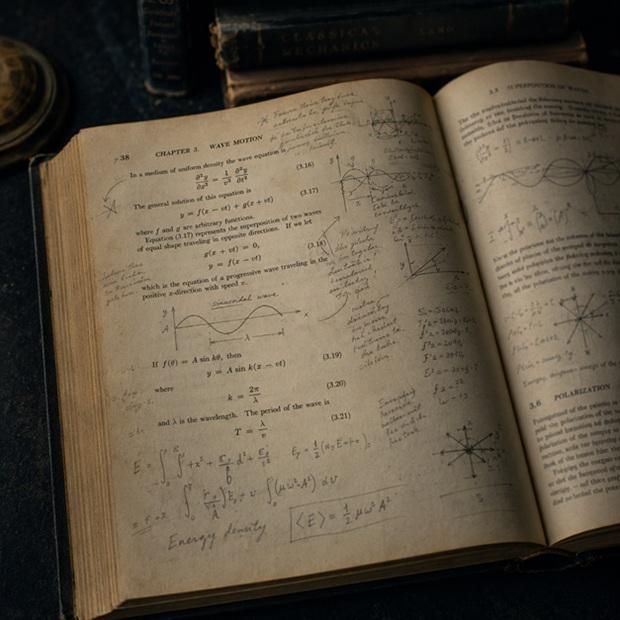
What Is Angular Momentum?
If you have ever watched a spinning figure skater pull in their arms and rotate faster, or seen a bicycle wheel resist being tilted, you have already met angular momentum. It is one of the most important ideas in mechanics, and yet it is often introduced as if it were mysterious. In fact, angular mo
What Is Angular Momentum?
If you have ever watched a spinning figure skater pull in their arms and rotate faster, or seen a bicycle wheel resist being tilted, you have already met angular momentum. It is one of the most important ideas in mechanics, and yet it is often introduced as if it were mysterious. In fact, angular momentum is a natural extension of ordinary momentum to rotating motion. Once we build it carefully from the ground up, it becomes a powerful and intuitive tool.
From Linear Momentum to Rotational Motion
Let us begin with the familiar quantity: linear momentum. For a particle of mass moving with velocity , the momentum is
This quantity tells us how difficult it is to stop the object or change its motion. A heavy truck moving quickly has large momentum; a small ball moving slowly has less.
Now suppose the object is not merely moving in a straight line, but moving around a point. For example, imagine a particle traveling in a circle around the origin. In rotational situations, we want a quantity that measures how much “rotational motion” the particle has about that point. That quantity is angular momentum.
Definition of Angular Momentum
For a particle located at position relative to some origin, with momentum , the angular momentum about that origin is defined as
This is a vector cross product, so has both magnitude and direction.
Its magnitude is
where is the angle between and .
This formula tells us something important: only the part of the momentum perpendicular to the radius vector contributes to angular momentum. If the particle is moving directly toward or away from the origin, then or , so , and the angular momentum is zero.
That makes sense physically. Motion straight inward or outward does not produce rotation about the origin.
Why the Cross Product Matters
The cross product encodes both size and orientation. The direction of is given by the right-hand rule: point the fingers of your right hand along and curl them toward . Your thumb points in the direction of .
For motion in a plane, angular momentum points perpendicular to that plane. For example, if a particle moves counterclockwise in the -plane, its angular momentum points in the direction.
This direction is not just a mathematical convenience. It helps us describe whether the rotation is clockwise or counterclockwise, and it plays a central role in three-dimensional physics.
A Simple Example
Imagine a particle moving at at a distance of from the origin, with its velocity perpendicular to the radius vector. Then
Since the velocity is perpendicular to , we have , so
This is the angular momentum magnitude about the origin.
If the same particle moved directly toward the origin instead, its angular momentum would be zero, even though it still has linear momentum. This distinction is crucial: angular momentum depends not only on motion, but also on the choice of reference point.
Angular Momentum of a Rigid Body
For a single particle, the definition is straightforward. For a rigid body made of many particles, we add the angular momentum of each piece:
For a rigid body rotating about a fixed axis, this simplifies to
where is the moment of inertia and is the angular velocity.
This is one of the most useful formulas in rotational dynamics. It mirrors the linear relationship . In the same way that mass measures resistance to changes in linear motion, the moment of inertia measures resistance to changes in rotational motion.
A figure skater with arms extended has a larger moment of inertia than when the arms are pulled in. If angular momentum is conserved, reducing forces to increase, so the skater spins faster.
Torque and the Change in Angular Momentum
Linear momentum changes when a force acts. Angular momentum changes when a torque acts.
Torque is defined by
The rotational analogue of Newton’s second law is
This equation says that the net torque on a system equals the rate of change of its angular momentum.
If the net external torque is zero, then angular momentum is conserved:
This is one of the great conservation laws of physics. It explains why spinning tops stay upright for a while, why planets sweep out equal areas in equal times, and why skaters spin faster when they pull their arms in.
Conservation of Angular Momentum
Angular momentum conservation is not a special trick for rotating objects; it is a deep feature of nature. In any isolated system with no external torque, the total angular momentum remains constant.
This means that angular momentum can be transferred from one part of a system to another, but the total stays the same. For example, when a person standing on a rotating platform throws a heavy ball in one direction, the platform and person recoil in the opposite direction so that total angular momentum is preserved.
This principle is especially useful in astronomy. When a star collapses into a neutron star, its radius shrinks dramatically. If angular momentum is approximately conserved, the rotation rate increases enormously. That is one reason neutron stars can spin many times per second.
Units and Physical Meaning
The SI units of angular momentum are
These units may look unfamiliar at first, but they follow directly from the definition : position has units of meters, and momentum has units of .
Physically, angular momentum measures how strongly an object tends to keep rotating about a point or axis. It is not exactly “how fast something spins.” A large, slowly rotating object can have more angular momentum than a small, fast one.
Common Misconceptions
1. Angular momentum is the same as momentum with a different name
Not quite. Linear momentum describes straight-line motion. Angular momentum describes rotational motion about a chosen origin or axis. They are related, but they are not the same quantity.
2. If something is spinning, it must have angular momentum
Usually yes, but the details matter. Angular momentum depends on the point or axis you choose. A particle can be moving rapidly and still have zero angular momentum about a particular point if its motion is directed radially.
3. Angular momentum is always conserved
Only if the net external torque is zero. If an external torque acts, angular momentum can change.
4. Faster spin always means larger angular momentum
Not necessarily. Angular momentum depends on both angular speed and moment of inertia. A large spinning wheel may have more angular momentum than a small fast one.
A Final Intuition
A useful way to think about angular momentum is this: it measures not just motion, but motion with a lever arm. The farther the momentum is from the axis, and the more perpendicular it is to the radius, the greater the angular momentum. That is why opening a door is easier when you push at the handle rather than near the hinge.
Angular momentum is the rotational cousin of linear momentum, and it is one of the most elegant ideas in physics. It connects particles, rigid bodies, planets, and atoms under one common principle. Once you understand it, rotational motion becomes much less mysterious.
Suggested Follow-Up Questions
- How is angular momentum related to torque in real-world examples?
- Why does pulling in your arms make a spinning skater rotate faster?
- What is the difference between moment of inertia and angular momentum?
- How does angular momentum explain planetary orbits and spinning stars?