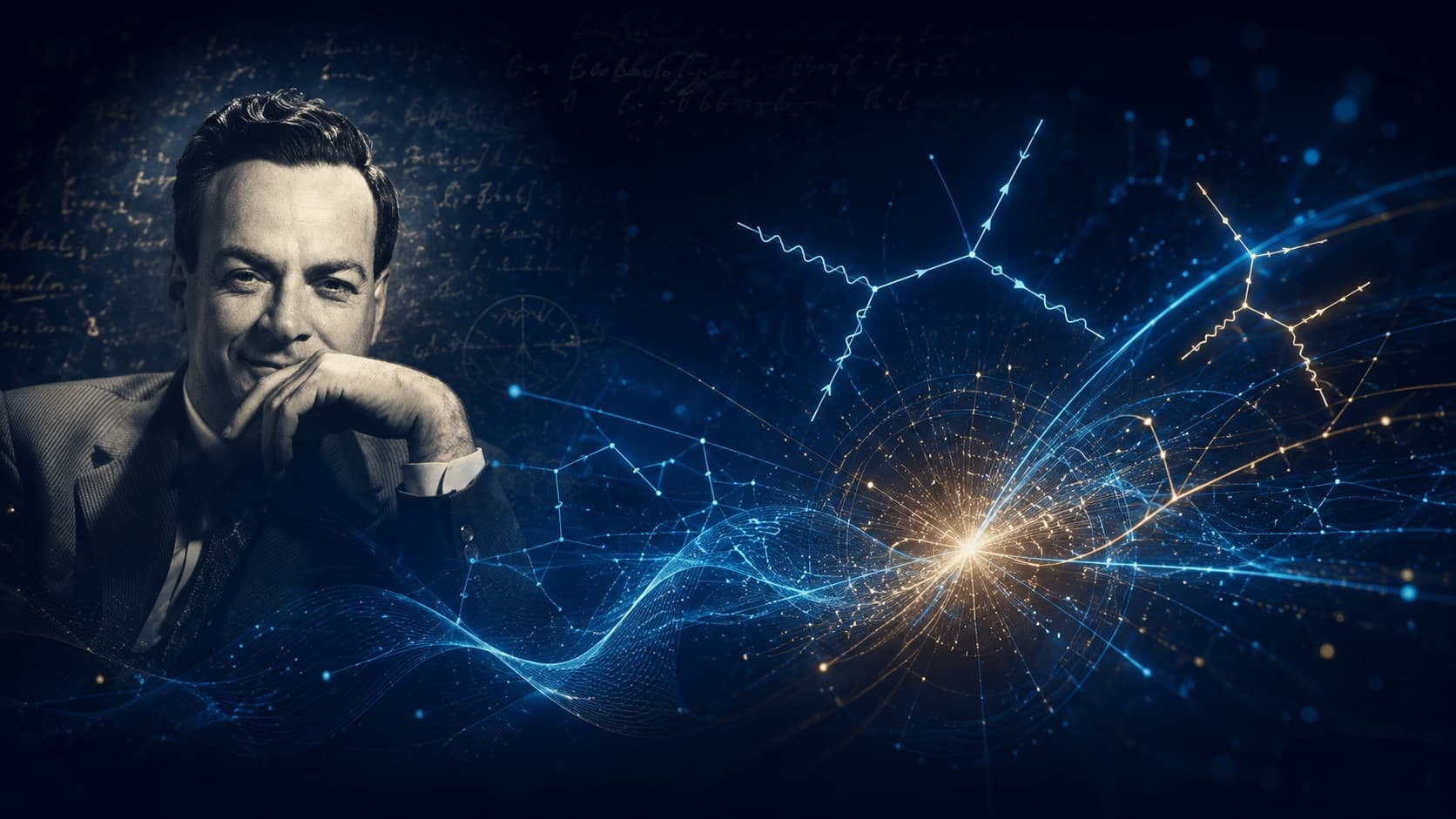
Richard Feynman
Architect of Quantum Electrodynamics
1918–1988
Richard Feynman developed quantum electrodynamics — the most precisely tested theory in physics — invented Feynman diagrams, and reformulated quantum mechanics through path integrals. He was also one of history's greatest physics communicators, making deep ideas accessible without sacrificing rigor.
Why Richard Feynman Matters
Richard Feynman matters because he solved one of the deepest problems of mid-twentieth century physics and gave scientists tools they still use every day. Quantum electrodynamics — the theory of how light and matter interact at the quantum level — was mathematically broken when Feynman began his work. Calculations produced infinite, meaningless answers. Feynman, along with Julian Schwinger and Sin-Itiro Tomonaga, found a way to make the theory work through a technique called renormalization.
But Feynman's contribution was not just a fix. He introduced an entirely new way of thinking about quantum processes using simple diagrams that represented interactions between particles. Feynman diagrams became one of the most powerful tools in all of theoretical physics. Physicists still use them to calculate particle interactions, and their logic underpins quantum field theory — the language of the Standard Model of particle physics.
Feynman also reformulated quantum mechanics from scratch using the path integral approach, showing that a particle traveling between two points effectively explores every possible path simultaneously, weighted by probability amplitudes. This formulation deepened understanding of quantum behavior and opened new doors in condensed matter physics, cosmology, and quantum computing.
Beyond his technical achievements, Feynman had a rare gift for explanation. His Lectures on Physics remain among the most celebrated physics textbooks ever written. He demonstrated that deep understanding and accessible teaching were not in conflict.
Historical Context
Feynman came of age in the golden era of American physics. He studied at MIT and Princeton, then joined the Manhattan Project at Los Alamos during World War II, where he worked on the theoretical calculations for the atomic bomb. After the war he became a professor at Cornell, then Caltech, where he spent most of his career.
The central problem of his early career was the divergence crisis in quantum electrodynamics. Quantum mechanics and special relativity had each been enormously successful, but their combination produced a theory of electrons and photons riddled with infinities. The 1947 Shelter Island Conference, where experimental results including the Lamb shift were announced, galvanized theorists to fix QED. Feynman, working with his own diagrammatic methods, and independently Schwinger and Tomonaga, solved this problem. All three shared the 1965 Nobel Prize in Physics.
In his later career Feynman made important contributions to the theory of superfluidity, the weak force (with Murray Gell-Mann), and partons — the constituent parts of protons and neutrons. In 1981 he gave a visionary talk proposing that quantum computers could simulate quantum systems far more efficiently than classical ones, laying early groundwork for the field of quantum computing.
Feynman died in 1988, but left behind a legacy in physics education through his lectures, books, and the culture of honest, rigorous, joyful inquiry he modeled.
Key Contributions
Quantum Electrodynamics (QED)
Feynman developed a consistent, calculable quantum theory of how electrons and photons interact. His renormalization methods resolved the infinities that had plagued earlier attempts. QED has since been confirmed to extraordinary precision — its predictions match experiment to better than one part in a billion — making it the most accurately tested theory in the history of science.
Feynman Diagrams
Feynman invented a pictorial shorthand for calculating quantum interactions. Each diagram represents a term in a perturbation series, and rules for turning diagrams into mathematical expressions made complex calculations tractable. Feynman diagrams are now ubiquitous in particle physics, condensed matter, and quantum field theory.
Path Integral Formulation of Quantum Mechanics
Feynman showed that quantum amplitudes could be computed by summing over all possible paths a particle might take between two points. This path integral approach gave quantum mechanics a new mathematical foundation and turned out to be especially powerful for quantum field theory, statistical mechanics, and modern cosmology.
Parton Model
In the late 1960s, Feynman proposed the parton model to explain high-energy scattering experiments at SLAC. He suggested that protons and neutrons contain point-like constituents — partons — which were later identified with quarks and gluons. This work helped establish the framework of quantum chromodynamics (QCD).
Quantum Computing Proposal
In a 1981 lecture, Feynman argued that simulating quantum systems on classical computers was fundamentally inefficient, and that a computer built on quantum mechanical principles could do the job. This insight was one of the founding ideas of the field of quantum computing.
How Their Ideas Changed Physics
Feynman changed physics in two distinct but related ways: he extended its technical reach and transformed its culture.
Technically, his QED work completed the unification of quantum mechanics and special relativity for electromagnetism. The resulting framework became the template for all subsequent quantum field theories. The weak nuclear force and the strong nuclear force were eventually described in the same language — quantum field theory — with methods that trace directly to Feynman's work. The Standard Model of particle physics, which describes all known fundamental particles and forces except gravity, is built on this foundation.
Feynman diagrams gave physicists an intuitive way to organize and visualize calculations that would otherwise be almost impossibly abstract. By turning algebraic perturbation theory into a visual language, he lowered the barrier to performing and checking complex calculations.
Culturally, Feynman modeled a style of doing physics that prized physical intuition, independent thinking, and skepticism of formalism for its own sake. He distrusted authority and insisted on deriving things from first principles. His public lectures, his books — especially The Feynman Lectures on Physics and QED: The Strange Theory of Light and Matter — and his personal story made physics exciting and accessible to generations of students.
His influence on quantum computing, though indirect, is also profound. The field he sketched in 1981 is now one of the most active areas of research in both physics and computer science.
Legacy
Feynman's legacy is threefold: scientific, educational, and cultural.
Scientifically, his contributions to QED and quantum field theory are foundational. No modern particle physicist works without using tools he either invented or heavily influenced. The Standard Model — the culmination of twentieth century physics — speaks in a language Feynman helped create.
Educationally, The Feynman Lectures on Physics (1963–1965), co-authored with Robert Leighton and Matthew Sands, are still read and assigned worldwide. They are admired not only for their content but for their approach: treating students as intelligent people capable of appreciating genuine understanding. QED: The Strange Theory of Light and Matter (1985) remains one of the best popular explanations of a deep scientific theory ever written.
Culturally, Feynman became a symbol of scientific curiosity, irreverence, and joy. His autobiographical books — Surely You're Joking, Mr. Feynman! and What Do You Care What Other People Think? — introduced millions of non-scientists to what it is like to think like a physicist. His final public role, serving on the Rogers Commission investigating the Space Shuttle Challenger disaster and demonstrating the O-ring failure with a glass of ice water, became iconic for its plain-speaking honesty.
Feynman once said that if all scientific knowledge were destroyed and only one sentence could be passed on to the next generation, it should be the atomic hypothesis — that everything is made of atoms. He spent his career finding deeper and deeper ways to say what that means.
Related Physics Concepts
Related GuidedPhysics Courses
Quantum Mechanics
Feynman's path integral formulation provides an alternative foundation for quantum mechanics and deepens understanding of wave functions and probability amplitudes.
Particle Physics and the Standard Model
QED and Feynman diagrams are the direct ancestors of the quantum field theory language used throughout the Standard Model.
Modern Physics
Feynman's work bridges quantum mechanics and special relativity, two pillars of modern physics.
Nuclear and Particle Physics
The parton model and QCD grew from Feynman's framework for understanding the internal structure of protons and neutrons.

Explore the physics of Richard Feynman
Richard Feynman's ideas are woven into the courses at GuidedPhysics. Start a conversation with an AI guide and explore the physics they built.