Introduction
Galileo’s Falling Bodies is one of the most famous thought experiments in the history of physics because it shows how careful reasoning can overturn a belief that had dominated science for nearly two thousand years. Instead of relying only on everyday appearances, Galileo asked what would logically follow if Aristotle’s theory of falling objects were true. The result revealed a deep problem in the old view of motion.
The Setup
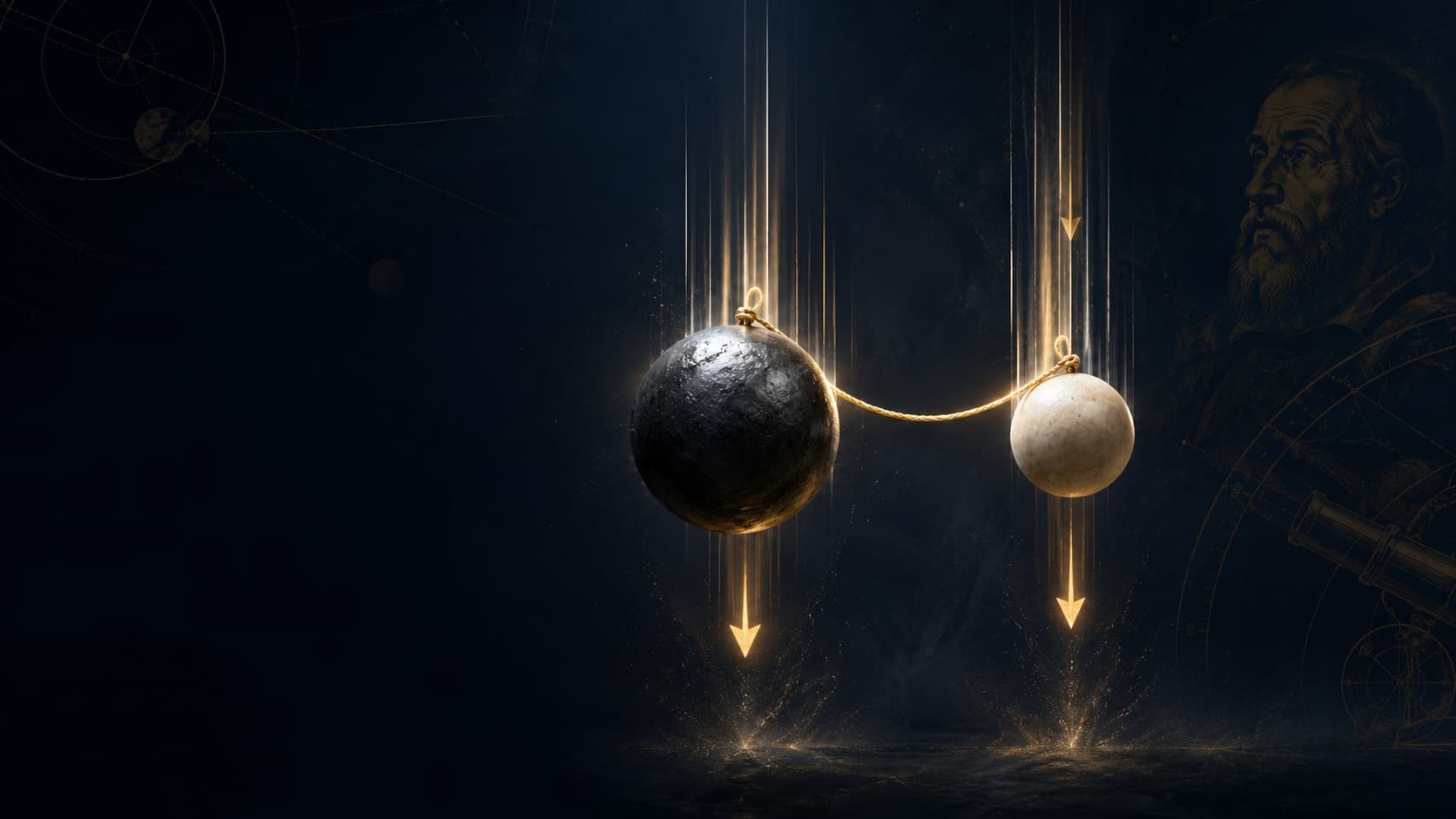
Imagine two objects: one heavy and one light. According to the Aristotelian view, the heavier object should fall faster than the lighter one. Now imagine tying the two objects together with a rope and dropping them from the same height. If the light object falls more slowly, it should act as a drag on the heavy object, making the combined system fall slower than the heavy object alone. But once tied together, the two objects form a single object heavier than either one by itself. By Aristotle’s rule, the combined object should fall faster than the heavy object alone. The same setup therefore seems to predict both a slower fall and a faster fall.
The Paradox or Question
The central question is whether the speed of falling depends directly on an object’s weight. If heavier objects truly fall faster, then tying a lighter object to a heavier one creates a contradiction: the pair should fall both slower and faster than the heavy object alone. Galileo used this contradiction to show that the old assumption could not be right.
How It Changed Physics
Galileo’s reasoning suggests that, in the absence of air resistance, objects fall with the same acceleration regardless of their mass. A feather and a cannonball behave differently in everyday life because air resistance affects them differently, not because gravity gives the heavier object a fundamentally greater falling speed. This insight helped shift physics away from qualitative explanations based on natural tendencies and toward mathematical laws of motion. It prepared the way for Newton’s later work, in which acceleration, force, inertia, and gravity became part of a unified mechanical framework.
Historical Context
Before Galileo, European natural philosophy was strongly influenced by Aristotle, who taught that heavier bodies fall faster because they have a stronger natural tendency to move toward the Earth. Galileo lived during a period when observation, mathematics, and experiment were beginning to challenge inherited authority. His work on falling bodies, inclined planes, and motion helped launch the scientific revolution and transformed how physicists studied nature.
Related Physics Concepts
Relevance Today
Galileo’s Falling Bodies remains important because it introduces one of the central ideas of mechanics: gravitational acceleration is independent of mass when air resistance is negligible. This principle is used in physics education, engineering, aerospace science, ballistics, orbital mechanics, and any field where motion under gravity must be modeled accurately. It also remains a powerful example of scientific reasoning, showing that a simple logical argument can reveal flaws in a long-accepted theory.
Related GuidedPhysics Courses
classical mechanics
Explore core ideas connected to this thought experiment.
introductory physics
Explore core ideas connected to this thought experiment.
history of physics
Explore core ideas connected to this thought experiment.
gravitation and orbits
Explore core ideas connected to this thought experiment.
