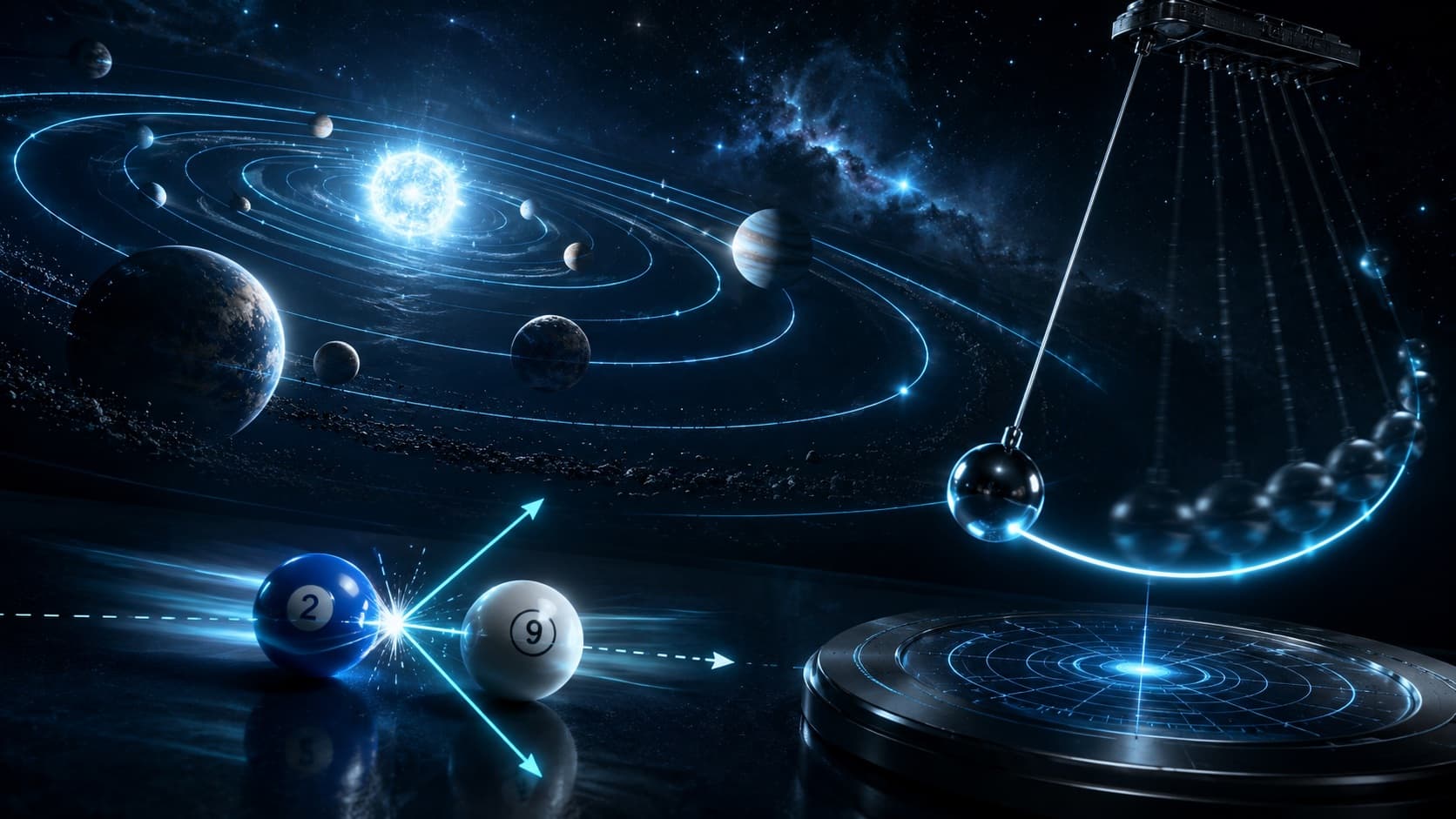
Orbital mechanics and Kepler's laws
PHYS 201 · Gravity Oscillations and Lagrangian
Orbital motion follows from gravity and conservation laws. This lesson introduces circular orbits, orbital energy, Kepler's laws, and the connection between geometry and dynamics.
Key equations
G\frac{Mm}{r^2}=m\frac{v^2}{r}v=\sqrt{\frac{GM}{r}}v=\frac{2\pi r}{T}T^2=\frac{4\pi^2}{GM}r^3\vec{\tau}=\vec{r}\times\vec{F}=0\vec{L}=\vec{r}\times\vec{p}=constantT^2=\frac{4\pi^2}{GM}a^3E=K+UU=-G\frac{Mm}{r}E=-G\frac{Mm}{2r}Learning objectives
- Derive circular orbit speed from gravity and centripetal acceleration.
- Explain Kepler's three laws in Newtonian terms.
- Connect Kepler's second law to angular momentum conservation.
- Interpret orbital energy for bound circular orbits.
Orbits as falling motion
An orbit is continuous free fall around a central body. A satellite in orbit is always falling toward Earth, but it also has enough sideways velocity that Earth's surface curves away beneath it. Gravity provides the centripetal acceleration needed to bend the path.
For a circular orbit of radius around mass , set gravitational force equal to the required centripetal force:
G rac{Mm}{r^2}=m rac{v^2}{r}
Solving gives
v=sqrt{ rac{GM}{r}}
The orbiting mass cancels.
Orbital period
For a circular orbit, speed is circumference divided by period:
v= rac{2pi r}{T}
Combining with gives
T^2= rac{4pi^2}{GM}r^3
This is the circular-orbit version of Kepler's third law.
Kepler's first law
Kepler's first law says planets move in ellipses with the Sun at one focus. A circle is a special case of an ellipse. Newtonian gravity explains why inverse-square central forces produce conic-section orbits: ellipses, parabolas, or hyperbolas depending on energy.
Bound orbits are ellipses. Escape trajectories are parabolic or hyperbolic.
Kepler's second law
Kepler's second law says a line from the Sun to a planet sweeps out equal areas in equal times. This is a statement of angular momentum conservation.
Gravity is a central force, meaning it points along ec{r}. Therefore the torque about the central mass is zero:
ec{ au}= ec{r} imes ec{F}=0
So angular momentum is conserved:
ec{L}= ec{r} imes ec{p}=constant
When the planet is closer to the Sun, it moves faster; when farther away, it moves slower.
Kepler's third law
Kepler's third law relates orbital period and size. For an elliptical orbit with semi-major axis ,
T^2= rac{4pi^2}{GM}a^3
This says larger orbits have longer periods. The relationship is not linear: period squared is proportional to semi-major axis cubed.
Orbital energy
The total mechanical energy of a circular orbit is
where
K= rac{1}{2}mv^2
and
U=-G rac{Mm}{r}
Using ,
K=G rac{Mm}{2r}
so
E=-G rac{Mm}{2r}
The negative total energy indicates a bound orbit.
Changing orbits
To move to a higher circular orbit, a spacecraft needs energy added. Higher orbits have larger total energy, meaning less negative energy. However, the orbital speed in a higher circular orbit is lower because decreases with .
This can feel counterintuitive: raising an orbit requires energy, but the final circular speed is smaller.
The big idea
Orbital mechanics is Newtonian gravity plus conservation laws. Circular orbit speed comes from balancing gravity with centripetal acceleration. Kepler's laws emerge from inverse-square central forces and angular momentum conservation. Orbital energy determines whether motion is bound or unbound.
Sign in to track your progress.
Ask your AI physics guide
Ask anything about Classical Mechanics — Orbital mechanics and Kepler's laws, or choose a suggested question below.
AI responses are educational and may not be perfectly accurate. Press Enter to send, Shift+Enter for new line.