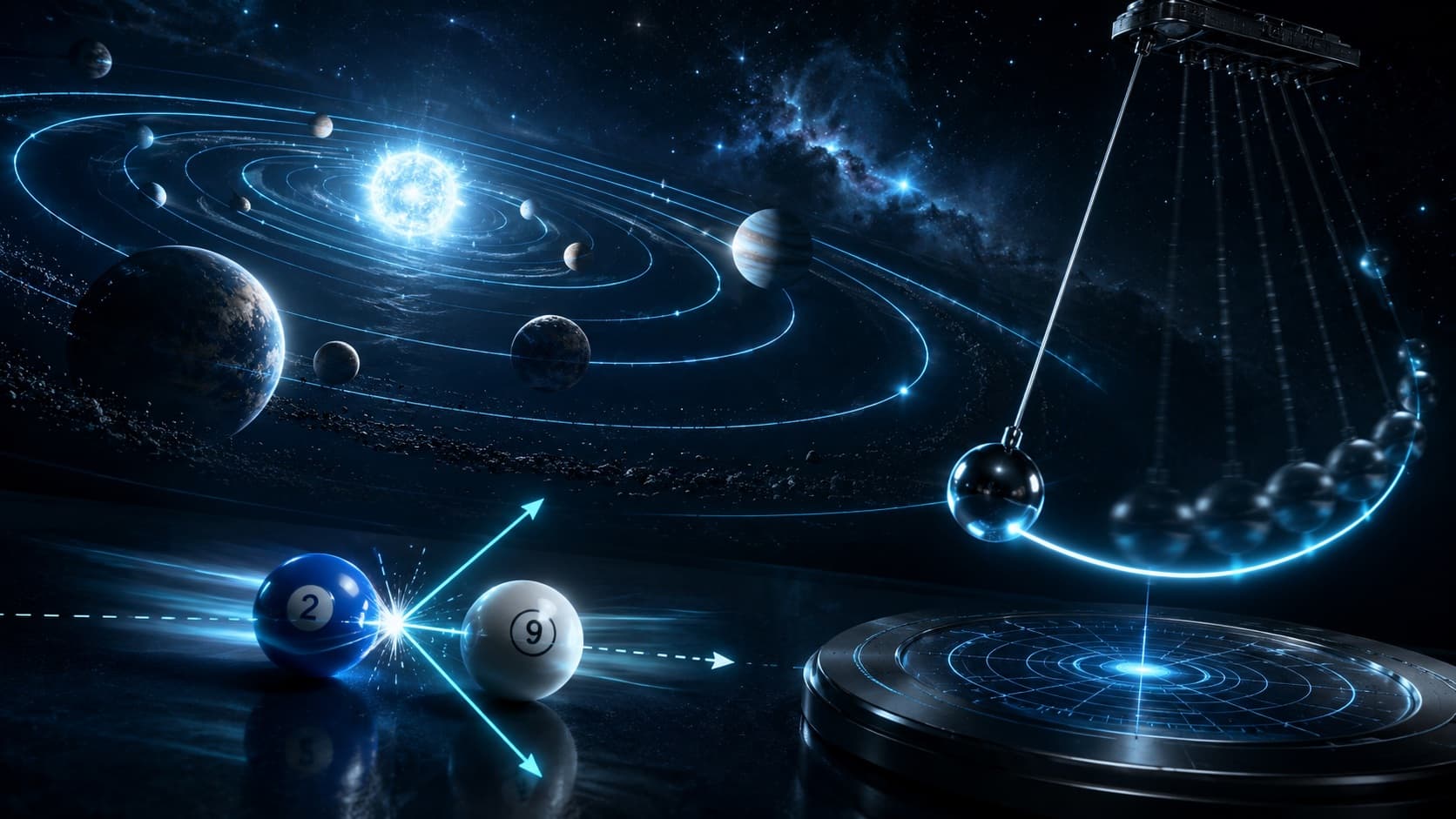
Elastic and inelastic collisions
PHYS 201 · Momentum and Collisions
Collisions are classified by whether kinetic energy is conserved. This lesson compares elastic, inelastic, and perfectly inelastic collisions using momentum and energy.
Key equations
\vec{P}_i=\vec{P}_fK_i=K_fv_{1i}-v_{2i}=-(v_{1f}-v_{2f})m_1v_{1i}+m_2v_{2i}=(m_1+m_2)v_fv_f=\frac{m_1v_{1i}+m_2v_{2i}}{m_1+m_2}\Delta K=K_f-K_im_1v_{1xi}+m_2v_{2xi}=m_1v_{1xf}+m_2v_{2xf}m_1v_{1yi}+m_2v_{2yi}=m_1v_{1yf}+m_2v_{2yf}Learning objectives
- Distinguish elastic, inelastic, and perfectly inelastic collisions.
- Apply momentum conservation to collision problems.
- Use kinetic energy conservation only for elastic collisions.
- Analyze one-dimensional and two-dimensional collision setups.
Momentum in all isolated collisions
In an isolated collision, total momentum is conserved:
ec{P}_i= ec{P}_f
This is true for elastic and inelastic collisions, as long as the net external impulse is zero or negligible.
Kinetic energy behaves differently. The classification of collisions depends on what happens to kinetic energy.
Elastic collisions
An elastic collision conserves both momentum and kinetic energy:
ec{P}_i= ec{P}_f
Ideal elastic collisions are approximated by hard, nearly lossless objects such as steel balls or air-track gliders. At microscopic scales, some particle collisions can be highly elastic.
In one dimension, a useful additional relation for elastic collisions is that relative speed of approach equals relative speed of separation:
This relation follows from combining momentum and kinetic energy conservation.
Inelastic collisions
An inelastic collision conserves momentum but not kinetic energy. Some initial kinetic energy is transformed into thermal energy, sound, deformation, internal vibrations, or other forms.
Most real macroscopic collisions are inelastic to some degree. A bouncing ball does not rebound to its original height because some mechanical energy is lost to non-mechanical forms.
Perfectly inelastic collisions
A perfectly inelastic collision is one in which the objects stick together after collision. Momentum conservation gives
Solving for final velocity:
v_f= rac{m_1v_{1i}+m_2v_{2i}}{m_1+m_2}
Kinetic energy is not conserved. In fact, for given initial conditions, perfectly inelastic collisions lose the maximum possible kinetic energy while still conserving momentum.
Kinetic energy loss
The kinetic energy change is
For an inelastic collision, . The missing mechanical energy has not vanished; it has changed form.
In collision problems, it is important not to apply mechanical energy conservation unless the collision is stated or known to be elastic. Momentum conservation is usually the starting point.
Equal masses in elastic collision
A famous special case occurs when two equal masses collide elastically in one dimension and one is initially at rest. The incoming object stops, and the target object leaves with the incoming object's original velocity. This is approximately seen in Newton's cradle.
This result depends on both momentum and kinetic energy conservation.
Two-dimensional collisions
In two dimensions, momentum conservation must be applied in components:
If the collision is elastic, kinetic energy conservation provides another equation.
Collision strategy
First decide whether external impulse is negligible. If so, write momentum conservation. Then determine the collision type. If objects stick, use perfectly inelastic conditions. If kinetic energy is conserved, use elastic equations. If the collision is inelastic but not perfectly inelastic, additional information is needed.
The big idea
All isolated collisions conserve momentum. Elastic collisions also conserve kinetic energy. Inelastic collisions transform some kinetic energy into other forms, and perfectly inelastic collisions involve objects sticking together. Understanding which quantities are conserved is the key to solving collision problems.
Sign in to track your progress.
Ask your AI physics guide
Ask anything about Classical Mechanics — Elastic and inelastic collisions, or choose a suggested question below.
AI responses are educational and may not be perfectly accurate. Press Enter to send, Shift+Enter for new line.