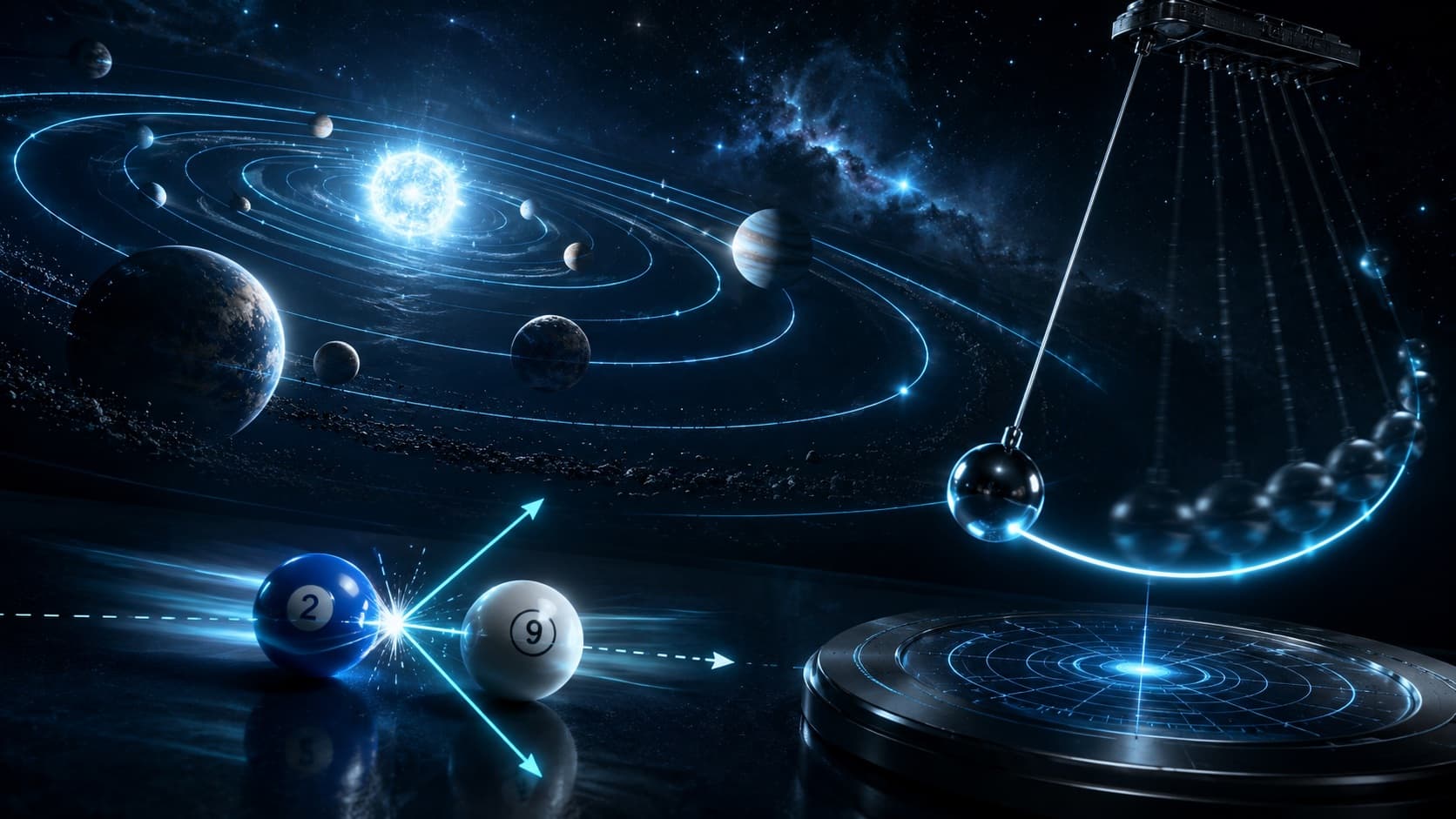
The three laws of motion
PHYS 201 · Newton's Laws
Newton's three laws form the foundation of classical dynamics. This lesson presents the laws in calculus-based form and explains inertia, net force, and interaction pairs.
Key equations
\vec{F}_{net}=0\vec{v}=constant\vec{F}_{net}=m\vec{a}\vec{F}_{net}=\frac{d\vec{p}}{dt}\vec{p}=m\vec{v}\vec{a}=\frac{\vec{F}_{net}}{m}\vec{F}_{A\ on\ B}=-\vec{F}_{B\ on\ A}\sum F_x=ma_x\sum F_y=ma_yLearning objectives
- State Newton's three laws in vector form.
- Explain inertia and inertial frames.
- Distinguish the momentum and constant-mass forms of Newton's second law.
- Identify third-law force pairs correctly.
Dynamics and the cause of motion changes
Kinematics describes motion. Dynamics explains why motion changes. Newton's laws connect forces to changes in motion and form the core of classical mechanics.
A force is an interaction that can change an object's momentum. Forces may involve contact, such as a push, tension, friction, or the normal force, or they may act at a distance, such as gravity. Newton's laws tell us how to reason about the combined effect of these forces.
First law: inertia
Newton's first law states that an object remains at rest or moves with constant velocity unless acted on by a net external force. In vector form, if
ec{F}_{net}=0
then
ec{v}=constant
This includes rest as the special case where the constant velocity is zero.
The first law defines inertial frames. In an inertial frame, objects with no net force do not accelerate. This law rejects the everyday misconception that force is required to maintain motion. Force is required to change motion.
Second law: net force and acceleration
Newton's second law is commonly written
ec{F}_{net}=m ec{a}
for constant mass. More generally, Newton stated the law in terms of momentum:
ec{F}_{net}= rac{d ec{p}}{dt}
where
ec{p}=m ec{v}
If mass is constant, then
rac{d ec{p}}{dt}=m rac{d ec{v}}{dt}=m ec{a}
The second law says acceleration is caused by net force, not by individual forces separately. If several forces act, they must be added as vectors before determining acceleration.
Mass and inertia
Mass measures inertia, the resistance to changes in motion. For the same net force, a larger mass accelerates less:
ec{a}= rac{ ec{F}_{net}}{m}
This is why a loaded cart is harder to accelerate than an empty one. The same push produces a smaller acceleration.
Third law: interaction pairs
Newton's third law states that if object A exerts a force on object B, then object B exerts an equal and opposite force on object A:
ec{F}*{A on B}=- ec{F}*{B on A}
These forces are equal in magnitude and opposite in direction, but they act on different objects. Therefore they do not cancel when analyzing one object.
For example, Earth pulls downward on a book, and the book pulls upward on Earth. The forces are equal in magnitude, but the book accelerates much more because its mass is far smaller.
Internal and external forces
When analyzing a system of multiple objects, third-law pairs inside the system are internal forces. Internal forces can change how parts of the system move relative to each other, but they cancel in the total momentum balance for the whole system.
External forces come from outside the chosen system and can change the motion of the system's center of mass.
Newton's laws as a method
Applying Newton's laws usually follows a pattern. Choose the object or system. Identify all external forces. Draw a free-body diagram. Choose axes. Write Newton's second law in component form:
Then solve the equations with constraints and known information.
Limits of Newtonian mechanics
Newton's laws work extremely well for everyday speeds and sizes. They require modification near the speed of light, where relativity becomes important, and at atomic scales, where quantum mechanics is needed. But for planets, projectiles, machines, vehicles, and many engineering systems, Newtonian mechanics remains extraordinarily powerful.
The big idea
Newton's laws explain how forces affect motion. The first law defines inertial motion, the second law connects net force to acceleration or momentum change, and the third law describes forces as mutual interactions. Together they provide the framework for solving most classical mechanics problems.
Sign in to track your progress.
Ask your AI physics guide
Ask anything about Classical Mechanics — The three laws of motion, or choose a suggested question below.
AI responses are educational and may not be perfectly accurate. Press Enter to send, Shift+Enter for new line.