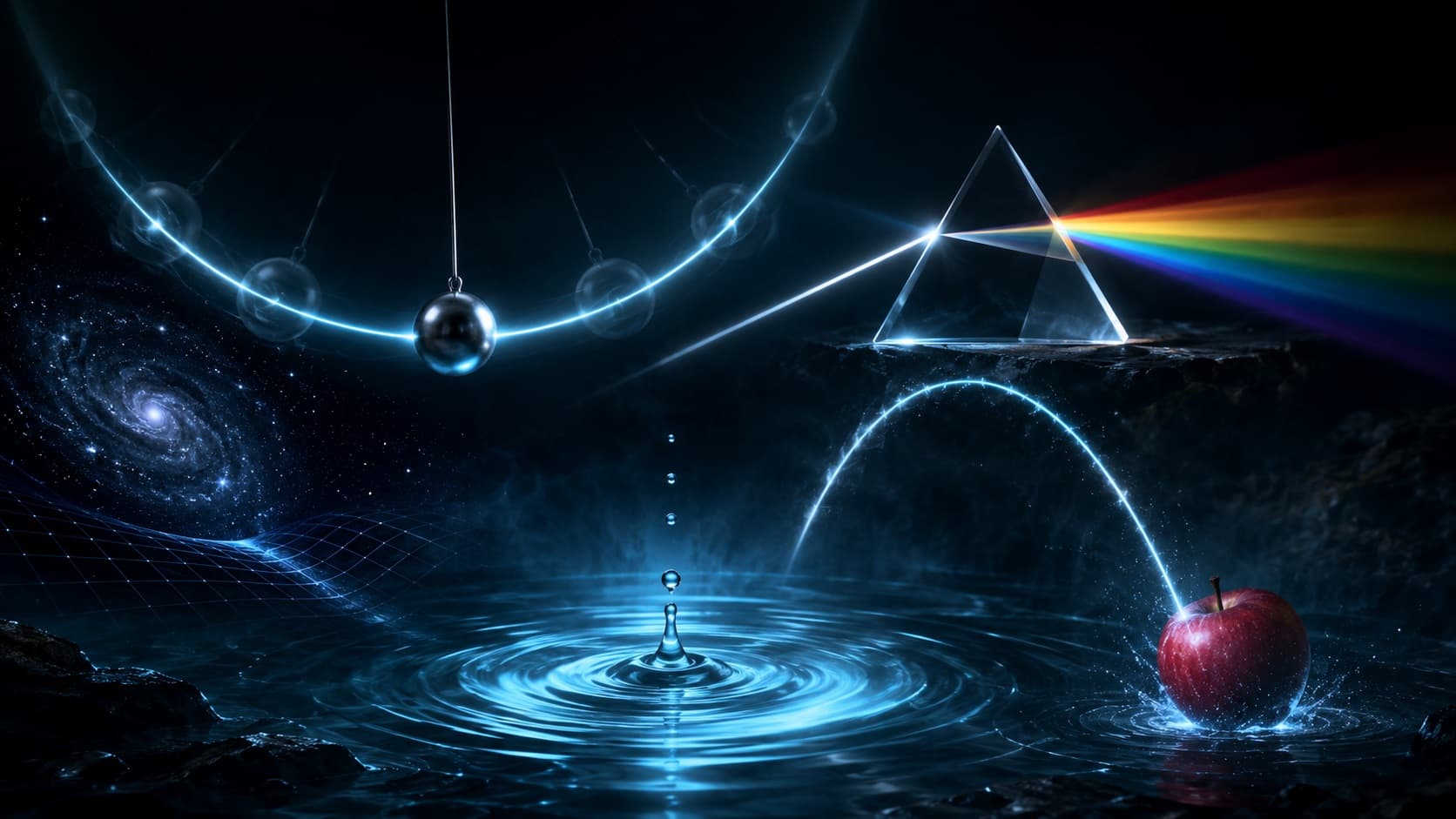
Gravity and cosmology overview
PHYS 101 · Modern Physics Preview
Gravity shapes planets, stars, galaxies, and the universe as a whole. This lesson previews general relativity, black holes, cosmic expansion, dark matter, and dark energy.
Key equations
F = G
rac{m_1m_2}{r^2}v = H_0dLearning objectives
- Describe gravity's role from Earth to cosmic scales.
- Explain general relativity conceptually as curved spacetime.
- Describe black holes and event horizons.
- Summarize cosmic expansion, dark matter, and dark energy.
Gravity on cosmic scales
Gravity is the force that structures the universe. It pulls matter together to form planets, stars, galaxies, and clusters of galaxies. Near Earth, gravity explains falling objects and weight. On larger scales, it explains orbits, tides, stellar formation, and the motion of galaxies.
Newton described gravity as an attractive force between masses. His law of universal gravitation showed that the same physics governing falling apples also governs the Moon's orbit. A simplified form is:
F = G rac{m_1m_2}{r^2}
Here is gravitational force, and are masses, is the distance between their centers, and is the gravitational constant.
General relativity
Einstein's general theory of relativity gives a deeper description of gravity. Instead of treating gravity only as a force, general relativity describes it as the curvature of spacetime caused by mass and energy. Objects move along paths shaped by this curvature.
A common analogy is a heavy ball placed on a stretched rubber sheet, causing the sheet to curve. Smaller balls roll along curved paths nearby. This analogy is imperfect because spacetime is not a rubber sheet, but it helps suggest the idea that mass changes geometry.
General relativity is needed for strong gravity, very precise measurements, and the universe as a whole. It helps explain Mercury's orbit, gravitational time dilation, black holes, gravitational waves, and cosmology.
Black holes
A black hole is a region where gravity is so strong that nothing, not even light, can escape from within a boundary called the event horizon. Black holes can form when massive stars collapse at the end of their lives. Supermassive black holes exist at the centers of many galaxies.
Black holes are not cosmic vacuum cleaners pulling in everything around them. From far away, a black hole's gravity acts like the gravity of any object with the same mass. The unusual effects become extreme near the event horizon.
The expanding universe
Cosmology is the study of the universe as a whole. One of the greatest discoveries in cosmology is that the universe is expanding. Distant galaxies are generally moving away from us, and more distant galaxies recede faster. This pattern is described by Hubble's law:
Here is recession speed, is distance, and is the Hubble constant.
The expansion of the universe supports the Big Bang model, which says the universe was once much hotter and denser and has been expanding and cooling for about 13.8 billion years.
Dark matter and dark energy
Modern cosmology includes mysteries. Galaxies rotate in ways suggesting there is more gravity than visible matter can explain. This unseen source is called dark matter. It does not seem to emit, absorb, or reflect light, but it has gravitational effects.
Dark energy is the name given to whatever is causing the expansion of the universe to accelerate. Together, dark matter and dark energy appear to make up most of the universe's total contents, but their exact nature remains unknown.
The big idea
Gravity connects falling objects to the structure and history of the universe. Newton's gravity works extremely well in many situations, while general relativity gives a deeper picture involving spacetime. Cosmology applies physics to the universe as a whole, revealing expansion, black holes, dark matter, dark energy, and profound open questions.
Sign in to track your progress.
Ask your AI physics guide
Ask anything about Introduction to Physics — Gravity and cosmology overview, or choose a suggested question below.
AI responses are educational and may not be perfectly accurate. Press Enter to send, Shift+Enter for new line.