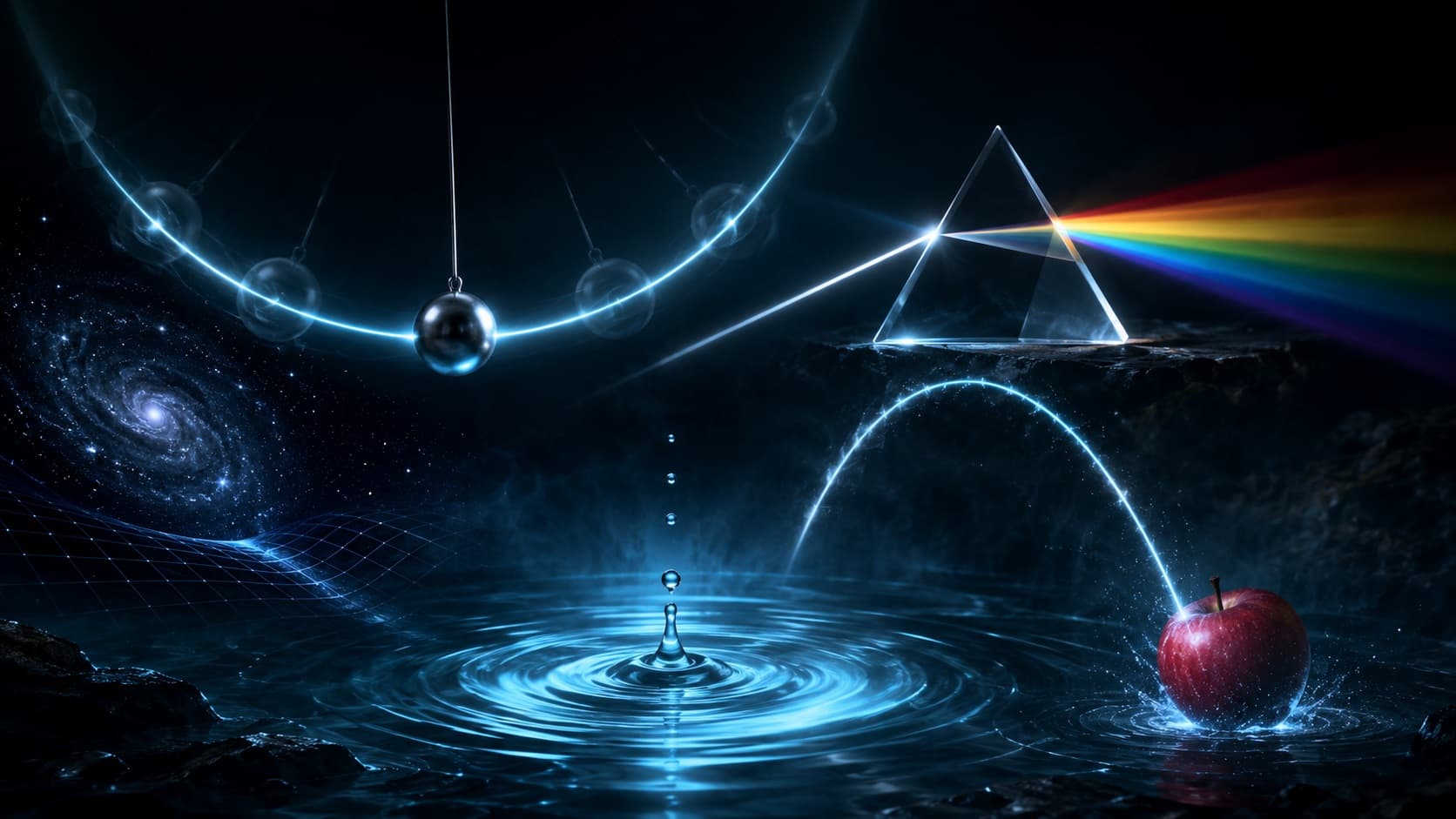
Newton's three laws
PHYS 101 · Motion and Forces
Newton's laws connect forces to motion. This lesson explains inertia, acceleration from net force, and action-reaction pairs in plain language.
Key equations
F_{net} = ma1 N = 1 kgcdot m/s^2Learning objectives
- State Newton's three laws in plain language.
- Explain inertia and net force.
- Use $F_{net}=ma$ conceptually.
- Identify action-reaction force pairs.
Forces and motion
Newton's three laws of motion are among the most important ideas in introductory physics. They explain how forces affect motion and why objects behave as they do when pushed, pulled, dropped, or left alone. A force is a push or pull. Forces can come from contact, such as a hand pushing a box, or from a distance, such as gravity pulling Earth and the Moon toward each other.
The key idea is that motion changes when there is a net force. The net force is the overall force after all forces are combined. If two equal forces push in opposite directions, they cancel. If one force is larger, the net force points in the direction of the larger force.
Newton's first law: inertia
Newton's first law says that an object at rest stays at rest, and an object in motion continues moving at constant velocity, unless acted on by a net external force. This is often called the law of inertia.
Inertia is the tendency of an object to resist changes in its motion. A book resting on a table remains there unless something moves it. A hockey puck sliding on nearly frictionless ice keeps moving much longer than a puck sliding on rough pavement. The difference is not that moving objects naturally need force to keep moving. Rather, rough surfaces provide friction, a force that changes the motion.
This law corrects a common misconception. Motion does not require a continuing force. A change in motion requires a net force.
Newton's second law: force and acceleration
Newton's second law describes how much an object's motion changes when a net force acts on it:
Here is net force, is mass, and is acceleration. The law says that a larger net force produces a larger acceleration, while a larger mass produces a smaller acceleration for the same force.
Mass measures how much inertia an object has. A full shopping cart is harder to accelerate than an empty one because it has more mass. If you push both with the same force, the empty cart accelerates more.
The unit of force is the newton. One newton is the force needed to accelerate a mass at .
Newton's third law: action and reaction
Newton's third law says that when one object exerts a force on a second object, the second object exerts an equal and opposite force on the first. These are action-reaction pairs.
If you push on a wall, the wall pushes back on you with equal force. If a swimmer pushes water backward, the water pushes the swimmer forward. If Earth pulls a falling apple downward, the apple pulls Earth upward with equal force. Earth's acceleration is tiny because its mass is enormous.
Action-reaction forces act on different objects, so they do not cancel each other. This is very important. The force of your hand on a box and the force of the box on your hand are equal and opposite, but one acts on the box and the other acts on your hand.
Using the laws together
Newton's laws work as a system. The first law describes what happens when net force is zero. The second law describes what happens when net force is not zero. The third law reminds us that forces arise from interactions between objects.
These laws explain motion from sports to vehicles to planets. They are simple to state, but learning to apply them carefully takes practice. The most important habit is to identify the object being studied, list the forces on that object, and then reason about the net force.
Sign in to track your progress.
Ask your AI physics guide
Ask anything about Introduction to Physics — Newton's three laws, or choose a suggested question below.
AI responses are educational and may not be perfectly accurate. Press Enter to send, Shift+Enter for new line.