What is physics?
PHYS 101 · The Nature of Physics
Physics is the study of matter, energy, motion, forces, waves, electricity, light, atoms, space, and time. This lesson explains why physics is both practical and deeply connected to everyday experience.
Key equations
v =
rac{d}{t}Learning objectives
- Define physics in broad terms.
- Explain why physics uses models.
- Describe how physics connects everyday observations to general principles.
- Recognize that equations express physical relationships.
What physics studies
Physics is the branch of science that asks how the physical universe works. It studies the basic patterns behind motion, forces, energy, matter, light, sound, electricity, atoms, stars, and even space and time. At first, that list may seem enormous, but the goal of physics is simple: to find clear, testable ideas that explain many different things at once.
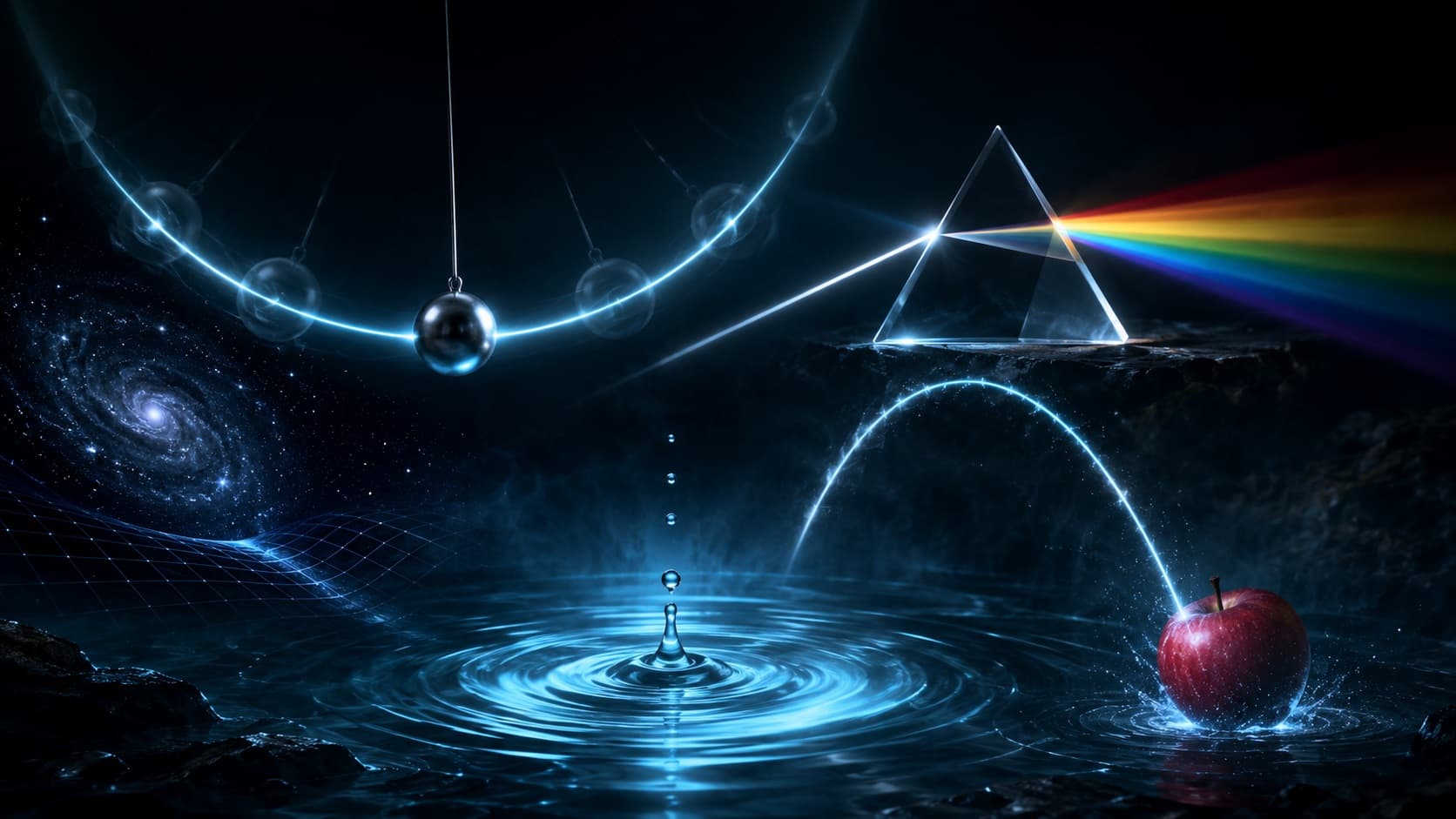
For example, the same idea of force helps explain a pushed shopping cart, a falling apple, a car turning on a road, and the Moon orbiting Earth. The same idea of energy helps explain food, fuel, batteries, roller coasters, sunlight, and heat. Physics looks for these shared principles beneath the surface details.
Physics begins with observation
Physics does not begin with equations. It begins with noticing. A ball speeds up as it falls. A mirror reflects light. A stretched rubber band snaps back. A hot drink cools down. A magnet attracts some metals but not others. These everyday observations raise questions: Why does this happen? Can we predict it? Does it always happen the same way?
Once a question is clear, physicists try to describe it carefully. They measure quantities such as distance, time, mass, temperature, electric charge, and speed. Then they look for patterns. A pattern that can be tested and used to make predictions may become a scientific model or law.
Models are useful simplifications
A physics model is not the real thing itself. It is a simplified way of representing something so we can understand it better. For example, when studying a thrown ball, we might ignore air resistance at first. That does not mean air resistance is imaginary. It means we are starting with a simpler model before adding more detail.
This is one of the most important habits in physics: start simple, understand the main idea, then improve the model. A map is useful even though it is not the same as the city. In the same way, a physics model is useful when it captures the important features of a situation.
Physics connects concepts and mathematics
Physics often uses mathematics because math is a precise language for patterns. If an object travels the same distance every second, we can describe its motion with an equation such as , where is speed, is distance, and is time. The equation is not just a symbol puzzle. It says that speed compares how much distance is covered to how much time passes.
In a foundations course, the most important goal is not memorizing equations. The goal is understanding what the equations mean. A formula is a compact sentence about nature.
Why physics matters
Physics is behind technologies such as phones, cameras, bridges, satellites, medical imaging, electric power, engines, speakers, glasses, lasers, and computers. It also helps us understand natural events such as rainbows, tides, earthquakes, lightning, seasons, stars, and galaxies.
But physics matters for another reason: it teaches a way of thinking. Physics trains you to separate evidence from guesses, to define words carefully, to estimate, to check units, and to ask whether an explanation can be tested. These habits are useful far beyond science.
The big idea
Physics is not just a list of facts. It is a disciplined way of asking questions about the physical world. It combines observation, measurement, models, experiments, and reasoning. The universe may be complicated, but physics shows that many parts of it follow patterns we can discover, describe, and use.
Sign in to track your progress.
Ask your AI physics guide
Ask anything about Introduction to Physics — What is physics?, or choose a suggested question below.
AI responses are educational and may not be perfectly accurate. Press Enter to send, Shift+Enter for new line.