Color and basic optics
PHYS 101 · Waves Light and Sound
Color comes from the wavelengths of light that objects emit, reflect, transmit, or absorb. This lesson introduces reflection, refraction, lenses, prisms, and how eyes see color.
Key equations
heta_i = heta_rLearning objectives
- Explain color in terms of visible wavelengths.
- Distinguish emission, reflection, absorption, and transmission.
- State the law of reflection conceptually.
- Describe refraction and how lenses use it.
What color means
Color is our brain's interpretation of different wavelengths of visible light. Red light has relatively long wavelengths, violet light has shorter wavelengths, and other visible colors lie between. When many wavelengths enter the eye together, we may see white light. When little visible light enters the eye, we see darkness or black.
Objects have color because of how they interact with light. A red shirt looks red under white light because it reflects red wavelengths strongly and absorbs many others. A blue object reflects blue wavelengths. A black object absorbs most visible light, while a white object reflects most visible wavelengths.
Emission, reflection, and transmission
Some objects emit light, meaning they produce it. The Sun, flames, phone screens, and light bulbs emit light. Most everyday objects are seen by reflection. They do not make their own light; they redirect light from a source.
Transparent materials transmit light, allowing it to pass through. Clear glass transmits much visible light. Colored glass transmits some wavelengths more than others and absorbs the rest. This is why a red filter lets mostly red light through.
Reflection
Reflection occurs when light bounces off a surface. A smooth mirror produces regular reflection, where incoming parallel rays reflect in an organized way. This allows clear images. A rough wall produces diffuse reflection, scattering light in many directions. This is why you can see the wall from many angles but do not see a clear mirror image.
The law of reflection says:
The angle of incidence equals the angle of reflection, measured from an imaginary line perpendicular to the surface called the normal.
Refraction
Refraction is the bending of light as it passes from one material into another, such as from air into water or glass. Light changes speed in different materials. When it enters at an angle, this speed change causes the path to bend.
Refraction explains why a straw in a glass of water looks bent. Light from the underwater part of the straw changes direction as it leaves water and enters air, so your brain traces the light backward to an apparent position.
Lenses and images
Lenses use refraction to bend light in controlled ways. A converging lens brings light rays together and can form real images. Magnifying glasses, cameras, eyeglasses, microscopes, and telescopes all use lenses or mirrors to redirect light.
The human eye also uses a lens. Light enters through the cornea and pupil, then the lens helps focus it onto the retina. Cells in the retina respond to light and send signals to the brain.
Prisms and rainbows
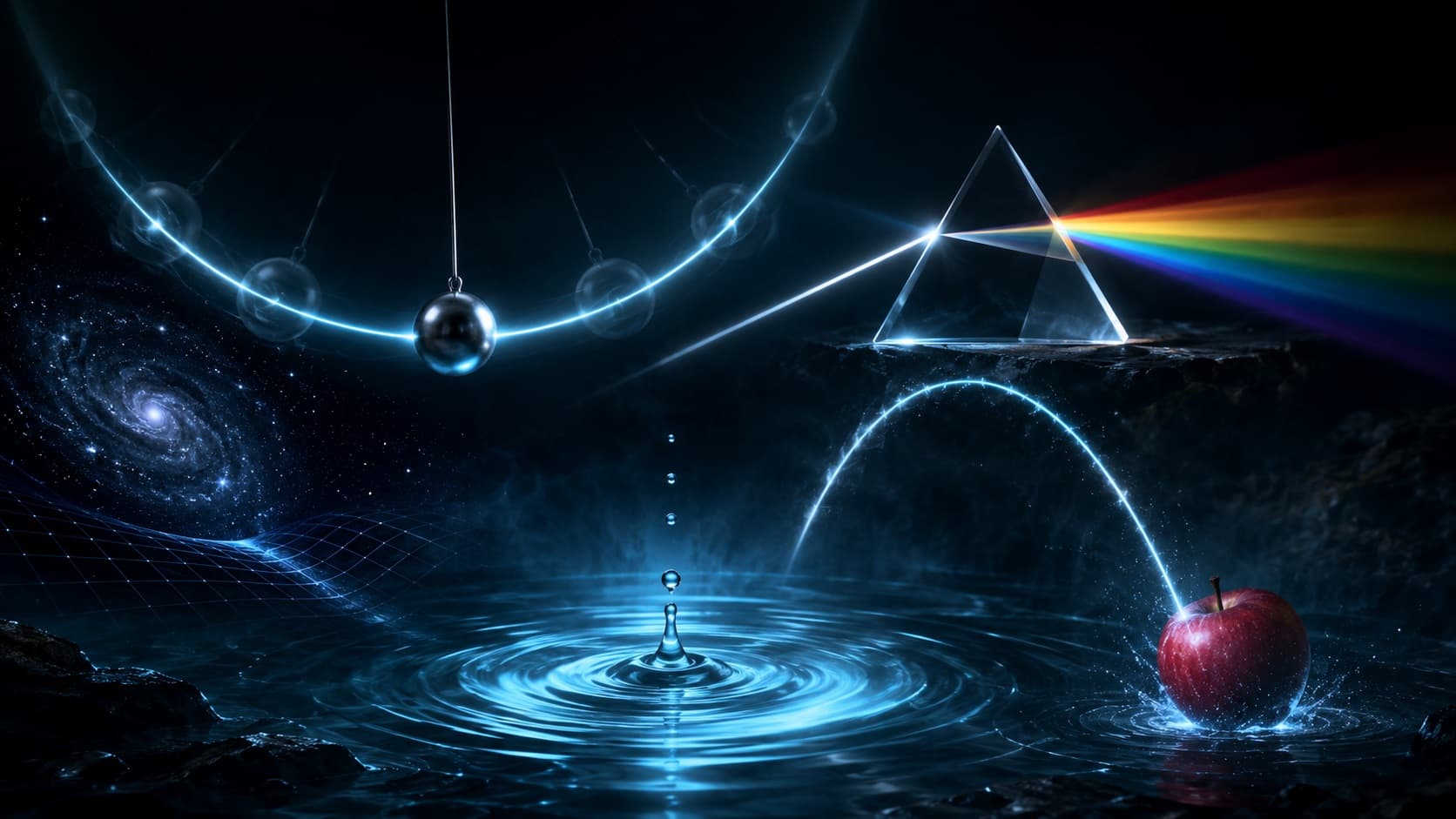
A prism separates white light into colors because different wavelengths bend by slightly different amounts in glass. This spreading of colors is called dispersion. Rainbows form when sunlight enters water droplets, reflects inside them, and refracts back out. The droplets act somewhat like tiny prisms.
Color mixing
Light colors mix differently from paint colors. Red, green, and blue light can combine to make many colors on screens. Combining red, green, and blue light at full intensity appears white. Paints and inks work by absorbing wavelengths, so mixing pigments usually removes more light and tends toward darker colors.
The big idea
Color depends on wavelengths of light and how matter emits, reflects, transmits, or absorbs them. Optics is the study of light behavior, including reflection and refraction. These ideas explain mirrors, lenses, glasses, cameras, rainbows, screens, and human vision.
Sign in to track your progress.
Up next · Module 5
Electricity and Atoms
This module connects electric charge, circuits, and atomic structure. Students learn how charges interact, how simple circuits work, and how atoms and the periodic table organize matter.
Ask your AI physics guide
Ask anything about Introduction to Physics — Color and basic optics, or choose a suggested question below.
AI responses are educational and may not be perfectly accurate. Press Enter to send, Shift+Enter for new line.