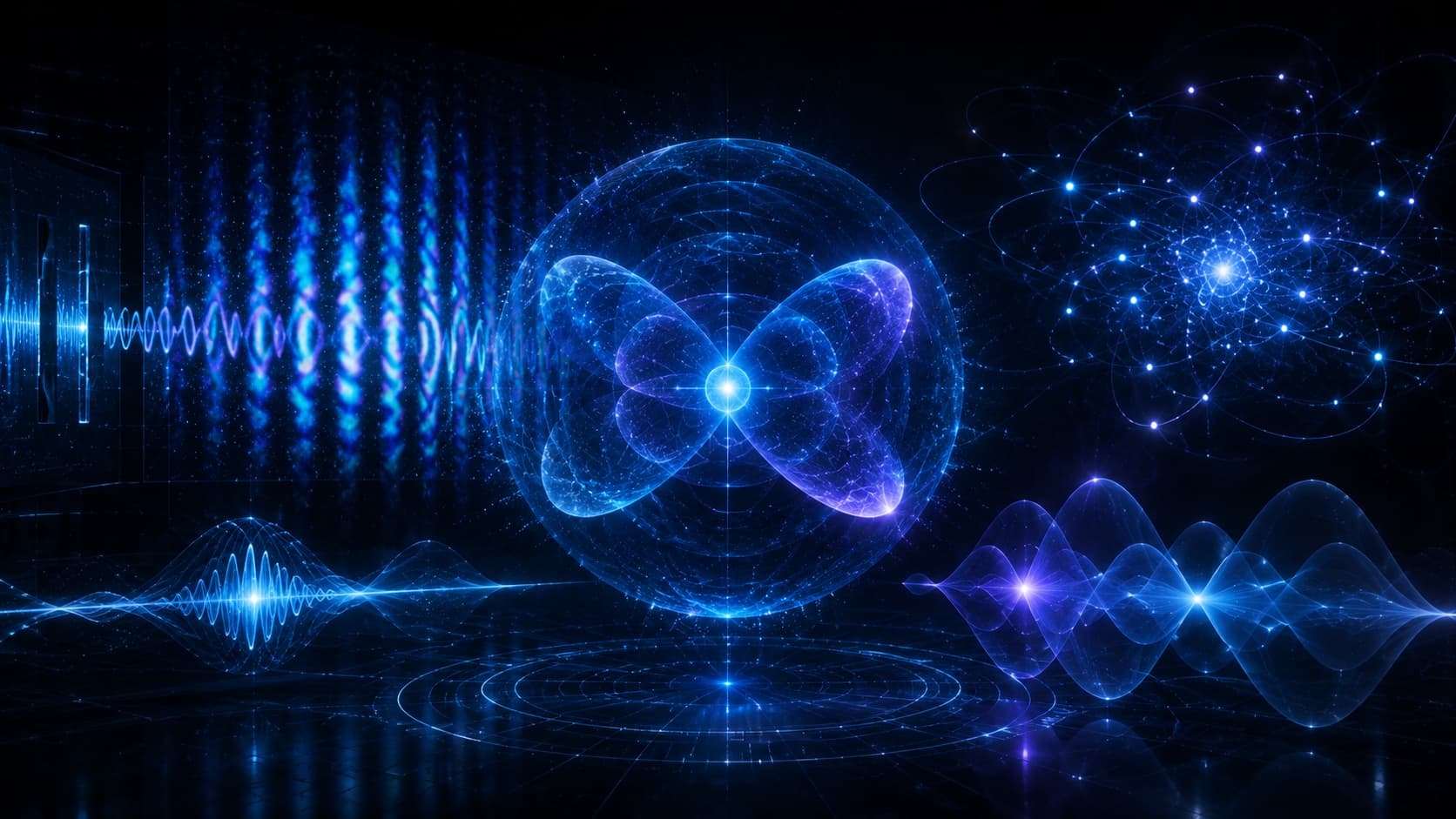
de Broglie and matter waves
PHYS 410 · Origins of Quantum Theory
de Broglie proposed that matter has wave properties with wavelength $lambda=h/p$. This lesson introduces matter waves, electron diffraction, and the wave-particle duality of material particles.
Key equations
lambda=
rac{h}{p}p=mvlambda=
rac{h}{mv}2dsin heta=nlambdaK=eVK=
rac{p^2}{2m_e}p=sqrt{2m_e eV}lambda=
rac{h}{sqrt{2m_e eV}}v_g=
rac{domega}{dk}Learning objectives
- State de Broglie's matter-wave hypothesis.
- Calculate de Broglie wavelength for nonrelativistic particles.
- Explain electron diffraction evidence.
- Apply de Broglie wavelength to accelerated electrons.
- Connect matter waves to wave packets and uncertainty.
Symmetry between light and matter
By the early twentieth century, light had shown both wave and particle behavior. It interfered and diffracted like a wave, yet the photoelectric effect and Compton scattering showed photon-like energy and momentum.
Louis de Broglie proposed a bold symmetry: if waves can behave like particles, perhaps particles can behave like waves. He suggested that a particle with momentum has wavelength
lambda= rac{h}{p}
This is the de Broglie wavelength.
Nonrelativistic matter wavelength
For a nonrelativistic particle of mass moving at speed ,
so
lambda= rac{h}{mv}
For everyday objects, is large, so is fantastically small and unobservable. For electrons, atoms, and molecules, the wavelength can be comparable to atomic spacings, making wave effects measurable.
Electron diffraction
The Davisson-Germer experiment confirmed de Broglie's hypothesis by showing electron diffraction from a crystal. A crystal lattice has regularly spaced planes of atoms, similar to a three-dimensional diffraction grating. Electrons scattered from the crystal produced intensity maxima consistent with wave interference.
Constructive interference from crystal planes obeys Bragg's law:
where is plane spacing. The observed electron diffraction pattern matched the de Broglie wavelength.
Electrons accelerated through voltage
If an electron is accelerated from rest through potential difference , it gains kinetic energy
Nonrelativistically,
K= rac{p^2}{2m_e}
so
and
lambda= rac{h}{sqrt{2m_e eV}}
This relationship is used in electron diffraction and electron microscopy.
Matter waves are not ordinary material waves
The de Broglie wave is not a little physical ripple in a substance like a water wave. In modern quantum mechanics, it is related to the wavefunction, whose squared magnitude gives probability density.
This interpretation was developed after de Broglie's proposal. The wave nature of matter is not merely a metaphor; it produces measurable interference and diffraction.
Wave packets
A particle localized in space is represented not by a single infinite sinusoidal wave but by a wave packet: a superposition of waves with different wavelengths. The packet can be localized, while the spread of wavelengths relates to momentum uncertainty.
This leads naturally to the uncertainty principle. A sharply localized particle requires many wave components, which means uncertain momentum.
Phase and group velocity
For matter waves, the phase velocity and group velocity differ. The physically relevant speed of a localized particle is the group velocity:
v_g= rac{domega}{dk}
For a nonrelativistic free particle, the group velocity equals the particle velocity.
The big idea
de Broglie's hypothesis extended wave-particle duality to matter. A particle with momentum has wavelength . Electron diffraction confirmed this idea, and matter waves became a foundation for Schrödinger's wave mechanics. Quantum objects are neither classical particles nor classical waves, but entities described by wavefunctions and probabilities.
Sign in to track your progress.
Up next · Module 2
The Wavefunction and Schrödinger Equation
This module introduces the wavefunction as the central object of nonrelativistic quantum mechanics. Students study the Schrödinger equation, Born rule, normalization, inner products, and the uncertainty principle.
Ask your AI physics guide
Ask anything about Quantum Mechanics — de Broglie and matter waves, or choose a suggested question below.
AI responses are educational and may not be perfectly accurate. Press Enter to send, Shift+Enter for new line.