Introduction
Maxwell’s Demon is one of the most important thought experiments in thermodynamics because it asks whether the second law of thermodynamics is absolute or statistical. At first glance, the demon appears to create order from disorder without paying an energy cost. The puzzle forced physicists to think more carefully about what entropy means and eventually helped connect thermodynamics with information theory.
The Setup
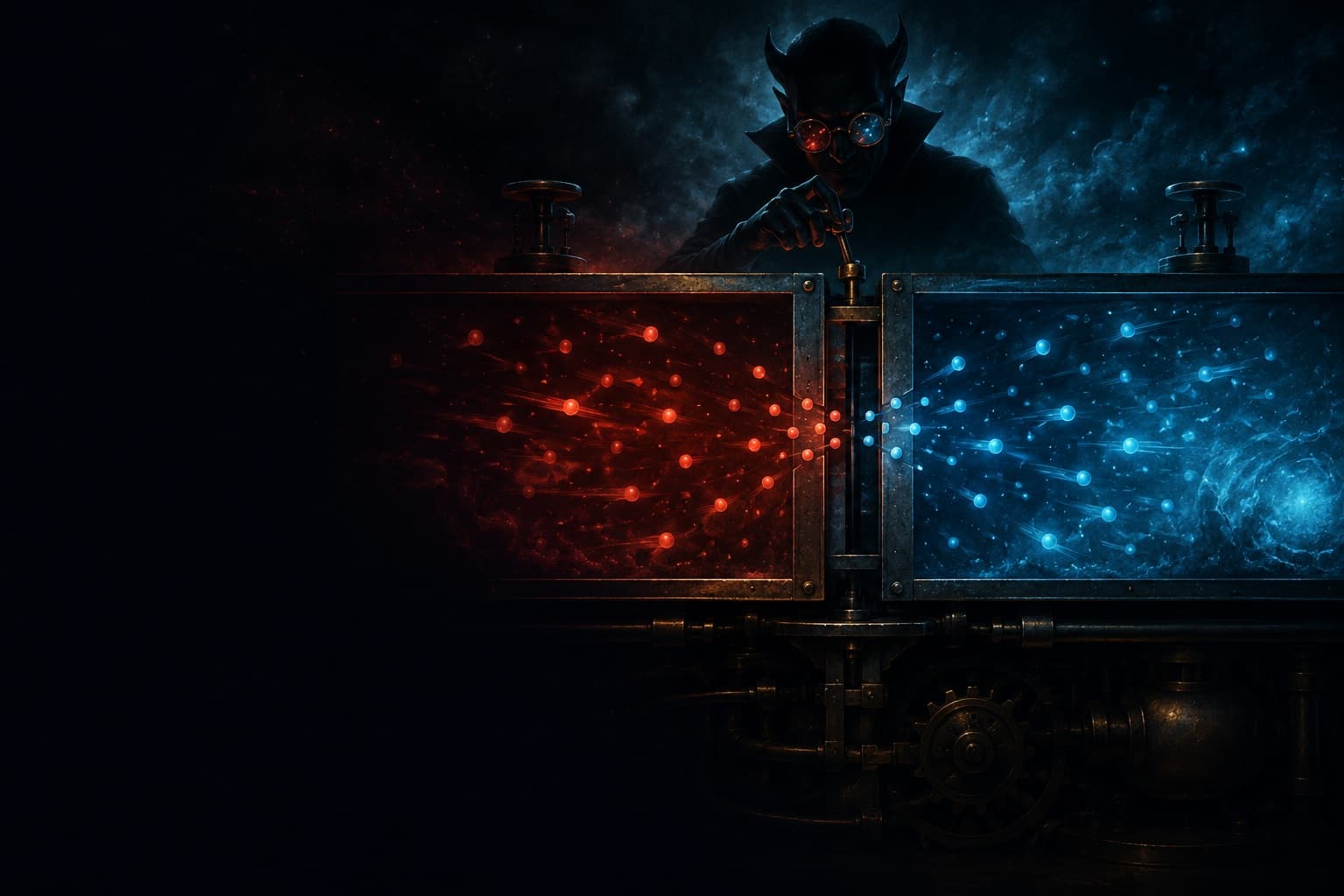
Imagine a box of gas divided into two chambers by a wall with a tiny door. The gas molecules move randomly, with some molecules traveling faster and others slower. A tiny intelligent being, later called Maxwell’s Demon, watches the molecules approach the door. When a fast molecule comes from the left side, the demon opens the door and lets it pass to the right. When a slow molecule comes from the right side, the demon opens the door and lets it pass to the left. Over time, the right chamber becomes filled with faster, hotter molecules, while the left chamber becomes filled with slower, colder molecules. The demon seems to create a temperature difference without doing ordinary mechanical work.
The Paradox or Question
The central question is whether information can be used to decrease entropy in an isolated system. If the demon can sort molecules by speed without expending energy, then heat would appear to flow from cold to hot, and a useful temperature difference could be created from random motion. That would seem to violate the second law of thermodynamics, which states that the total entropy of an isolated system should not decrease.
How It Changed Physics
The modern resolution is that the demon is not outside physics. To sort molecules, the demon must observe them, store information about their speeds and positions, and eventually erase or reset its memory. These information-processing steps have thermodynamic consequences. In particular, erasing information carries an entropy cost, often associated with Landauer’s principle. When the demon, its memory, and the gas are treated as one complete physical system, the apparent decrease in entropy is balanced or exceeded by entropy produced elsewhere. Maxwell’s Demon therefore does not defeat the second law; instead, it reveals that information is physical.
Historical Context
James Clerk Maxwell introduced the idea in the 19th century while physicists were developing the kinetic theory of gases and statistical mechanics. Thermodynamics had already established powerful laws about heat, work, and entropy, but the microscopic interpretation of those laws was still developing. Maxwell’s Demon challenged physicists to explain how irreversible macroscopic behavior could arise from the reversible motion of individual molecules. Later work by Leo Szilard, Rolf Landauer, Charles Bennett, and others connected the demon to information, computation, and the physical limits of measurement and memory.
Related Physics Concepts
Relevance Today
Maxwell’s Demon remains highly relevant because modern physics treats information as a physical quantity. The thought experiment appears in discussions of computation, nanoscale machines, quantum information, thermodynamic limits of computing, and the physics of memory. It also helps explain why real-world engines, computers, and measuring devices cannot escape thermodynamic costs. In modern research, versions of Maxwell’s Demon are studied in quantum systems, feedback-controlled devices, molecular machines, and information engines, making the thought experiment a bridge between classical thermodynamics and modern information physics.
Related GuidedPhysics Courses
thermodynamics and statistical mechanics
Explore core ideas connected to this thought experiment.
quantum mechanics
Explore core ideas connected to this thought experiment.
information theory
Explore core ideas connected to this thought experiment.
modern physics
Explore core ideas connected to this thought experiment.
introductory physics
Explore core ideas connected to this thought experiment.
