Introduction
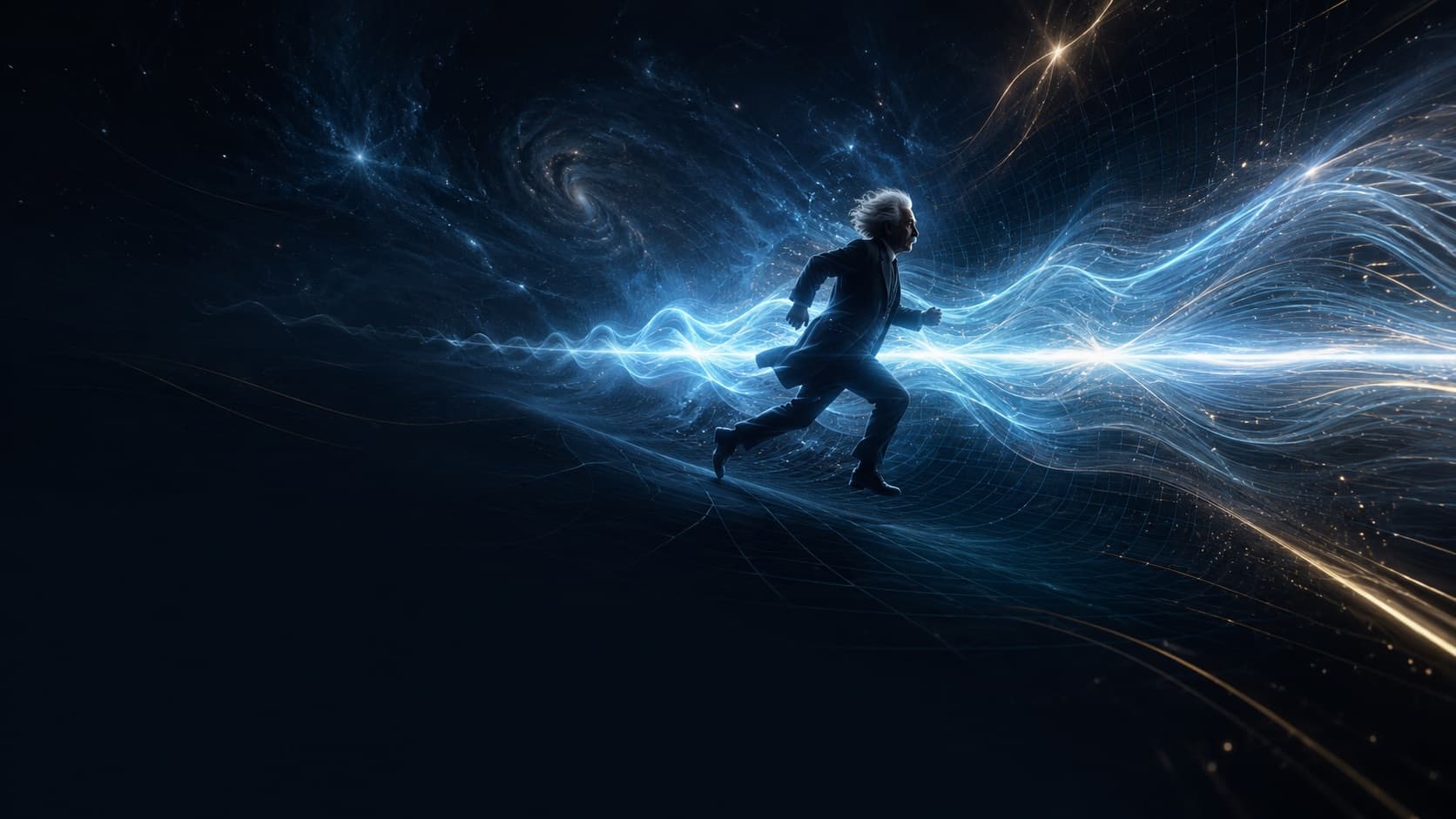
Einstein Chasing a Light Beam is one of the most powerful examples of how a simple mental image can transform physics. The question sounds almost childlike: What would I see if I could run alongside a beam of light? Yet this question exposed a deep conflict between Newtonian ideas of motion and Maxwell’s theory of electromagnetism. Einstein’s attempt to resolve that conflict helped lead to special relativity.
The Setup
Imagine a person traveling through space at the same speed as a beam of light. In everyday thinking, if you move at the same speed as something else, that object appears at rest relative to you. A car traveling beside another car at the same speed appears nearly stationary from the first car’s perspective. Applying that logic to light, Einstein wondered whether a light wave would appear frozen if he could move alongside it. Such a frozen wave would have electric and magnetic fields suspended in space, no longer propagating forward.
The Paradox or Question
The central question is whether light can ever be observed at rest. Newtonian velocity addition suggests that a sufficiently fast observer could catch up to light and see it standing still. But Maxwell’s equations describe light as a self-propagating electromagnetic wave that travels at a fixed speed in vacuum. They do not describe a physically valid frozen light wave. The paradox is that classical mechanics seems to permit something that electromagnetism appears to forbid.
How It Changed Physics
Einstein’s resolution was radical: the speed of light in vacuum is the same for all inertial observers, regardless of the motion of the source or observer. No observer with mass can catch a beam of light or see it frozen. To preserve this principle, space and time themselves must change between observers. Moving clocks run slow, moving lengths contract, and simultaneity becomes relative. The thought experiment therefore points directly toward special relativity, where the speed of light is not just the speed of a particular object but a fundamental structure of spacetime.
Historical Context
In the late 19th century, physicists had two extremely successful theories: Newtonian mechanics and Maxwell’s electromagnetism. Newtonian mechanics assumed absolute time and used ordinary velocity addition, while Maxwell’s equations predicted electromagnetic waves traveling at a fixed speed. Many physicists tried to explain this using the idea of a luminiferous ether, a medium through which light supposedly moved. Einstein took a different path. Rather than preserving absolute space and time, he treated the speed of light and the laws of physics as the same for all inertial observers.
Related Physics Concepts
Relevance Today
Einstein’s light beam thought experiment remains central to understanding modern physics. Special relativity is essential for particle accelerators, high-energy physics, relativistic astronomy, nuclear physics, and the behavior of objects moving close to the speed of light. It also underlies technologies that require precise timing and relativistic corrections, including GPS. Beyond its technical importance, the thought experiment shows how a conceptual conflict between two theories can lead to a deeper understanding of reality.
Related GuidedPhysics Courses
special relativity
Explore core ideas connected to this thought experiment.
electricity and magnetism
Explore core ideas connected to this thought experiment.
modern physics
Explore core ideas connected to this thought experiment.
classical mechanics
Explore core ideas connected to this thought experiment.
introductory physics
Explore core ideas connected to this thought experiment.
