Introduction
Einstein’s Train and Lightning thought experiment reveals one of the strangest and most important lessons of special relativity: simultaneity is not absolute. Before Einstein, people generally assumed that if two events happened at the same time, everyone in the universe could agree on that fact. Einstein showed that this assumption fails when observers are moving relative to one another.
The Setup
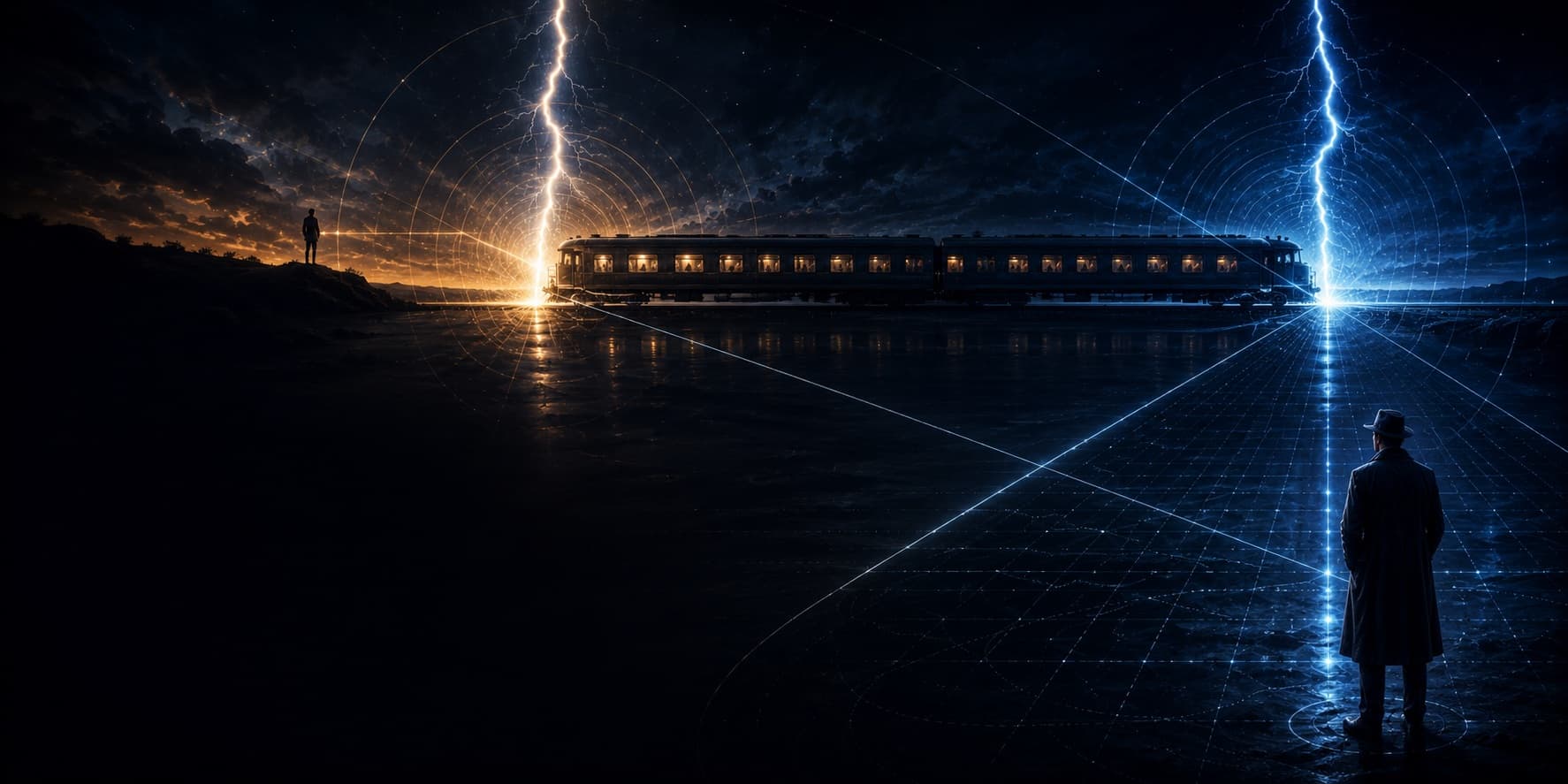
Imagine a long train moving at high speed past a station platform. Just as the midpoint of the train passes an observer standing on the platform, lightning strikes both the front and the back of the train. The platform observer is exactly halfway between the two strike locations on the ground. If light from both strikes reaches the platform observer at the same moment, the platform observer concludes that the strikes were simultaneous. Now consider an observer sitting at the midpoint of the moving train. During the time the light is traveling, the train observer moves toward the light coming from the front strike and away from the light coming from the rear strike. Because light travels at the same speed in both directions, the train observer receives the flashes at different times.
The Paradox or Question
The central question is whether two distant events that are simultaneous for one observer must also be simultaneous for another observer moving relative to the first. In everyday life, the answer seems obvious: time should be universal. But if the speed of light is the same for all inertial observers, then the order and timing of distant events can depend on the observer’s frame of reference.
How It Changed Physics
The resolution is that simultaneity is relative. The platform observer and the train observer can both be correct within their own frames of reference. The platform observer judges the lightning strikes to be simultaneous because the light from both strikes travels equal distances to reach them at the same time. The train observer, however, is moving while the light travels and therefore receives one flash before the other. Since the speed of light is invariant, the train observer concludes that one strike occurred before the other. This does not mean reality is inconsistent; it means time and space are linked differently for observers in relative motion. The thought experiment helps explain why special relativity requires a four-dimensional spacetime rather than a single universal clock.
Historical Context
Einstein introduced this kind of reasoning in the context of special relativity, published in 1905. At the time, physics was struggling to reconcile Newtonian mechanics with Maxwell’s electromagnetism. The assumption that time was absolute had worked well at ordinary speeds, but it conflicted with the constant speed of light. Einstein’s train examples made the new theory understandable by showing that familiar concepts such as same time depend on how observers synchronize clocks and measure light signals.
Related Physics Concepts
Relevance Today
Einstein’s Train and Lightning remains one of the clearest ways to understand special relativity. The relativity of simultaneity is essential in high-speed particle physics, relativistic astronomy, satellite timing, and any system where precise synchronization matters. Modern technologies such as GPS depend on relativistic corrections, including effects related to time and motion. The thought experiment also has deep philosophical importance because it shows that time is not a universal background shared equally by all observers, but part of a spacetime structure shaped by motion.
Related GuidedPhysics Courses
special relativity
Explore core ideas connected to this thought experiment.
modern physics
Explore core ideas connected to this thought experiment.
classical mechanics
Explore core ideas connected to this thought experiment.
electricity and magnetism
Explore core ideas connected to this thought experiment.
introductory physics
Explore core ideas connected to this thought experiment.
