Introduction
The Falling Elevator reframes what we mean by weight. It shows that the sensation of weight is often the result of support forces, not gravity itself.
The Setup
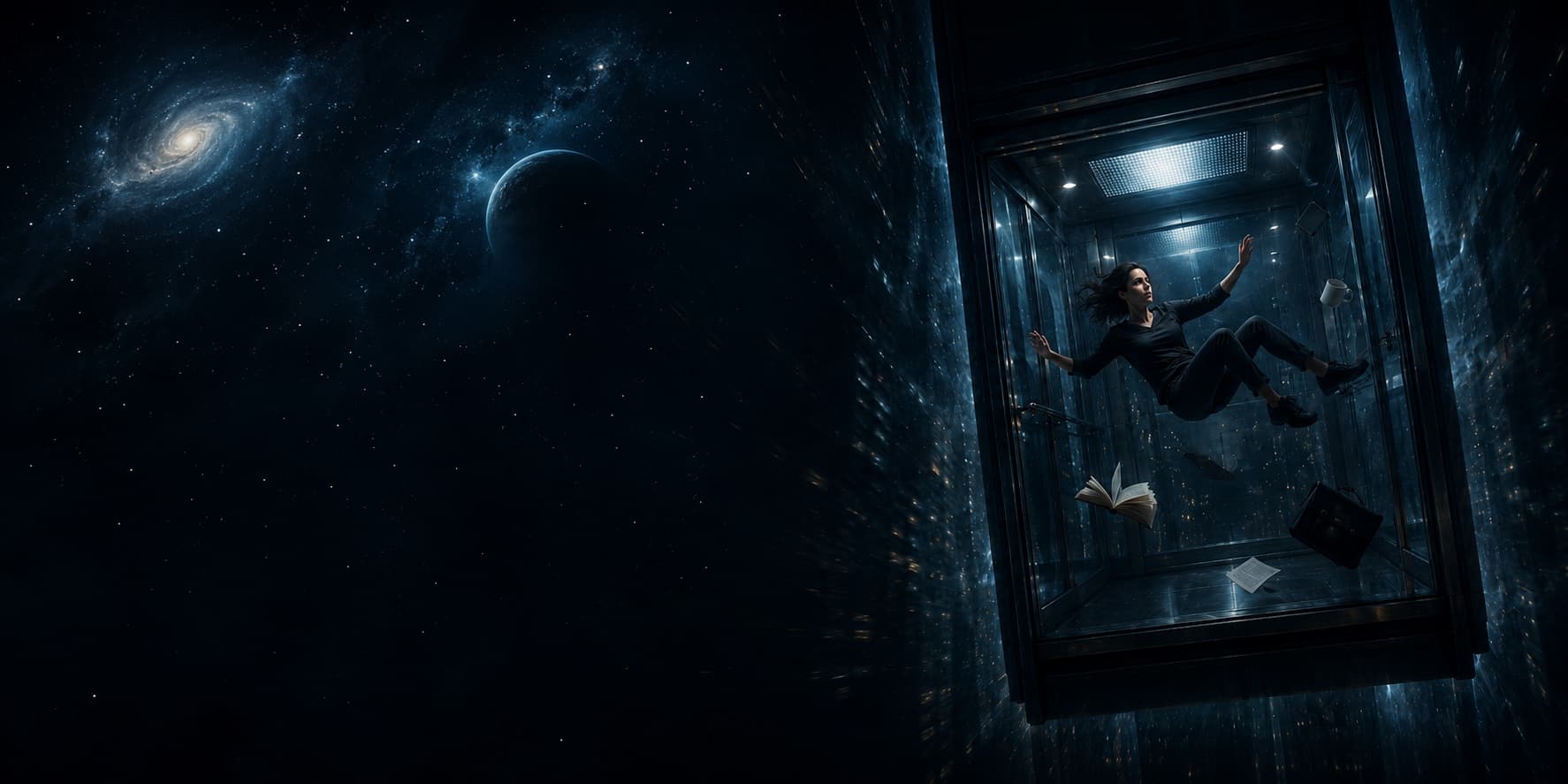
Imagine a sealed elevator dropped in a gravitational field. A person inside releases a ball, and both person and ball accelerate together. Relative to the cabin, the ball appears to hover or drift, producing a local weightless environment.
The Paradox or Question
How can gravity be present while occupants feel weightless? If gravity is pulling everything downward, why is there no local sense of downward force?
How It Changed Physics
In free fall, all nearby objects share nearly the same gravitational acceleration, so relative acceleration between them is small. Locally, the frame behaves like an inertial frame. This supports Einstein’s view that gravity is geometry: free-fall bodies follow natural spacetime paths and feel no force in the local frame.
Historical Context
Einstein used free-fall arguments extensively while developing general relativity. The conceptual distinction between support-force weight and gravitational acceleration became central to interpreting orbital motion and curved-spacetime dynamics.
Related Physics Concepts
Relevance Today
The Falling Elevator concept explains microgravity in spacecraft and the International Space Station. It is crucial in astronautics, gravitational physics education, and interpretation of tidal effects. It also underpins practical modeling of satellite dynamics and relativistic gravitational phenomena.
Related GuidedPhysics Courses
general relativity
Explore core ideas connected to this thought experiment.
special relativity
Explore core ideas connected to this thought experiment.
astrophysics and cosmology
Explore core ideas connected to this thought experiment.
classical mechanics
Explore core ideas connected to this thought experiment.
