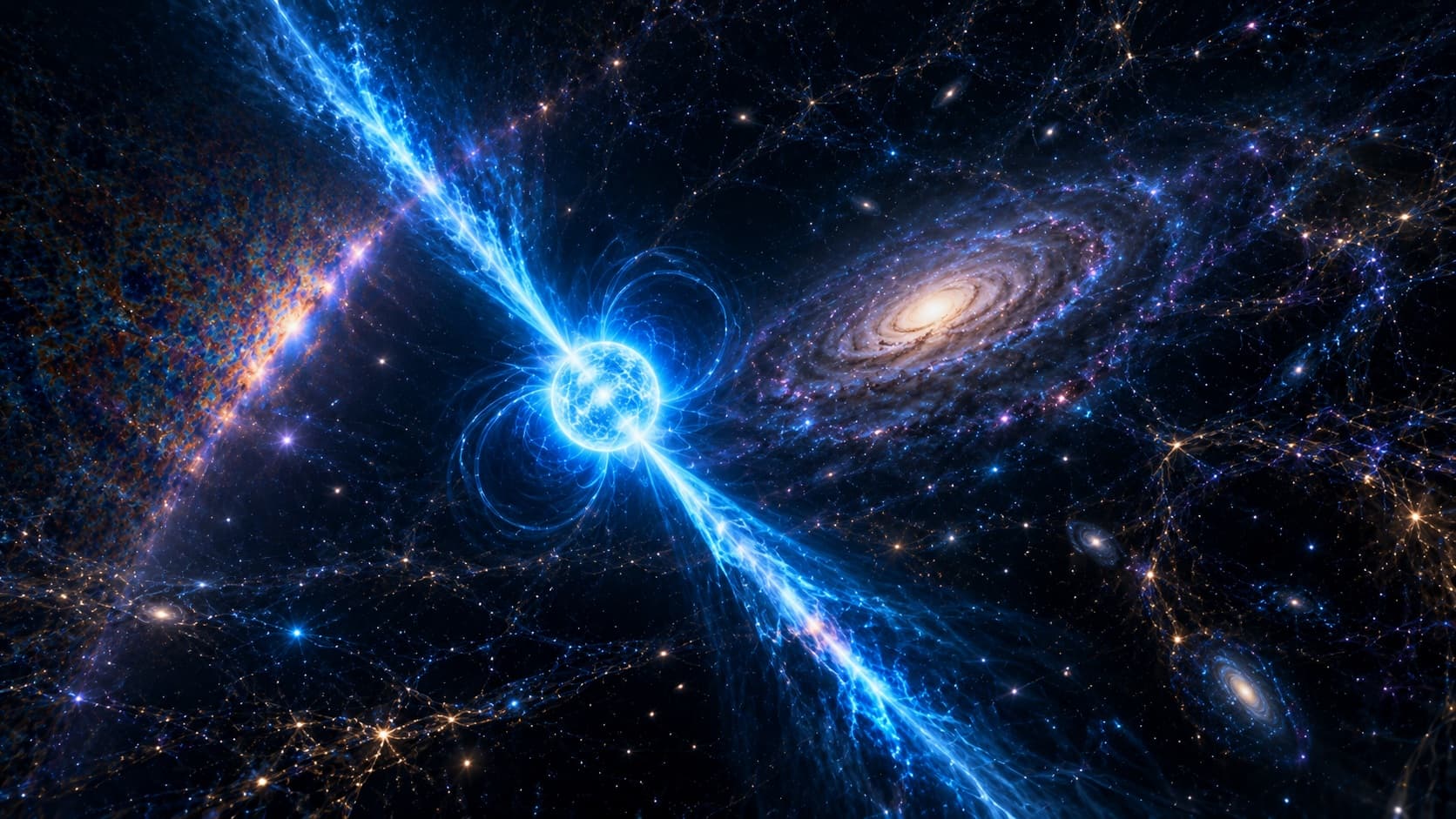
Stellar evolution from birth to death
PHYS 501 · Stellar Physics
A star's life is controlled mainly by its mass. This lesson follows stars from molecular clouds to protostars, main-sequence life, red giant phases, supernovae, and stellar remnants.
Key equations
t_{MS}sim
rac{M}{L}Learning objectives
- Describe star formation in molecular clouds.
- Explain how protostars reach the main sequence.
- Relate stellar mass to lifetime and evolution.
- Compare the deaths of Sun-like and massive stars.
- Explain how stellar evolution enriches the universe with heavy elements.
Birth in molecular clouds
Stars form in cold, dense molecular clouds. Gravity pulls gas and dust together, but collapse begins only when gravity overcomes pressure, turbulence, and magnetic support. A rough criterion for gravitational collapse is the Jeans mass. Regions more massive than this can become unstable.
As a cloud fragment collapses, gravitational potential energy turns into heat. The central object becomes a protostar surrounded by an accretion disk.
Protostars and ignition
A protostar shines mostly from gravitational contraction, not nuclear fusion. As it contracts, its core temperature rises. When the core becomes hot and dense enough for sustained hydrogen fusion, the star reaches the main sequence.
Hydrostatic equilibrium and thermal equilibrium then stabilize the star for a long period.
Main-sequence life
During the main sequence, a star fuses hydrogen into helium in its core. Its mass determines luminosity, temperature, and lifetime. Low-mass stars burn slowly and can last for tens or hundreds of billions of years. High-mass stars burn intensely and may live only millions of years.
The main-sequence lifetime roughly follows
t_{MS}sim rac{M}{L}
Because luminosity increases steeply with mass, massive stars die young.
Low- and intermediate-mass stars
When a Sun-like star exhausts hydrogen in its core, the core contracts while hydrogen fusion continues in a shell. The outer layers expand and cool, forming a red giant.
Eventually helium fusion begins, converting helium into carbon and oxygen. Later, the star may enter the asymptotic giant branch, lose its outer layers, and create a planetary nebula. The exposed core becomes a white dwarf.
The final remnant is supported by electron degeneracy pressure.
Massive stars
Massive stars can fuse heavier elements after helium burning. They develop layered interiors, sometimes compared to an onion, with different fusion shells. Fusion can proceed up to iron-group elements.
Iron fusion does not release energy. Once an iron core grows too massive, it collapses. The collapse triggers a core-collapse supernova, leaving a neutron star or black hole and ejecting heavy elements into space.
Supernovae and enrichment
Supernovae are crucial for chemical evolution. They disperse elements made inside stars and create additional heavy elements through neutron capture. The calcium in bones, iron in blood, and oxygen we breathe were forged in earlier generations of stars.
Stellar death enriches interstellar gas, enabling later stars, planets, and life.
Binary evolution
Many stars are in binary systems. Mass transfer between companions can dramatically alter evolution. A white dwarf gaining matter from a companion may explode as a Type Ia supernova if conditions lead to runaway thermonuclear burning.
Binary interactions also produce X-ray binaries, novae, neutron-star mergers, and gravitational-wave sources.
The big idea
Stellar evolution is mainly a story of gravity, pressure, nuclear fuel, and mass. Stars form from collapsing clouds, live by hydrogen fusion, and die as white dwarfs, neutron stars, or black holes. Their life cycles create and distribute the elements that make planets and living systems possible.
Sign in to track your progress.
Up next · Module 3
Compact Objects
This module explores the extreme remnants of stellar evolution. Students study white dwarfs, neutron stars, black holes, and the conceptual quantum-gravity idea of Hawking radiation.
Ask your AI physics guide
Ask anything about Astrophysics and Cosmology — Stellar evolution from birth to death, or choose a suggested question below.
AI responses are educational and may not be perfectly accurate. Press Enter to send, Shift+Enter for new line.