Energy stored in electric fields
PHYS 301 · Conductors and Capacitors
Capacitors store energy in their electric fields. This lesson derives capacitor energy formulas and introduces electric field energy density.
Key equations
V=\frac{q}{C}dW=V\,dq=\frac{q}{C}dqU=\int_0^Q \frac{q}{C}dq=\frac{Q^2}{2C}Q=CVU=\frac{Q^2}{2C}U=\frac{1}{2}QVU=\frac{1}{2}CV^2C=\frac{\epsilon_0 A}{d}V=EdU=\frac{1}{2}\epsilon_0 E^2(Ad)u_E=\frac{1}{2}\epsilon_0 E^2u_E=\frac{1}{2}\epsilon E^2U=\int \frac{1}{2}\epsilon_0 E^2\,dVLearning objectives
- Derive capacitor energy from charging work.
- Use equivalent capacitor energy formulas.
- Explain energy storage in the electric field.
- Calculate electric field energy density.
- Discuss energy accounting with batteries and capacitors.
Work required to charge a capacitor
Charging a capacitor requires work. At first, when there is little charge on the plates, moving additional charge requires little work. As charge accumulates, the voltage rises, and moving more charge requires more work.
For a capacitor,
V= rac{q}{C}
where is the charge already on the capacitor at an intermediate stage. The small work needed to add charge is
dW=V,dq= rac{q}{C}dq
Integrating from to gives
U=int_0^Q rac{q}{C}dq= rac{Q^2}{2C}
This work becomes energy stored in the capacitor.
Equivalent energy formulas
Using , the stored energy can be written in several equivalent forms:
U= rac{Q^2}{2C}
U= rac{1}{2}QV
U= rac{1}{2}CV^2
Each form is useful in different situations. If charge is fixed, is often convenient. If voltage is fixed, rac{1}{2}CV^2 is often convenient.
Where is the energy?
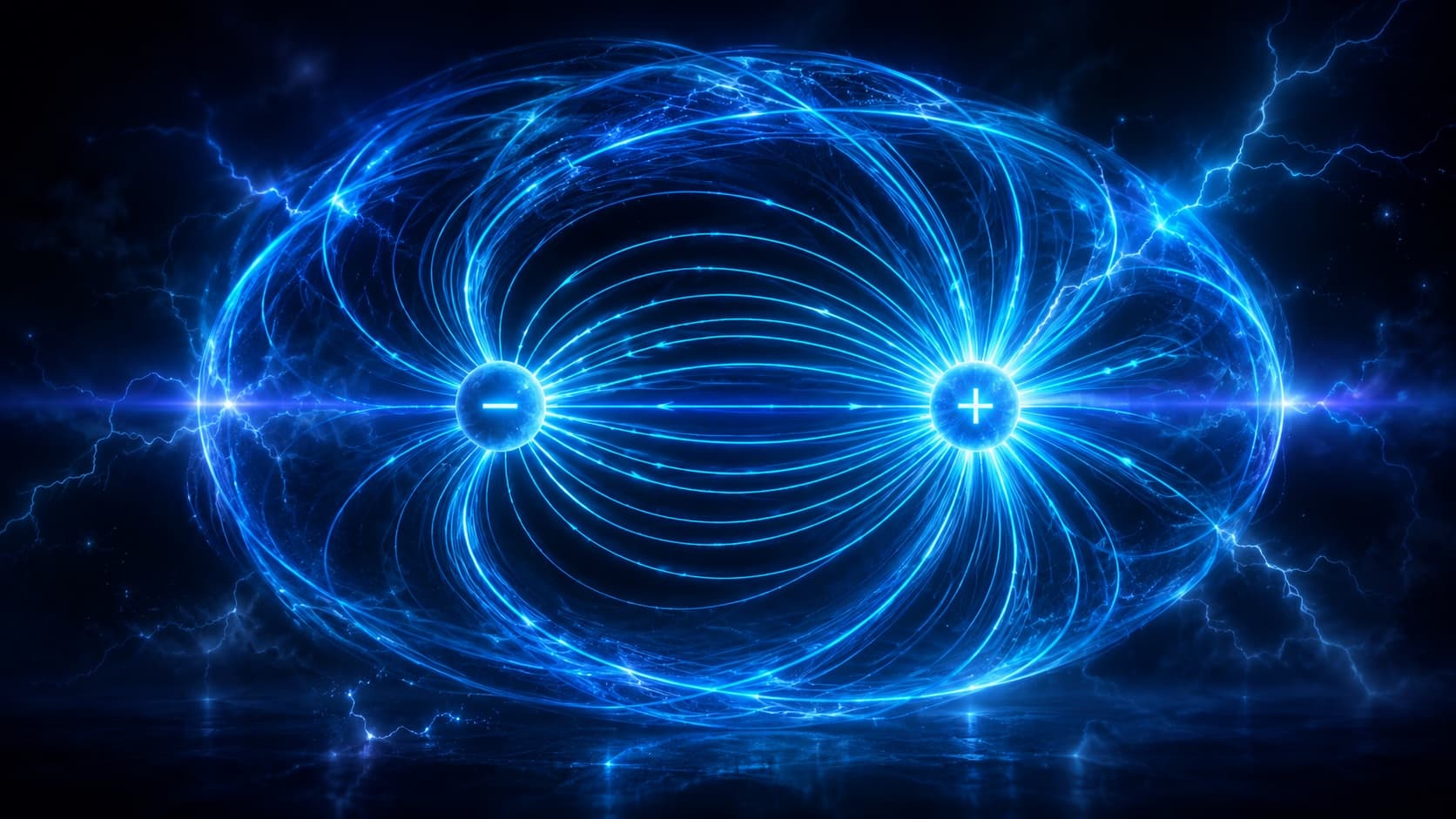
The energy is not best thought of as sitting on the plates. In electromagnetic theory, energy is stored in the electric field between and around the plates.
For a parallel-plate capacitor,
C= rac{epsilon_0 A}{d}
and
Substitute into
U= rac{1}{2}CV^2
to get
ight)(Ed)^2= rac{1}{2}epsilon_0 E^2(Ad)$$ The volume between the plates is $Ad$, so the energy density is $$u_E= rac{1}{2}epsilon_0 E^2$$ In a dielectric material, $$u_E= rac{1}{2}epsilon E^2$$ for a simple linear dielectric. ## Field energy density The formula $$u_E= rac{1}{2}epsilon_0 E^2$$ is more general than the parallel-plate example suggests. It represents the energy per unit volume stored in an electric field in vacuum. For nonuniform fields, total field energy is found by integrating over space: $$U=int rac{1}{2}epsilon_0 E^2,dV$$ This field viewpoint becomes central in Maxwell's theory and electromagnetic waves. ## Energy and batteries When a capacitor is connected to a battery, energy accounting can be subtle. A battery supplies energy as charge moves. Half the supplied energy may be stored in the capacitor, while the rest is dissipated as heat in wires or internal resistance during a simple charging process. This does not violate energy conservation; it shows that real circuits include dissipative effects. ## Forces from energy Stored electric energy can produce mechanical forces. Capacitor plates attract because reducing plate separation increases capacitance. Depending on whether charge or voltage is held fixed, energy methods can determine the force. Dielectrics are pulled into capacitors because doing so changes capacitance and lowers the appropriate energy of the system. ## Applications Capacitor energy storage is used in camera flashes, pulsed lasers, defibrillators, power conditioning, memory circuits, and particle accelerators. Capacitors can release stored energy quickly, which makes them useful when short bursts of power are needed. ## The big idea Charging a capacitor stores energy. The equivalent expressions $U=Q^2/(2C)$, $U= rac{1}{2}QV$, and $U= rac{1}{2}CV^2$ describe the same stored energy. At a deeper level, this energy resides in the electric field, with density $u_E= rac{1}{2}epsilon_0E^2$ in vacuum.Sign in to track your progress.
Up next · Module 3
Current and DC Circuits
This module connects microscopic charge motion to macroscopic circuits. Students study current, resistance, Ohm's law, resistivity, circuit reduction, and Kirchhoff's rules.
Ask your AI physics guide
Ask anything about Electricity and Magnetism — Energy stored in electric fields, or choose a suggested question below.
AI responses are educational and may not be perfectly accurate. Press Enter to send, Shift+Enter for new line.