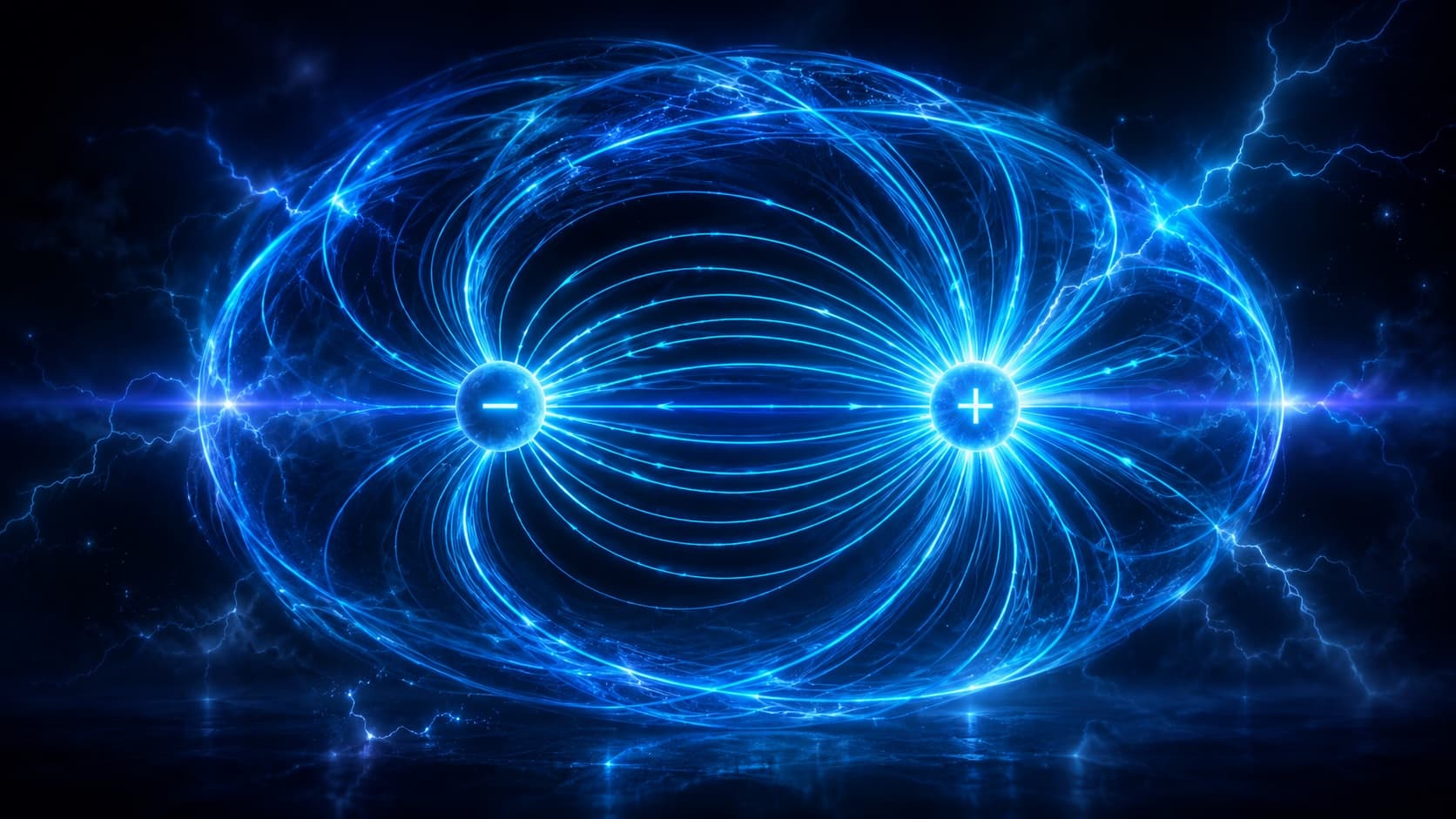
Magnetic materials and dipoles
PHYS 301 · Magnetostatics
Magnetic materials respond to applied fields through microscopic dipoles. This lesson introduces magnetic moments, torque, paramagnetism, diamagnetism, ferromagnetism, and hysteresis.
Key equations
\vec{\mu}=IA\hat{n}\vec{\tau}=\vec{\mu}\times\vec{B}U=-\vec{\mu}\cdot\vec{B}\vec{M}=\chi_m\vec{H}\vec{B}=\mu\vec{H}\chi_m<0\chi_m>0\chi_m=\frac{C}{T}Learning objectives
- Define magnetic dipole moment and dipole energy.
- Explain microscopic origins of magnetism.
- Distinguish diamagnetic, paramagnetic, and ferromagnetic materials.
- Describe magnetic domains and hysteresis.
- Interpret susceptibility and permeability conceptually.
Magnetic dipoles
The basic magnetic object is a dipole. A current loop has magnetic dipole moment
ec{mu}=IAhat{n}
where is current, is loop area, and is the direction given by the right-hand rule. In an external magnetic field, a dipole experiences torque
ec{ au}= ec{mu} imes ec{B}
The potential energy of a magnetic dipole is
U=- ec{mu}cdot ec{B}
The lowest energy occurs when the dipole aligns with the magnetic field.
Atomic origins of magnetism
Magnetism in materials arises from microscopic magnetic moments associated with electron orbital motion and electron spin. Electron spin is a quantum property with intrinsic magnetic moment.
Different materials respond differently depending on how these microscopic moments interact and whether they cancel or align.
Magnetization
Magnetization ec{M} is magnetic dipole moment per unit volume. It describes the collective magnetic response of a material. In many materials, magnetization is related to applied magnetic field intensity ec{H} by
ec{M}=chi_m ec{H}
where is magnetic susceptibility.
The magnetic field inside materials is often described using
ec{B}=mu ec{H}
where is magnetic permeability.
Diamagnetism
Diamagnetic materials develop weak magnetization opposite the applied field. They are weakly repelled by magnetic fields. Diamagnetism occurs in all materials but is often hidden by stronger effects.
In diamagnetic materials, induced microscopic currents oppose changes in magnetic flux, consistent with Lenz's law at a microscopic level.
Diamagnetic susceptibility is negative:
Paramagnetism
Paramagnetic materials have microscopic magnetic moments that tend to align weakly with an external field. Thermal motion randomizes them, so the effect is usually small.
Paramagnetic susceptibility is positive:
A simple high-temperature trend is Curie's law:
chi_m= rac{C}{T}
where is a material-dependent constant. Higher temperature makes alignment harder because thermal agitation is stronger.
Ferromagnetism
Ferromagnetic materials, such as iron, cobalt, and nickel, can exhibit strong spontaneous magnetization. Neighboring atomic moments interact in a way that favors alignment. The material forms domains, regions where many moments align.
An unmagnetized ferromagnet may have domains pointing in different directions, so the total magnetization is small. Applying a field can grow domains aligned with the field, producing strong magnetization.
Hysteresis
Ferromagnets often show hysteresis: magnetization depends on history, not just the current applied field. A plot of magnetization or versus applied field forms a loop. After the external field is removed, some magnetization may remain. This is remanence.
The field needed to reduce magnetization to zero is related to coercivity. Hard magnetic materials have large coercivity and are good permanent magnets. Soft magnetic materials magnetize and demagnetize easily, useful in transformer cores.
The big idea
Magnetic materials respond through microscopic magnetic dipoles. Diamagnets weakly oppose fields, paramagnets weakly align with fields, and ferromagnets can strongly magnetize through domain alignment. Magnetic dipole energy, torque, susceptibility, permeability, and hysteresis connect microscopic moments to macroscopic magnetic behavior.
Sign in to track your progress.
Up next · Module 5
Electromagnetic Induction
This module explores how changing magnetic flux produces electric fields and currents. Students learn Faraday's law, Lenz's law, inductance, magnetic energy storage, and AC circuit behavior.
Ask your AI physics guide
Ask anything about Electricity and Magnetism — Magnetic materials and dipoles, or choose a suggested question below.
AI responses are educational and may not be perfectly accurate. Press Enter to send, Shift+Enter for new line.