Refraction and Snell's law
PHYS 310 · Geometric Optics
Refraction is the bending of light as it crosses between materials where its speed changes. This lesson explains refractive index, Snell's law, wavelength change, and dispersion.
Key equations
c\approx 3.00\times 10^8\ m/sn=\frac{c}{v}n>1n_1\sin\theta_1=n_2\sin\theta_2v=f\lambdav=\frac{c}{n}\lambda=\frac{\lambda_0}{n}d_{app}\approx \frac{d}{n}Learning objectives
- Define index of refraction.
- Apply Snell's law to refraction problems.
- Explain why light bends toward or away from the normal.
- Describe how wavelength changes while frequency remains fixed.
- Explain dispersion and apparent depth.
Why light bends
Refraction occurs when light crosses from one medium into another and changes speed. If the ray enters at an angle, the change in speed changes the direction of propagation. This bending is responsible for lenses, prisms, mirages, and the apparent bending of objects partly submerged in water.
The speed of light in vacuum is
In a material, light travels more slowly. The index of refraction is
n= rac{c}{v}
where is the speed of light in the material. Since for most transparent materials, .
Snell's law
When light passes from medium 1 to medium 2, the angles satisfy Snell's law:
Angles are measured from the normal to the surface. If light enters a medium with larger refractive index, it bends toward the normal. If it enters a medium with smaller refractive index, it bends away from the normal.
For example, light passing from air into glass bends toward the normal because glass has a larger refractive index than air.
Frequency and wavelength
When light crosses a boundary, its frequency remains the same. The source determines frequency, and the electric field oscillations must match at the boundary. But speed changes, so wavelength changes.
Using
and
v= rac{c}{n}
the wavelength in a material is
lambda= rac{lambda_0}{n}
where is the wavelength in vacuum.
Deriving the direction change
Snell's law can be understood through wavefronts. When one side of a wavefront enters a slower medium first, that side slows while the other side continues faster, causing the wavefront to rotate. The ray direction, perpendicular to the wavefront, changes.
Snell's law can also be derived from Fermat's principle: light takes a path of stationary travel time. The fastest path through two media is not generally the shortest geometric distance.
Apparent depth
Refraction makes underwater objects appear closer to the surface than they really are. Rays from the object bend away from the normal as they leave water into air. Your eye traces the rays backward in straight lines, placing the object at a shallower virtual location.
For near-normal viewing, apparent depth is approximately
d_{app}approx rac{d}{n}
for an object in a medium of refractive index viewed from air.
Dispersion
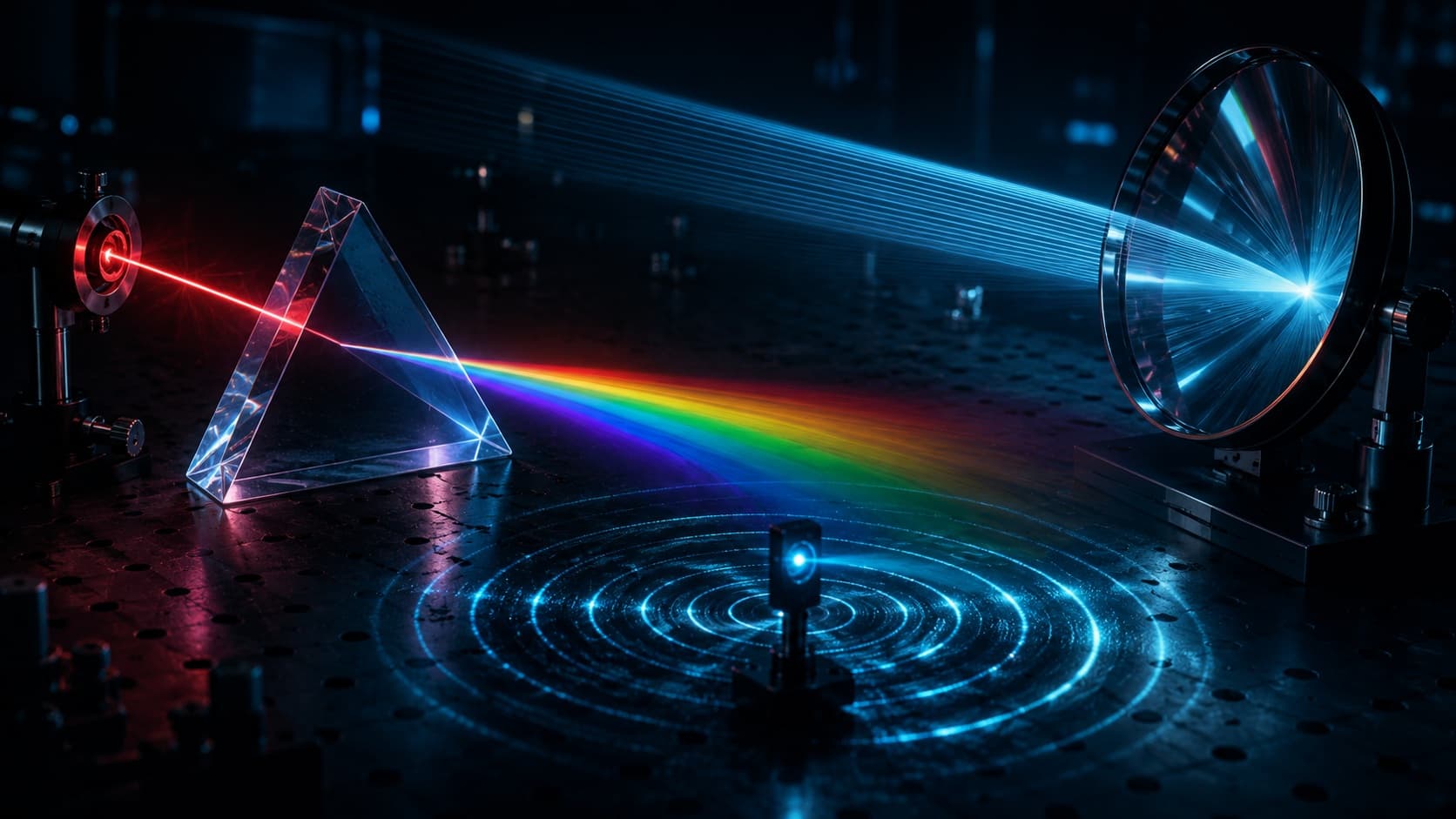
Refractive index often depends on wavelength. This is called dispersion. In glass, shorter wavelengths of visible light are usually refracted more strongly than longer wavelengths. A prism separates white light into colors because each wavelength bends by a different amount.
Dispersion also causes chromatic aberration in lenses, where different colors focus at slightly different positions.
Refraction and energy
Refraction changes direction and wavelength, but frequency stays fixed. Some light may also reflect at the boundary. The amount reflected and transmitted depends on angle, polarization, and refractive indices. Full treatment requires electromagnetic boundary conditions, but ray optics captures the basic geometry.
The big idea
Refraction is caused by a change in light speed at a boundary. Snell's law predicts how rays bend, while refractive index describes how much a material slows light. Frequency remains constant across a boundary, wavelength changes, and dispersion makes refractive index depend on color.
Sign in to track your progress.
Ask your AI physics guide
Ask anything about Optics and Light — Refraction and Snell's law, or choose a suggested question below.
AI responses are educational and may not be perfectly accurate. Press Enter to send, Shift+Enter for new line.