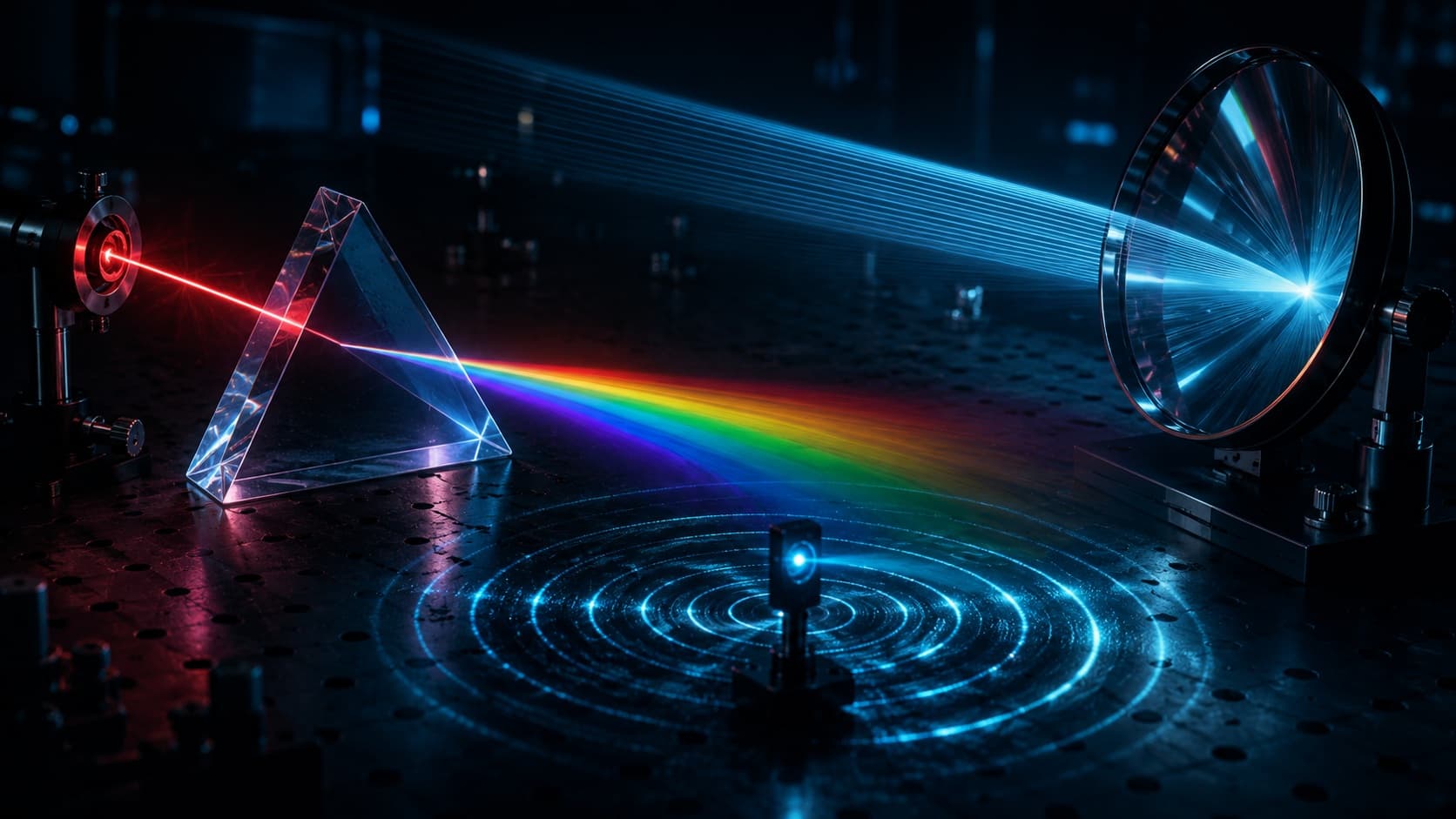
Newton's rings
PHYS 310 · Interference and Coherence
Newton's rings are circular interference fringes formed by a thin air film between curved and flat glass surfaces. This lesson derives ring conditions and explains radius measurements.
Key equations
t\approx \frac{r^2}{2R}\pi2t=m\lambdar_m^2=m\lambda R2t=\left(m+\frac{1}{2}\right)\lambdar_m^2=\left(m+\frac{1}{2}\right)\lambda Rr_m^2\propto mLearning objectives
- Describe how Newton's rings are formed.
- Relate air-film thickness to radial distance.
- Explain why the center is dark in reflected light.
- Derive ring radius formulas.
- Explain how Newton's rings are used in optical testing.
Circular thin-film interference
Newton's rings are circular bright and dark fringes seen when a curved lens surface rests on a flat glass plate. A thin air film exists between the curved surface and the plate. The film thickness increases with distance from the contact point.
Light reflected from the top and bottom boundaries of the air film interferes. Because the thickness depends only on radial distance from the center, the fringes are circular.
Geometry of the air film
Let be the radius of curvature of the lens surface and be the radial distance from the contact point. For small compared with , the air film thickness is approximately
tapprox rac{r^2}{2R}
This geometric relationship connects measured ring radius to film thickness.
Phase reversal
For an air film between glass surfaces, consider reflected light. At the top boundary, light reflects from glass to air, a higher-to-lower index boundary, so there is no phase reversal. At the bottom boundary, light reflects from air to glass, a lower-to-higher index boundary, so there is a phase reversal.
Thus there is one relative phase reversal.
Dark rings in reflected light
Because of one phase reversal, destructive interference in reflected light occurs when
for air, where . Combining with
tapprox rac{r^2}{2R}
gives
for dark rings.
At the center, , so gives a dark spot in reflected light. This is a classic signature of the phase reversal.
Bright rings in reflected light
Constructive interference in reflected light occurs when
ight)lambda$$ Using the thickness relation, $$r_m^2=left(m+ rac{1}{2} ight)lambda R$$ for bright rings, with indexing chosen according to convention. ## Measuring wavelength or curvature Newton's rings can be used to measure wavelength if $R$ is known, or measure radius of curvature if $lambda$ is known. The squared ring radius is proportional to integer order: $$r_m^2propto m$$ This makes the pattern useful for precision optical testing. ## Transmitted light The transmitted pattern is complementary to the reflected pattern. Where reflected light is dark, transmitted light tends to be bright, assuming little absorption. Energy is redistributed between reflection and transmission. This complementarity is a useful check on interference reasoning. ## Optical testing Newton's rings are used to test surface flatness and lens quality. Slight deviations from perfect circular fringes reveal imperfections in the surfaces. Optical technicians use interference fringes as extremely sensitive maps of thickness variations. Because visible wavelengths are tiny, interference can detect very small changes in surface height. ## The big idea Newton's rings are thin-film interference fringes formed by an air gap whose thickness increases with radius. One reflection phase reversal makes the center dark in reflected light. The ring radii satisfy simple relationships such as $r_m^2=mlambda R$, making Newton's rings a powerful precision measurement tool.Sign in to track your progress.
Ask your AI physics guide
Ask anything about Optics and Light — Newton's rings, or choose a suggested question below.
AI responses are educational and may not be perfectly accurate. Press Enter to send, Shift+Enter for new line.