Optical aberrations
PHYS 310 · Optical Instruments
Real optical systems do not form perfect images. This lesson introduces spherical aberration, chromatic aberration, coma, astigmatism, field curvature, distortion, and correction methods.
Key equations
f\approx \frac{R}{2}n=n(\lambda)Learning objectives
- Define optical aberration.
- Explain spherical and chromatic aberration.
- Describe coma, astigmatism, field curvature, and distortion.
- Distinguish aberration limits from diffraction limits.
- Identify common aberration correction methods.
Imperfect image formation
Ideal thin lenses and mirrors bring rays from one object point to one image point. Real optical systems are not perfect. Deviations from ideal image formation are called aberrations.
Aberrations blur images, shift focus, distort shapes, or create color fringes. Understanding aberrations is essential for cameras, microscopes, telescopes, eyeglasses, and lasers.
Spherical aberration
Spherical aberration occurs when rays far from the optical axis focus at a different point than rays near the axis. Spherical lenses and mirrors are easier to manufacture than ideal shapes, but they do not focus all parallel rays perfectly.
For a spherical mirror, paraxial rays focus near
fapprox rac{R}{2}
but marginal rays focus differently. This produces blur even for a single wavelength.
Correction methods include using parabolic mirrors, aspheric lenses, aperture stops, or combinations of optical elements.
Chromatic aberration
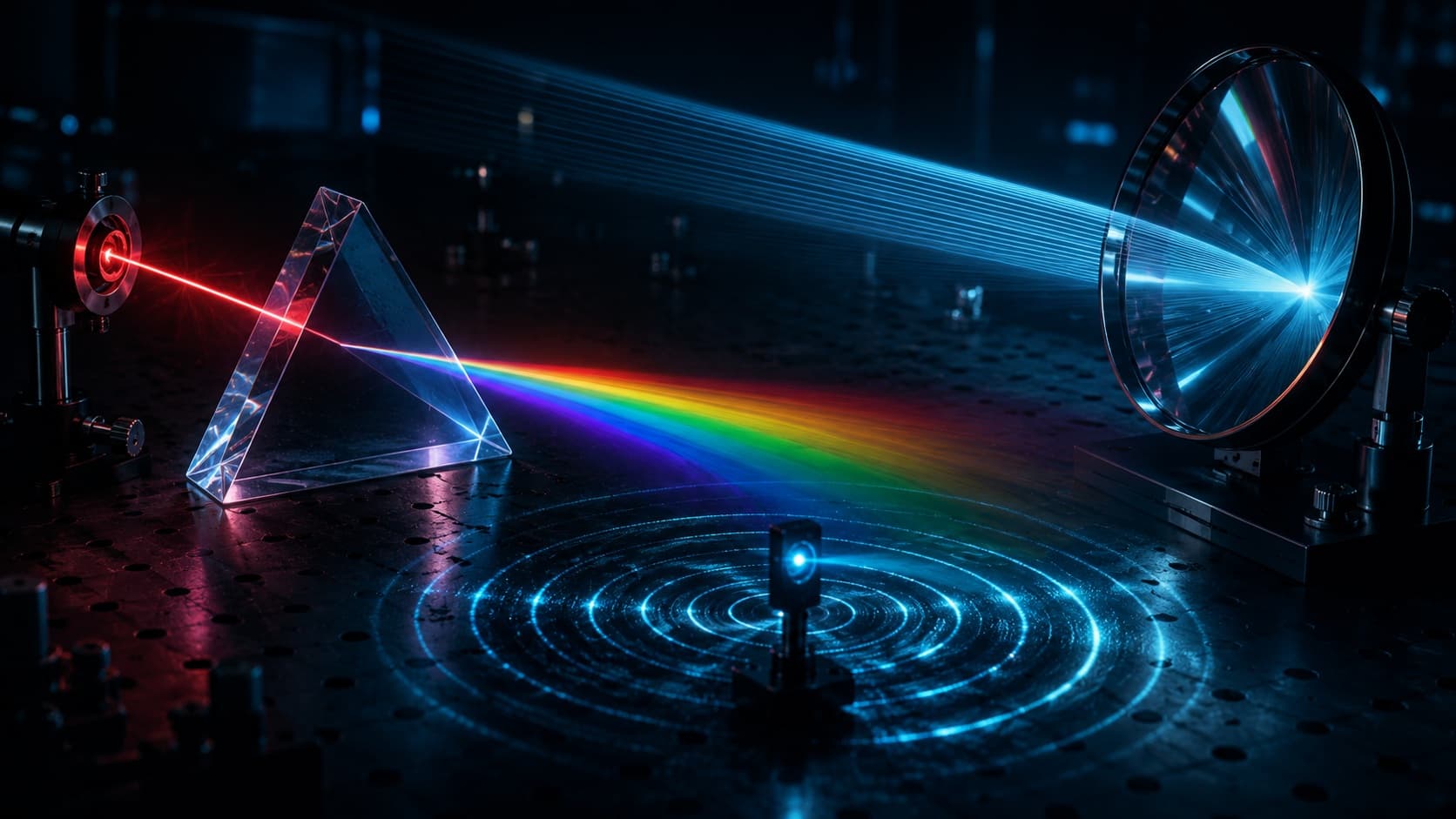
Chromatic aberration occurs because refractive index depends on wavelength. A lens bends blue light more strongly than red light, so different colors focus at different distances.
This is a consequence of dispersion:
Chromatic aberration appears as colored fringes around high-contrast edges.
Mirrors do not suffer from chromatic aberration in the same way because reflection is not based on wavelength-dependent refractive bending.
Achromatic lenses
An achromatic doublet combines two lenses made from different types of glass. The goal is to bring two wavelengths, commonly red and blue, to nearly the same focus. This greatly reduces chromatic aberration.
More advanced apochromatic designs correct multiple wavelengths and are used in high-quality cameras, microscopes, and telescopes.
Coma
Coma affects off-axis object points. A point source away from the center of the field forms a comet-shaped blur rather than a point. Coma is especially important in telescopes and wide-angle lenses.
Reducing coma requires careful optical design, such as parabolic or corrected mirror systems and multi-element lenses.
Astigmatism and field curvature
Astigmatism occurs when rays in different planes focus at different distances. An off-axis point may focus as a line in one direction at one plane and a line in the perpendicular direction at another plane.
Field curvature means the best focus lies on a curved surface rather than a flat sensor. Since most sensors are flat, this can make the center sharp while edges are out of focus, or vice versa.
Distortion
Distortion changes image geometry without necessarily blurring local detail. Straight lines may bow outward or inward. Barrel distortion makes lines bulge outward; pincushion distortion makes them pinch inward.
Distortion is common in wide-angle and zoom lenses and can be corrected optically or digitally.
Diffraction versus aberration
Even a perfectly corrected optical system is limited by diffraction. Aberrations are imperfections of focusing; diffraction is a wave effect caused by finite aperture. Good optical design tries to reduce aberrations until diffraction becomes the dominant limit.
A diffraction-limited system performs as well as physically possible for its aperture and wavelength.
The big idea
Optical aberrations are departures from ideal image formation. Spherical and chromatic aberration, coma, astigmatism, field curvature, and distortion each have distinct causes and visual effects. Correcting aberrations requires careful design, but diffraction sets the ultimate wave-optical limit.
Sign in to track your progress.
Up next · Module 3
Wave Optics
This module treats light as a wave and explains phenomena that ray optics cannot fully describe. Students study Huygens' principle, double-slit interference, diffraction gratings, and single-slit diffraction.
Ask your AI physics guide
Ask anything about Optics and Light — Optical aberrations, or choose a suggested question below.
AI responses are educational and may not be perfectly accurate. Press Enter to send, Shift+Enter for new line.