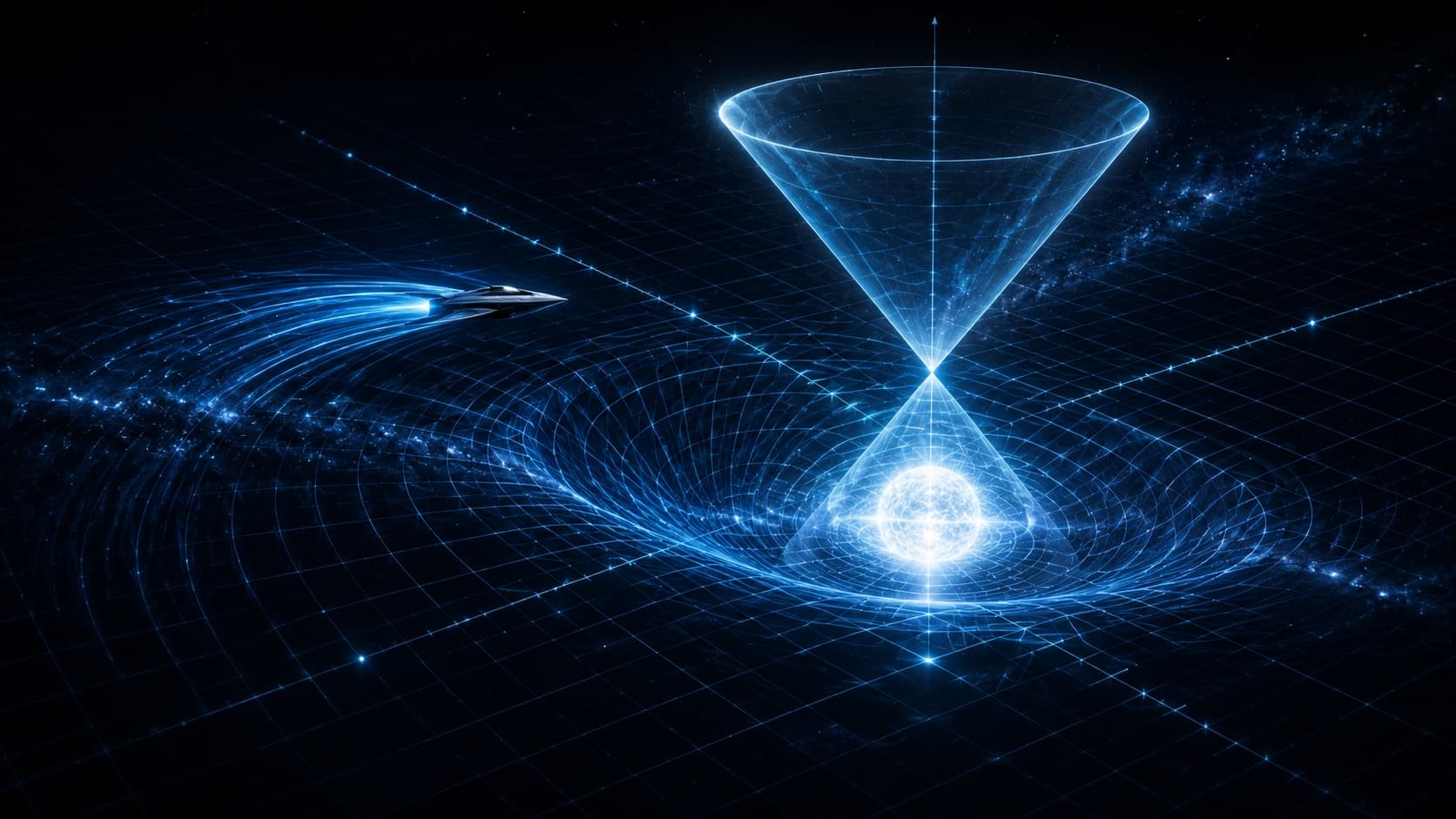
GPS satellites and general relativistic corrections
PHYS 401 · Applications and Paradoxes
GPS requires relativistic timing corrections to work accurately. This lesson explains special relativistic satellite motion, gravitational time dilation, and why full GPS timing uses general relativity.
Key equations
3.00 imes10^8 m/s300 mDelta t=gammaDelta aud au=dtsqrt{1-v^2/c^2}
rac{Delta f}{f}approx
rac{DeltaPhi}{c^2}Learning objectives
- Explain how GPS uses signal timing to determine position.
- Describe the special relativistic correction for satellite motion.
- Describe gravitational time dilation qualitatively.
- Explain why GPS needs general relativity as well as special relativity.
- Recognize GPS as a real-world application of relativistic time.
Precision timing and location
The Global Positioning System depends on extremely accurate clocks. A GPS receiver determines its position by comparing signal arrival times from multiple satellites. Since light travels about
an error of even one microsecond corresponds to about
of distance error. Relativistic effects are therefore not optional details; they are essential.
Special relativistic effect
GPS satellites move relative to clocks on Earth's surface. Moving clocks run slow according to special relativity:
For the satellite clock, its motion causes it to tick slower than an Earth-centered inertial reference clock by a small amount. This effect is due to speed and is roughly described by the time dilation factor
Gravitational effect
GPS satellites are farther from Earth's center than surface clocks, so they are in a weaker gravitational field. General relativity predicts that clocks higher in a gravitational potential tick faster than clocks lower down.
For weak gravitational fields, a rough gravitational time dilation comparison involves gravitational potential difference :
rac{Delta f}{f}approx rac{DeltaPhi}{c^2}
This effect makes satellite clocks run faster relative to surface clocks.
Net GPS correction
For GPS satellites, the gravitational effect is larger than the special relativistic speed effect. The net result is that satellite clocks tick faster than comparable clocks on Earth's surface by about tens of microseconds per day.
If uncorrected, this would cause navigation errors growing by kilometers per day. GPS accounts for these relativistic effects in clock settings and system modeling.
Why special relativity is not enough
Special relativity handles inertial frames without gravity. GPS satellites orbit Earth and are affected by gravity. A complete treatment requires general relativity because gravitational time dilation and curved spacetime matter.
Still, special relativity supplies the velocity-based time dilation part, and the conceptual foundation that time is not universal.
Signal propagation
GPS also requires careful treatment of signal travel time, satellite motion during signal propagation, Earth rotation, atmospheric delays, and clock synchronization. Relativity enters the coordinate time system used to describe satellite orbits and receiver positions.
The receiver solves for four unknowns: three spatial coordinates and its clock offset. That is why signals from at least four satellites are needed for a full position and time solution.
Relativity in technology
GPS is a powerful practical demonstration that relativity is real engineering. Without relativistic corrections, the system would not maintain its advertised accuracy. Similar timing issues matter in satellite communication, high-precision geodesy, and fundamental physics experiments.
The big idea
GPS works because it treats time relativistically. Satellite motion causes special relativistic time dilation, while weaker gravity at orbital altitude causes general relativistic gravitational time dilation. The gravitational effect dominates, and the combined corrections are essential for accurate navigation.
Sign in to track your progress.
Ask your AI physics guide
Ask anything about Special Relativity — GPS satellites and general relativistic corrections, or choose a suggested question below.
AI responses are educational and may not be perfectly accurate. Press Enter to send, Shift+Enter for new line.