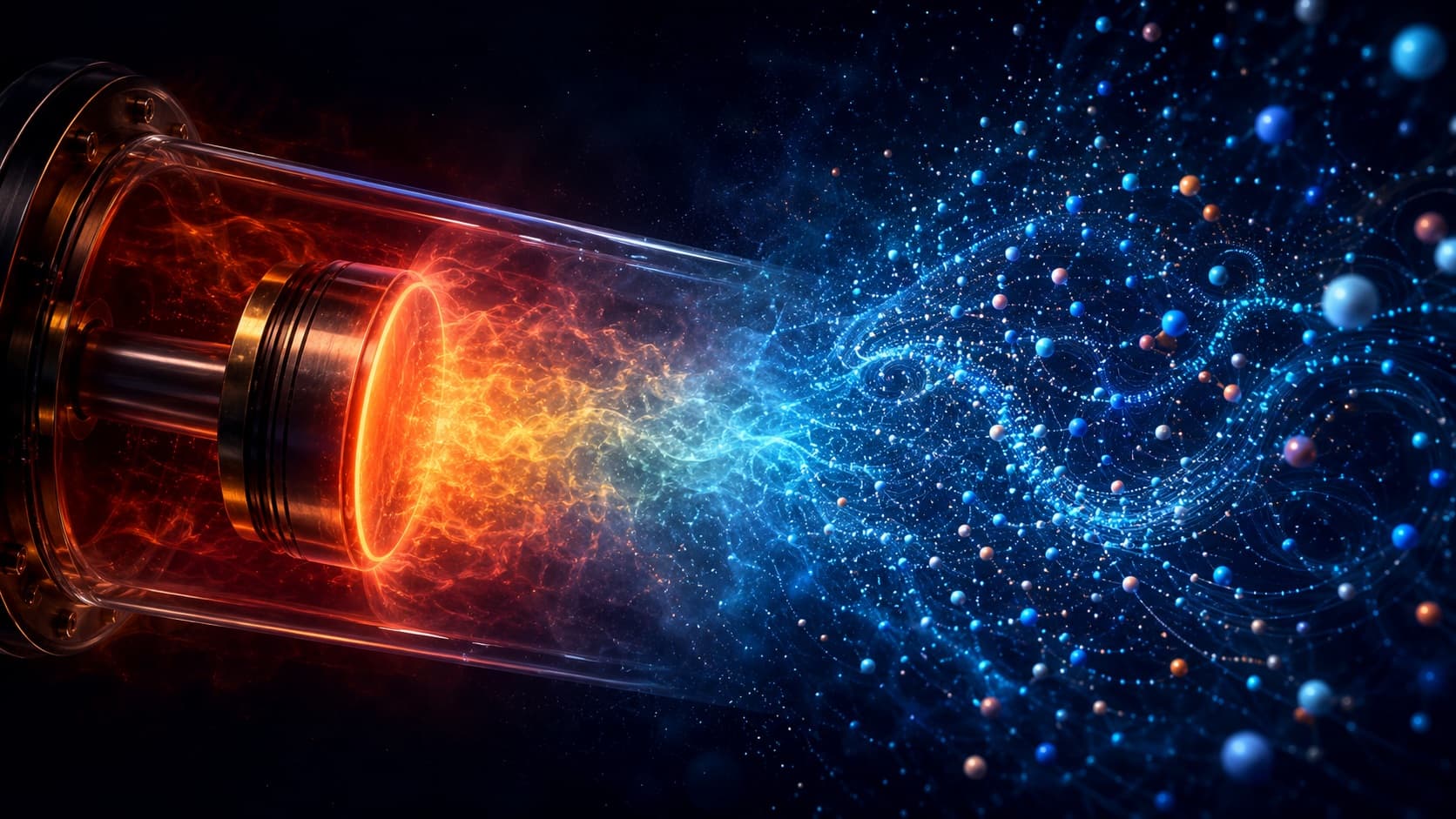
Statistical Mechanics
PHYS 220 · Module 6
This module connects thermodynamics to probability and microscopic states. Students study microstates, macrostates, the Boltzmann factor, partition functions, free energy, and phase transitions.
Lessons in this module
Microstates and macrostates
Statistical mechanics explains thermodynamics by counting microscopic arrangements. This lesson introduces microstates, macrostates, multiplicity, and entropy.
The Boltzmann factor
The Boltzmann factor gives the relative probability of energy states in thermal equilibrium. This lesson explains why lower-energy states are more probable and how temperature affects populations.
Partition function and free energy
The partition function organizes all thermal probabilities and connects microscopic states to macroscopic thermodynamics. This lesson introduces $Z$, average energy, and Helmholtz free energy.
Phase transitions
Phase transitions occur when matter changes macroscopic form, such as solid to liquid or liquid to gas. This lesson connects phases, latent heat, order parameters, and microscopic behavior.
Ask your AI physics guide
Ask anything about Thermodynamics and Statistical Mechanics — Statistical Mechanics, or choose a suggested question below.
AI responses are educational and may not be perfectly accurate. Press Enter to send, Shift+Enter for new line.