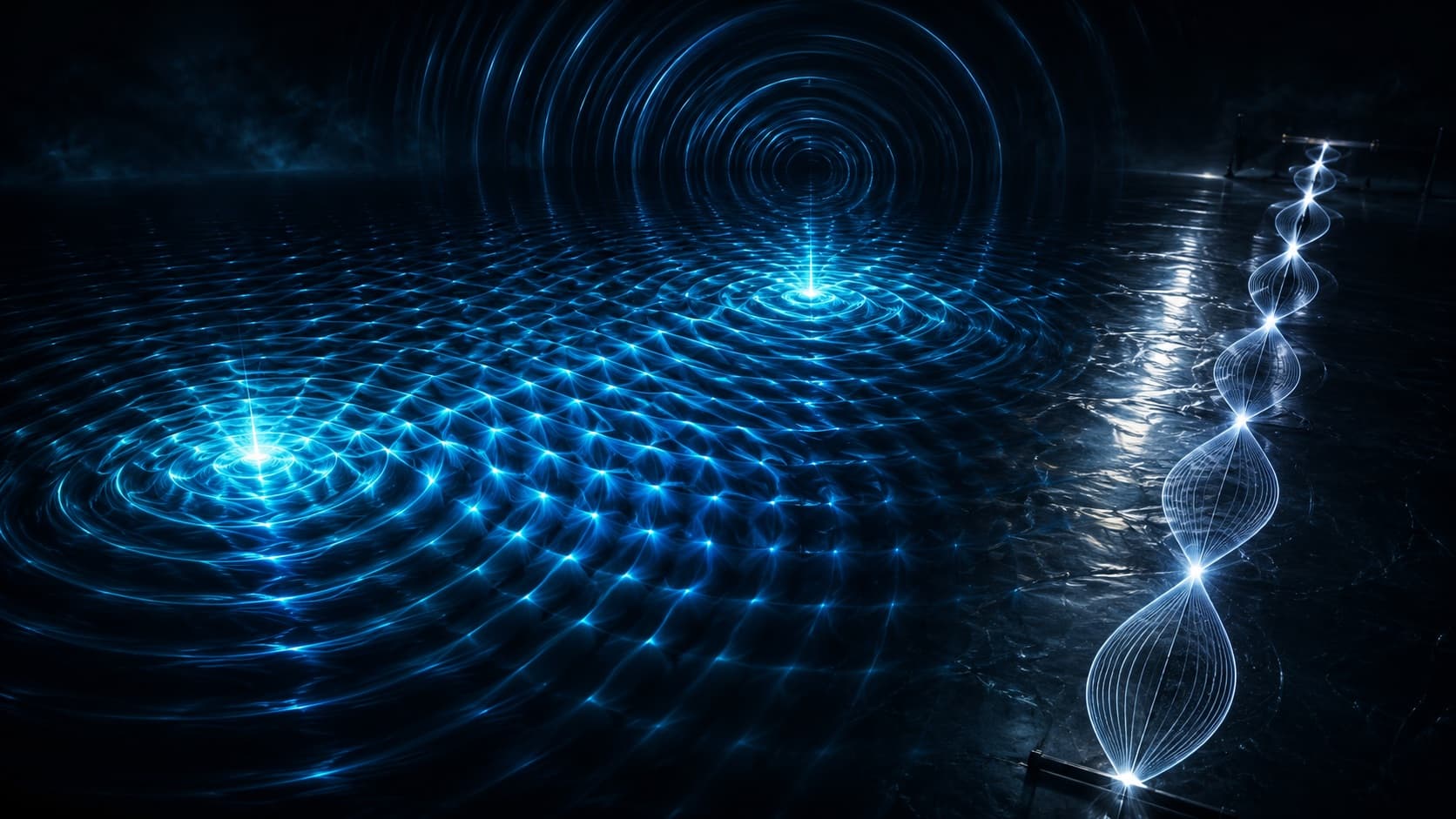
Standing waves on a string
PHYS 210 · Standing Waves
Standing waves form when waves traveling in opposite directions interfere. This lesson derives standing waves on a string fixed at both ends.
Key equations
y_1=A\cos(kx-\omega t)y_2=A\cos(kx+\omega t)y=2A\cos(kx)\cos(\omega t)y(0,t)=0y(L,t)=0y_n(x,t)=A_n\sin\left(\frac{n\pi x}{L}\right)\cos(\omega_n t+\phi_n)n=1,2,3,\ldotsL=n\frac{\lambda_n}{2}\lambda_n=\frac{2L}{n}v=\sqrt{\frac{T}{\mu}}f_n=\frac{nv}{2L}f_n=nf_1Learning objectives
- Explain standing waves as superpositions of opposite-traveling waves.
- Identify nodes and antinodes.
- Apply fixed-end boundary conditions to a string.
- Derive allowed wavelengths and frequencies for a string fixed at both ends.
- Relate string properties to musical pitch.
Waves trapped on a string
A string fixed at both ends can support standing waves. Unlike a traveling wave, a standing wave pattern does not move along the string. Instead, each point oscillates up and down with a fixed amplitude pattern.
Standing waves form from the superposition of two waves of the same frequency and amplitude traveling in opposite directions. For example,
Adding them gives, using a trig identity,
This is a standing wave.
Separation of space and time
The standing wave form
has a spatial factor and a time factor. The spatial factor determines which points have large or small amplitude. The time factor determines how the whole pattern oscillates.
Some standing waves are written with sine instead of cosine depending on boundary conditions.
Nodes and antinodes
A node is a point that does not move. At a node, the standing wave amplitude is zero. An antinode is a point of maximum oscillation amplitude.
For a string fixed at both ends, the endpoints must be nodes because they cannot move. This requirement restricts the allowed wavelengths.
Fixed-end boundary conditions
Let the string have length and be fixed at and . The displacement must satisfy
A convenient standing wave form is
ight)cos(omega_n t+phi_n)$$ where $$n=1,2,3,ldots$$ The integer $n$ labels the mode. ## Allowed wavelengths For a string fixed at both ends, the allowed wavelengths satisfy $$L=n rac{lambda_n}{2}$$ so $$lambda_n= rac{2L}{n}$$ The fundamental mode has $n=1$ and wavelength $2L$. The second harmonic has $n=2$ and wavelength $L$. Higher modes fit more half-wavelengths onto the string. ## Allowed frequencies Wave speed on a string is $$v=sqrt{ rac{T}{mu}}$$ Since $f=v/lambda$, $$f_n= rac{v}{lambda_n}= rac{nv}{2L}$$ The fundamental frequency is $$f_1= rac{v}{2L}$$ and $$f_n=nf_1$$ These are harmonics. ## Physical meaning A guitar string, violin string, or piano string supports standing waves. The fundamental gives the main pitch. Harmonics contribute to tone quality. Changing the string length, tension, or mass density changes the frequencies. Shorter strings have higher frequency. Greater tension raises frequency. Larger mass density lowers frequency. ## Energy in standing waves A standing wave does not transport energy steadily along the string in one direction the way a traveling wave does. Instead, energy alternates between kinetic energy of string motion and potential energy associated with string stretching. Locally, energy still moves, but the average transport pattern is different from a single traveling wave. ## The big idea Standing waves on a string arise from interference between opposite-traveling waves and boundary conditions at the fixed ends. Only wavelengths that fit an integer number of half-wavelengths on the string are allowed. These allowed patterns are the normal modes and harmonics that shape musical sound and many wave systems.Sign in to track your progress.
Ask your AI physics guide
Ask anything about Waves and Oscillations — Standing waves on a string, or choose a suggested question below.
AI responses are educational and may not be perfectly accurate. Press Enter to send, Shift+Enter for new line.