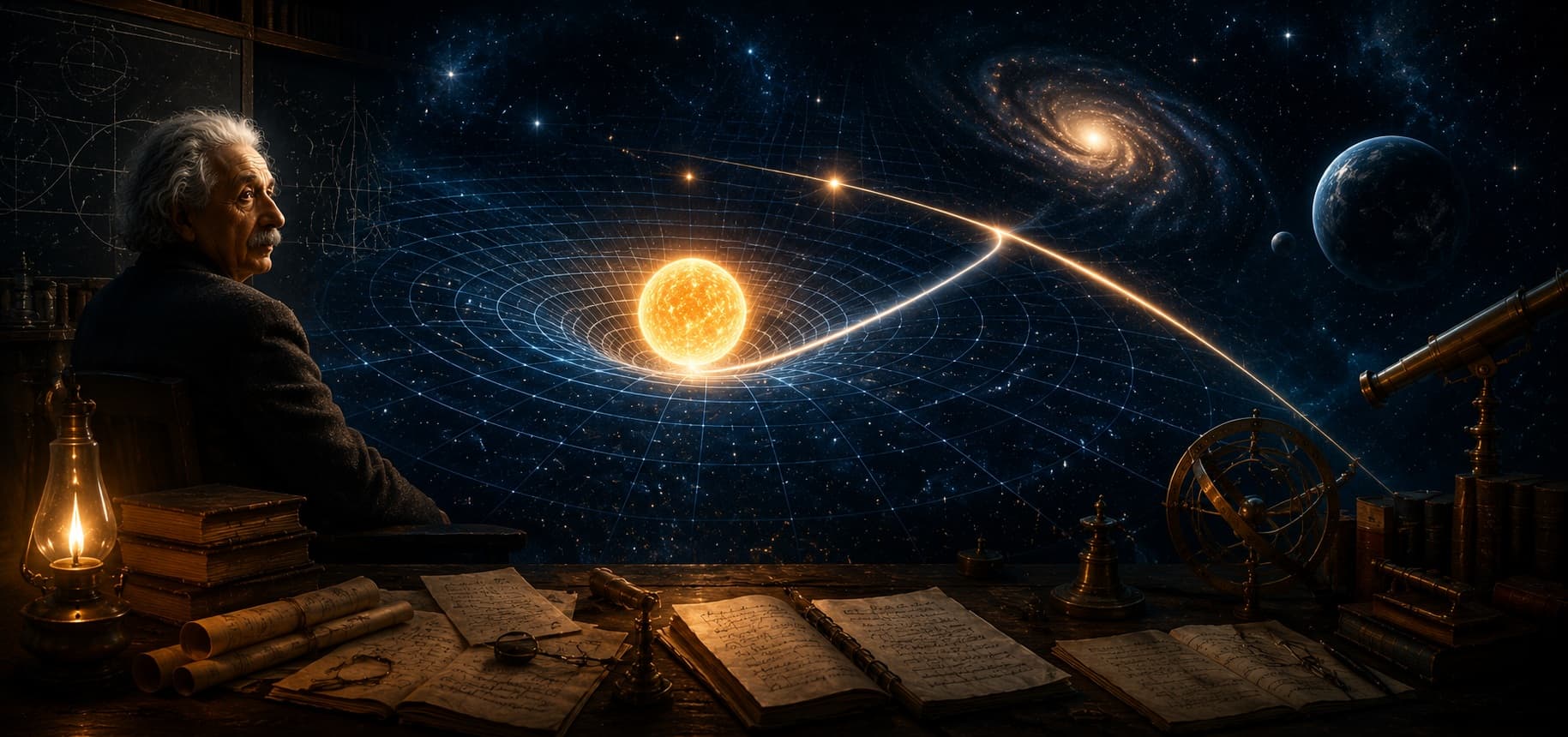
Albert Einstein
Relativity, Spacetime, and Modern Physics
1879–1955
Albert Einstein transformed physics by changing how scientists understand space, time, gravity, light, and energy. His theories of special and general relativity reshaped modern physics, while his work on the photoelectric effect helped launch quantum theory.
Why Albert Einstein Matters
Albert Einstein is one of the most important figures in physics because he changed the basic framework scientists use to understand the universe. Before Einstein, Newtonian physics described motion and gravity with extraordinary success, but certain problems involving light, electromagnetism, and very fast motion did not fit neatly into the older picture.
Einstein showed that space and time are not separate, absolute backgrounds. Instead, they are connected as spacetime, and measurements of time and distance can depend on the motion of the observer. This idea was not just a philosophical change. It led to precise predictions about fast-moving particles, light, energy, and the behavior of clocks.
Einstein's general theory of relativity went even further. It replaced the idea of gravity as a simple force acting at a distance with the idea that mass and energy curve spacetime. Objects move through this curved spacetime, producing what we experience as gravity. This theory became essential for understanding black holes, gravitational waves, the expansion of the universe, and modern cosmology.
Einstein also made crucial contributions to quantum theory. His explanation of the photoelectric effect showed that light can behave as discrete packets of energy, later called photons. Even though he became famous for debating aspects of quantum mechanics, his own work helped make quantum physics possible.
Historical Context
Einstein lived during a turning point in physics. By the late nineteenth century, Newton's mechanics and Maxwell's theory of electromagnetism had produced a powerful picture of nature. Many scientists believed physics was nearly complete. Yet several deep problems remained.
One major issue involved light. Maxwell's equations showed that light is an electromagnetic wave, but physicists struggled to explain how the speed of light could fit with ordinary ideas of motion. Experiments such as the Michelson-Morley experiment failed to detect the expected motion of Earth through a hypothetical luminiferous ether. This suggested that something was wrong with the old assumptions about space and time.
Another problem came from atomic and thermal physics. The behavior of blackbody radiation, the photoelectric effect, and atomic spectra could not be fully explained by classical physics. These puzzles helped lead to quantum theory.
Einstein's remarkable year came in 1905, often called his annus mirabilis, or miracle year. While working at the Swiss patent office, he published papers on the photoelectric effect, Brownian motion, special relativity, and mass-energy equivalence. Each paper addressed a major problem in physics.
In 1915, Einstein completed general relativity. Its confirmation during observations of a solar eclipse in 1919 made him internationally famous and helped establish relativity as one of the great achievements of modern science.
Key Contributions
Special Relativity
Einstein's special theory of relativity showed that the laws of physics are the same for observers moving at constant velocity and that the speed of light in a vacuum is constant for all such observers. This led to surprising conclusions: moving clocks run slow compared with stationary ones, lengths can contract in the direction of motion, and simultaneity depends on the observer. Special relativity became essential for high-speed physics and modern particle theory.
General Relativity
Einstein's general theory of relativity explained gravity as the curvature of spacetime caused by mass and energy. Instead of treating gravity as a force pulling objects across empty space, general relativity describes objects as following paths through curved spacetime. This theory predicted gravitational lensing, the bending of light by massive objects, the existence of black holes, the expansion of the universe, and gravitational waves.
Mass-Energy Equivalence
Einstein's famous relationship between mass and energy showed that mass is a form of energy. This idea became one of the most recognizable results in physics and is central to nuclear physics, particle physics, and astrophysics. It helps explain how stars produce energy and why small amounts of mass can correspond to enormous amounts of energy.
Photoelectric Effect
Einstein explained the photoelectric effect by proposing that light can transfer energy in discrete packets. This helped establish the idea of photons and showed that light has particle-like properties as well as wave-like behavior. His work on the photoelectric effect was one of the foundations of quantum theory.
Brownian Motion and Atomic Reality
Einstein's work on Brownian motion helped provide strong evidence for the existence of atoms and molecules. He explained the random motion of tiny particles suspended in a fluid as the result of collisions with unseen molecules. This gave physicists a way to connect microscopic atomic motion with observable macroscopic behavior.
How Their Ideas Changed Physics
Einstein changed physics by revealing that some of its most basic assumptions needed revision. Newtonian mechanics assumed that time passed the same way everywhere and that space was an unchanging stage on which motion occurred. Einstein showed that this picture is only an approximation that works well at ordinary speeds and gravitational fields.
Special relativity connected space and time into a single structure: spacetime. It also showed that measurements of time, length, and simultaneity are not absolute. These ideas became essential for understanding particles moving near the speed of light, the behavior of radiation, and the relationship between energy and mass.
General relativity changed gravity even more dramatically. Instead of seeing gravity as an invisible force acting instantly across space, Einstein described it as geometry. Matter and energy shape spacetime, and spacetime guides the motion of matter and light. This geometric view of gravity opened the door to modern studies of black holes, neutron stars, gravitational waves, and cosmology.
Einstein's influence also reached quantum mechanics. His explanation of the photoelectric effect helped show that energy in light comes in discrete units. This was a major step away from classical wave theory and toward the quantum view of matter and radiation.
Today, Einstein's theories are not only historically important. They are used in real scientific and technological systems, from particle accelerators and astrophysical models to the timing corrections required by satellite navigation systems.
Legacy
Einstein's legacy is enormous because his ideas reshaped both theoretical physics and the public image of science. His theories of relativity became pillars of modern physics and remain essential for understanding the universe at large scales, high speeds, and strong gravitational fields.
In cosmology, Einstein's work made it possible to study the universe as a physical system with a history and structure. General relativity provides the mathematical foundation for models of expanding space, black holes, gravitational lensing, and gravitational waves. Even when scientists search for theories beyond relativity, they usually begin by understanding what Einstein's theory explains so well.
In quantum physics, Einstein played a more complex role. He helped establish quantum theory through his work on light and the photoelectric effect, but he later questioned whether the standard interpretation of quantum mechanics was complete. His debates with Niels Bohr over probability, measurement, and reality remain among the most famous intellectual disagreements in science.
Einstein also became a cultural symbol of genius, curiosity, and independent thought. Yet his importance is not merely symbolic. His work changed the equations of physics, the meaning of space and time, and the way scientists think about the relationship between theory, experiment, and reality.
For students, Einstein represents a major turning point: the moment when classical physics gave way to the modern view of a universe shaped by relativity, quantum ideas, and deep mathematical structure.
Related Physics Concepts
Related GuidedPhysics Courses
Special Relativity
Einstein's special relativity is the foundation for understanding spacetime, high-speed motion, time dilation, and mass-energy equivalence.
Astrophysics and Cosmology
General relativity is central to modern cosmology, black holes, gravitational waves, and the large-scale structure of the universe.
Quantum Mechanics
Einstein's explanation of the photoelectric effect helped establish the quantum nature of light and contributed to the development of quantum theory.

Explore the physics of Albert Einstein
Albert Einstein's ideas are woven into the courses at GuidedPhysics. Start a conversation with an AI guide and explore the physics they built.