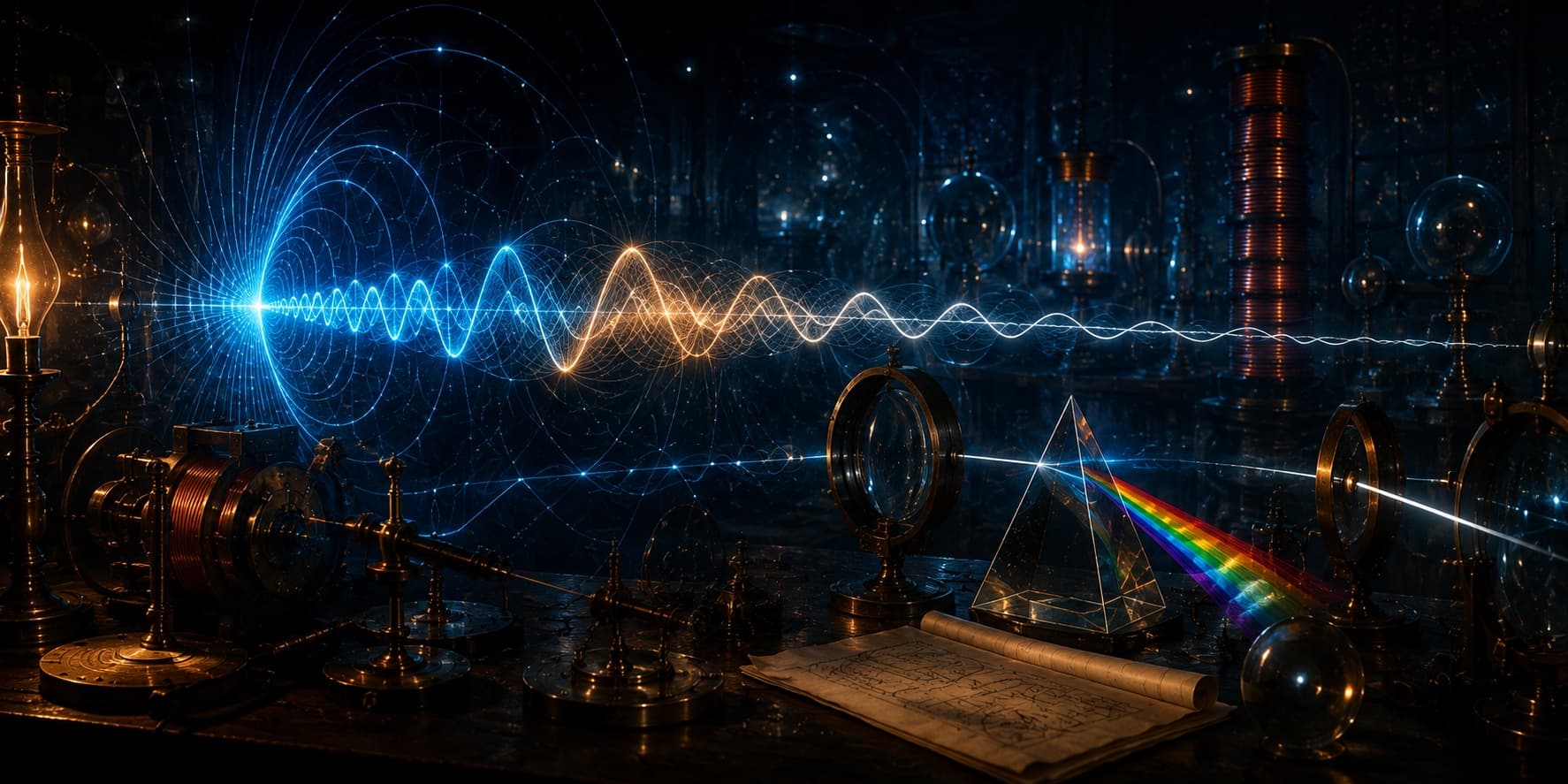
James Clerk Maxwell
Electricity, Magnetism, and Light
1831–1879
James Clerk Maxwell transformed physics by unifying electricity, magnetism, and light into one mathematical theory. His equations showed that light is an electromagnetic wave and became one of the foundations of modern physics and modern technology.
Why James Clerk Maxwell Matters
James Clerk Maxwell is one of the most important people in physics because he revealed that electricity, magnetism, and light are different expressions of the same underlying physical reality. Before Maxwell, scientists had discovered many separate laws about electric charges, currents, magnets, and fields, but these discoveries had not yet been united into one complete theory.
Maxwell brought these ideas together mathematically. He showed that changing electric fields can create magnetic fields, and changing magnetic fields can create electric fields. From this relationship, he predicted that electromagnetic disturbances could travel through space as waves. When he calculated the speed of these waves, he found that it matched the known speed of light. This led to one of the great conclusions in physics: light itself is an electromagnetic wave.
His work changed physics from a science focused mainly on matter and mechanical forces into a science of fields. The idea of a field — something spread throughout space that can carry energy and influence objects — became central to later physics, including relativity, quantum field theory, and modern particle physics.
Maxwell's impact also reaches far beyond theory. Radio, television, radar, wireless communication, optics, electrical engineering, and much of modern electronics depend on the electromagnetic principles that Maxwell unified.
Historical Context
Maxwell lived in the nineteenth century, a period when physics was rapidly expanding beyond mechanics and astronomy. Newton's laws had already provided a powerful framework for motion and gravity, but electricity and magnetism were still being developed through experiments and partial mathematical descriptions.
Several earlier scientists prepared the way for Maxwell. Charles-Augustin de Coulomb studied electric forces between charges. André-Marie Ampère explored the relationship between electric currents and magnetism. Hans Christian Ørsted discovered that an electric current could deflect a compass needle, showing that electricity and magnetism were connected. Michael Faraday introduced the idea of lines of force and demonstrated electromagnetic induction, showing that changing magnetic effects could produce electric currents.
Faraday's work was especially important for Maxwell. Faraday thought visually and experimentally, using field lines to picture how electrical and magnetic influences filled space. Maxwell took Faraday's physical insights and translated them into a powerful mathematical theory.
In the 1860s, Maxwell published his mature theory of electromagnetism. His work eventually became known through Maxwell's equations, a compact set of equations that describe electric fields, magnetic fields, charges, currents, and electromagnetic waves.
Maxwell's theory arrived before the technology existed to fully exploit it. Later, Heinrich Hertz experimentally produced and detected electromagnetic waves, confirming Maxwell's prediction and opening the path to radio and wireless communication.
Key Contributions
Maxwell's Equations
Maxwell's equations describe how electric and magnetic fields are produced and how they change. They combine earlier experimental laws into one coherent mathematical framework. These equations explain electric fields from charges, magnetic fields from currents, electromagnetic induction, and the way changing fields can generate waves that travel through space.
Unification of Electricity and Magnetism
Maxwell showed that electricity and magnetism are not separate forces but connected aspects of electromagnetism. A changing electric field can produce a magnetic field, and a changing magnetic field can produce an electric field. This unification became one of the great achievements of nineteenth-century physics.
Electromagnetic Theory of Light
Maxwell calculated that electromagnetic waves should travel at a speed matching the speed of light. From this, he concluded that light is an electromagnetic wave. This connected optics with electricity and magnetism and gave physicists a deeper explanation of visible light, infrared radiation, ultraviolet radiation, radio waves, and other forms of electromagnetic radiation.
Field Theory
Maxwell helped establish the field as a central idea in physics. Instead of thinking only in terms of forces acting directly between objects, physicists could describe electric and magnetic effects as fields spread through space. This field-based view later influenced Einstein's relativity and the development of quantum field theory.
Kinetic Theory and Statistical Physics
Maxwell also made major contributions to the kinetic theory of gases. The Maxwell distribution describes the range of molecular speeds in a gas at a given temperature. This work helped connect heat and temperature to the motion of molecules and became an important step toward statistical mechanics.
How Their Ideas Changed Physics
Maxwell changed physics by showing that separate areas of science could be united through deep mathematical structure. Before Maxwell, electricity, magnetism, and optics were often treated as related but distinct subjects. Maxwell's theory showed that they were parts of one larger framework: electromagnetism.
This unification changed how physicists understood light. Light was no longer just something studied through lenses, mirrors, and color. It became a traveling electromagnetic wave. This meant that visible light belonged to a wider spectrum of electromagnetic radiation. Later discoveries of radio waves, microwaves, X-rays, and other radiation fit naturally into the world Maxwell described.
Maxwell's work also shifted physics toward the concept of fields. Newtonian gravity had often been described as a force acting between masses, but Maxwell's electromagnetism required physicists to take fields seriously as physical entities. Electric and magnetic fields could store energy, carry momentum, and travel through space as waves. This was a profound step toward modern physics.
Einstein later recognized Maxwell's theory as one of the foundations of special relativity. The constancy of the speed of light, central to relativity, grew out of the electromagnetic theory of light. In this sense, Maxwell helped prepare the ground for the twentieth-century revolution in space and time.
Maxwell also influenced practical technology. Once electromagnetic waves were understood and experimentally confirmed, inventors and engineers developed wireless telegraphy, radio, television, radar, antennas, and eventually the communication systems that support the modern world.
Legacy
Maxwell's legacy is both theoretical and technological. In theoretical physics, his equations are among the most important in all of science. They stand beside Newton's laws, Einstein's relativity, and the Schrödinger equation as fundamental tools for understanding nature.
His unification of electricity, magnetism, and light became a model for later physics. Physicists continued to search for deeper unifications, such as the electroweak theory that connects electromagnetism with the weak nuclear force. Maxwell showed that apparently different phenomena can sometimes be understood as parts of a single mathematical structure.
His field concept became essential to modern science. Today, fields are used not only in electromagnetism but also in gravity, quantum mechanics, and particle physics. Modern quantum field theory, which describes particles as excitations of underlying fields, owes part of its intellectual ancestry to Maxwell's work.
Maxwell's technological legacy is equally vast. Electrical power systems, wireless communication, fiber optics, broadcasting, radar, smartphones, satellites, and countless other technologies depend on electromagnetic theory. Even when people do not know Maxwell's name, they live in a world shaped by his equations.
For students of physics, Maxwell marks a major turning point. His work shows the power of mathematics to unify experiments, predict new phenomena, and reveal hidden connections in nature.
Related Physics Concepts
Related GuidedPhysics Courses
Electricity and Magnetism
Maxwell's equations are the central framework for understanding electric fields, magnetic fields, circuits, induction, and electromagnetic waves.
Waves and Oscillations
Maxwell's theory shows how changing electric and magnetic fields can travel through space as waves.
Optics and Light
Maxwell revealed that light is an electromagnetic wave, connecting optics to electricity and magnetism.
Special Relativity
Einstein's special relativity grew partly from the challenge of understanding Maxwell's equations and the constant speed of light.
Thermodynamics and Statistical Mechanics
Maxwell's work on molecular speeds helped connect heat, temperature, and probability in the kinetic theory of gases.

Explore the physics of James Clerk Maxwell
James Clerk Maxwell's ideas are woven into the courses at GuidedPhysics. Start a conversation with an AI guide and explore the physics they built.