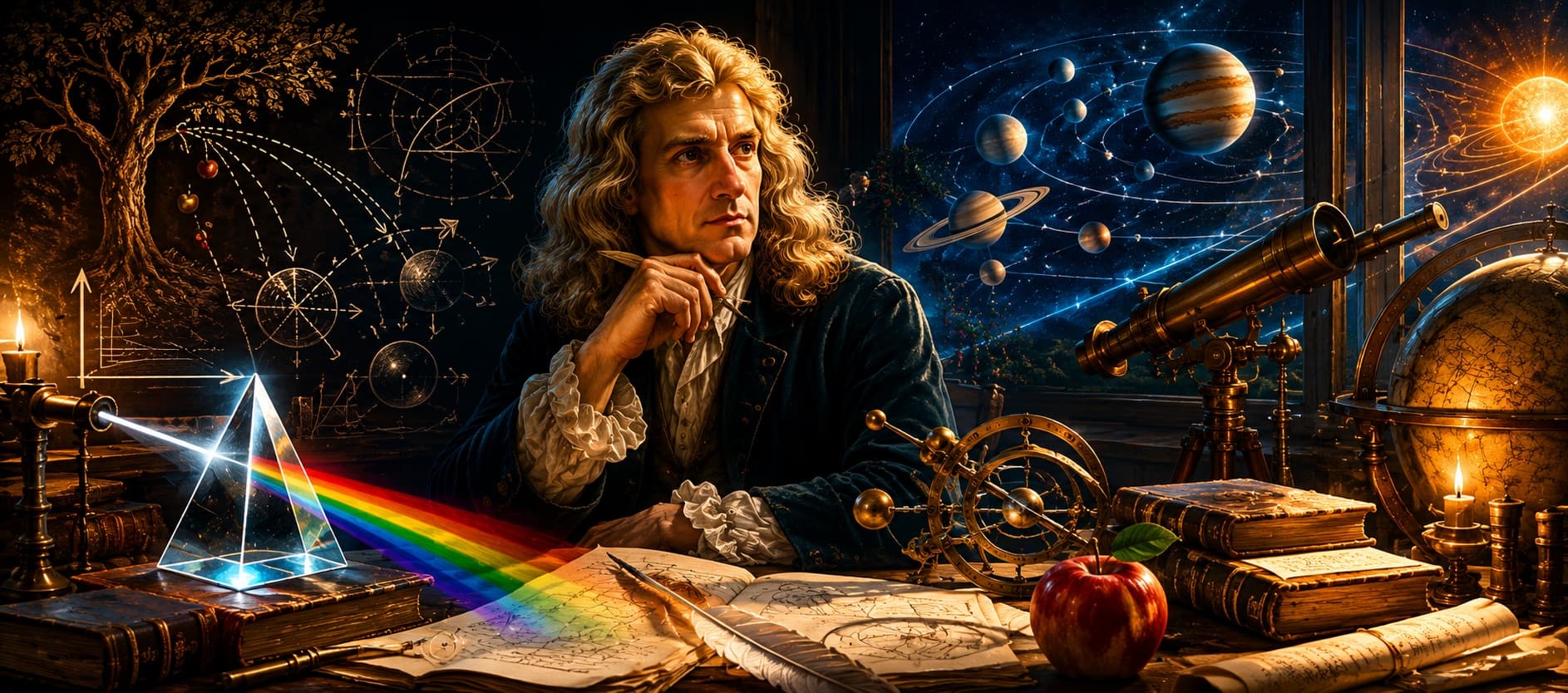
Isaac Newton
Founder of Classical Mechanics
1642–1727
Isaac Newton transformed physics by showing that motion on Earth and motion in the heavens obey the same mathematical laws. His laws of motion and universal law of gravitation became the foundation of classical mechanics and shaped science for more than two centuries.
Why Isaac Newton Matters
Isaac Newton is one of the central figures in the history of physics because he gave science a powerful mathematical framework for describing motion, force, and gravity. Before Newton, natural philosophers had made important discoveries about falling objects, planetary motion, and astronomy, but these ideas were not yet unified into one comprehensive physical system.
Newton showed that the same principles could explain a falling apple, a cannonball's path, the orbit of the Moon, and the motion of planets around the Sun. This was revolutionary. It meant the universe was not a collection of separate earthly and heavenly realms governed by different rules. Instead, nature could be understood through universal laws expressed in mathematics.
His work made physics more predictive. Scientists could now calculate how objects should move under the influence of forces. Engineers, astronomers, and later physicists used Newton's ideas to design machines, predict celestial events, understand tides, and model nearly every everyday motion.
Even after relativity and quantum mechanics revealed limits to Newtonian physics, Newton's laws remain essential. They are still the starting point for mechanics, engineering, astronomy, and much of applied science.
Historical Context
Newton lived during the Scientific Revolution, a period when European scholars were rethinking ancient explanations of nature and replacing them with observation, experiment, and mathematics. Earlier thinkers such as Nicolaus Copernicus, Johannes Kepler, Galileo Galilei, and René Descartes had already challenged the old Aristotelian worldview.
Copernicus had placed the Sun near the center of the planetary system. Kepler had discovered mathematical laws describing planetary orbits. Galileo had studied falling bodies, inertia, and telescopic astronomy. Yet a major question remained: what physical principles explained both earthly motion and celestial motion?
Newton entered this intellectual world in the seventeenth century. He studied mathematics, optics, astronomy, and natural philosophy. During the plague years of 1665 and 1666, when Cambridge University temporarily closed, Newton returned home to Woolsthorpe. This period later became famous as his "annus mirabilis," or miracle year, when he developed many of the ideas that would shape calculus, mechanics, optics, and gravitation.
His greatest work, Philosophiae Naturalis Principia Mathematica, usually called the Principia, was published in 1687. It provided a mathematical system for understanding motion and gravity. The book became one of the most influential scientific works ever written.
Key Contributions
Three Laws of Motion
Newton's three laws of motion describe how objects behave when forces act on them. The first law explains inertia: an object remains at rest or continues moving in a straight line at constant speed unless acted on by a net external force. The second law connects force, mass, and acceleration. The third law states that for every action, there is an equal and opposite reaction. Together, these laws became the foundation of classical mechanics.
Universal Gravitation
Newton proposed that every mass attracts every other mass through gravity. His law of universal gravitation explained why objects fall, why the Moon orbits Earth, and why planets orbit the Sun. This was one of the great unifications in science: the same force that pulls objects toward Earth also governs the motion of celestial bodies.
Mathematical Physics
Newton showed that physics could be built as a mathematical science. He used geometry and early forms of calculus-like reasoning to derive predictions about motion, orbits, and forces. His work helped establish the idea that the laws of nature could be expressed in precise equations.
Optics and the Nature of Light
Newton made major contributions to optics. He showed that white light is composed of different colors by passing sunlight through a prism. He also studied reflection, refraction, and the behavior of lenses. His optical experiments helped move the study of light from speculation toward controlled experiment.
Calculus and Mathematical Tools
Newton developed methods related to calculus, which he called fluxions. These tools allowed scientists to analyze changing quantities such as velocity, acceleration, and curves. Although Gottfried Wilhelm Leibniz independently developed calculus notation that became more widely used, Newton's mathematical work was deeply connected to the rise of modern physics.
How Their Ideas Changed Physics
Newton changed physics by creating a unified system of mechanics. Before him, many discoveries existed as separate insights. Galileo had studied acceleration and inertia. Kepler had described planetary orbits. Astronomers had collected accurate observations. Newton connected these pieces into a single framework.
The most important shift was the idea of universal physical law. Newton's mechanics suggested that nature follows consistent rules everywhere. A ball rolling down a ramp, a planet orbiting the Sun, and the Moon circling Earth could all be studied through the same principles of force and motion.
This changed the purpose of physics. Physics was no longer only about describing what happens. It became a science of prediction. If the forces and initial conditions were known, one could calculate future motion. This style of thinking later influenced engineering, astronomy, navigation, mechanics, and even philosophy.
Newton's work also helped establish the ideal of a mathematical universe. His success encouraged later physicists to search for deeper equations behind heat, electricity, magnetism, waves, relativity, and quantum theory.
Modern physics eventually showed that Newton's laws are not the final word. At very high speeds, Einstein's relativity gives a more accurate account. At atomic scales, quantum mechanics is required. But Newtonian mechanics remains an extraordinarily accurate approximation for everyday speeds, ordinary objects, and many engineering problems.
Legacy
Newton's legacy is difficult to overstate. For more than two hundred years, Newtonian physics was the dominant framework for understanding the physical universe. It guided astronomy, mechanics, engineering, navigation, and the development of modern technology.
His ideas also shaped the Enlightenment. Newton's success suggested that reason, observation, and mathematics could uncover hidden order in nature. Many later thinkers saw Newton as proof that the universe was intelligible and law-governed.
In physics education, Newton remains unavoidable. Students still learn his laws of motion before moving to more advanced topics because they provide the clearest entry point into force, acceleration, momentum, energy, and orbital motion. Even when later theories revise Newton's picture, they often begin by showing where Newtonian mechanics works and where it breaks down.
Newton's influence also extends into optics and mathematics. His prism experiments changed the understanding of color and light. His mathematical methods helped give future scientists the tools to study change and motion.
Today, Isaac Newton stands as a symbol of the power of mathematical physics: the idea that deep patterns in nature can be discovered, expressed, tested, and used to understand the world.
Related Physics Concepts
Related GuidedPhysics Courses
Classical Mechanics
Newton's laws form the foundation for studying motion, forces, energy, momentum, and orbits.
Optics and Light
Newton's prism experiments and studies of color are central to the history of optics.
Mathematical Methods for Physics
Newton's work helped establish the mathematical language used to describe motion and change.
Astrophysics and Cosmology
Newtonian gravitation remains an essential starting point for understanding orbits, tides, and celestial motion.

Explore the physics of Isaac Newton
Isaac Newton's ideas are woven into the courses at GuidedPhysics. Start a conversation with an AI guide and explore the physics they built.