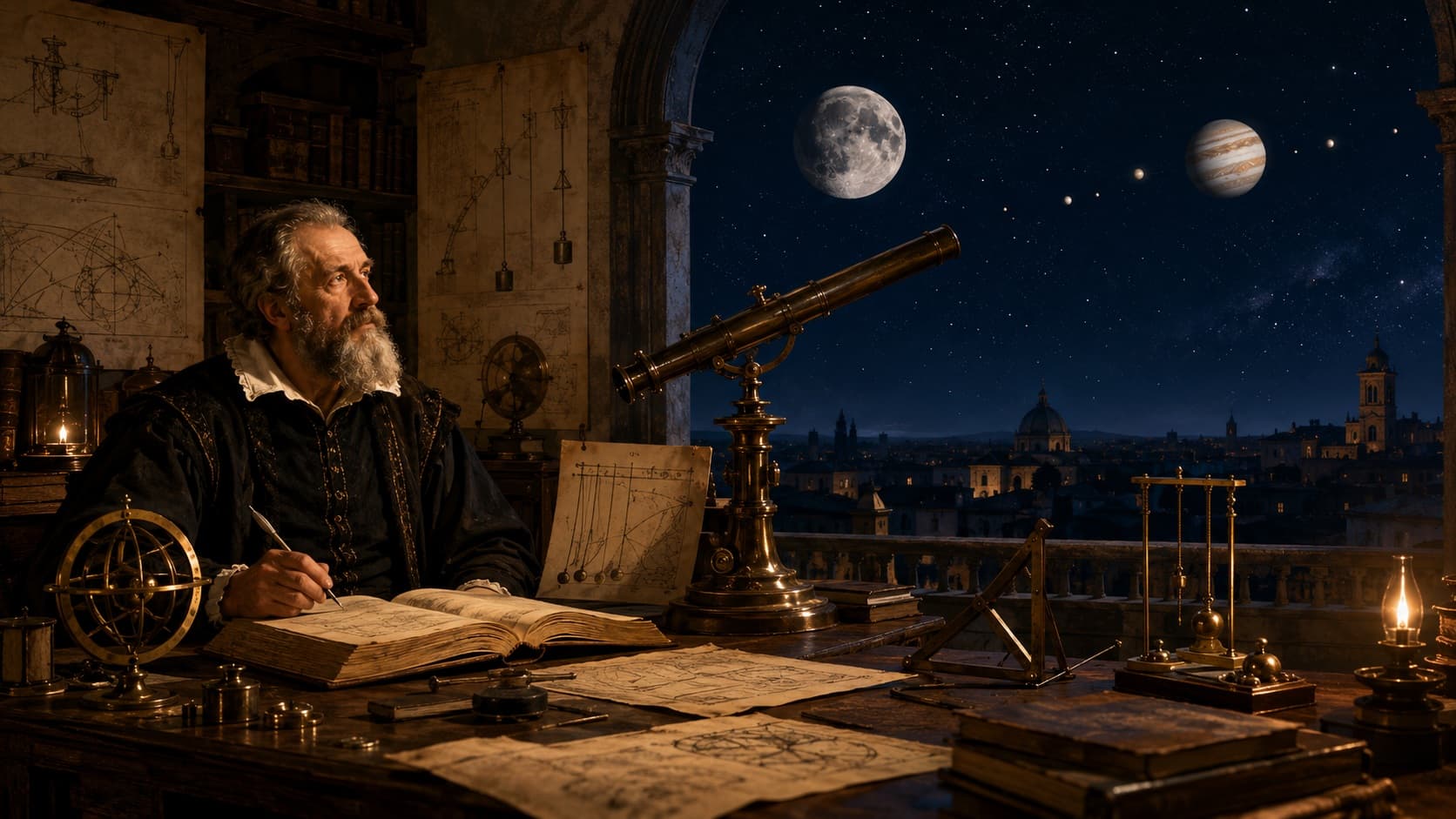
Galileo Galilei
Experiment, Motion, and Modern Science
1564–1642
Galileo Galilei helped launch modern physics by combining observation, experiment, mathematics, and bold scientific reasoning. His studies of motion challenged older ideas about nature, while his telescopic discoveries changed humanity's view of Earth's place in the cosmos.
Why Galileo Galilei Matters
Galileo Galilei is one of the most important figures in the history of physics because he helped change how people study nature. Before Galileo, much of European natural philosophy still relied heavily on ancient authorities, especially Aristotle. Galileo helped move science toward a new method based on observation, experiment, measurement, and mathematical description.
His work on motion was especially important. Galileo studied falling bodies, inclined planes, projectiles, and inertia. He challenged the idea that heavier objects naturally fall much faster than lighter ones. He also showed that motion could be analyzed mathematically, helping prepare the way for Newton's laws of motion later in the seventeenth century.
Galileo's astronomical observations were equally revolutionary. Using a telescope, he observed mountains and craters on the Moon, moons orbiting Jupiter, the phases of Venus, and countless stars invisible to the naked eye. These discoveries weakened the old belief that the heavens were perfect and unchanging and supported the Copernican view that Earth is not the center of the universe.
Galileo matters not only for what he discovered, but for how he worked. He helped establish the scientific habit of testing claims against evidence. His career represents a turning point from inherited explanations of nature toward modern experimental physics.
Historical Context
Galileo lived during the Scientific Revolution, a period when European thinkers were questioning older models of the universe and developing new methods for studying nature. The dominant view for centuries had been influenced by Aristotle and Ptolemy. In that worldview, Earth stood at the center of the cosmos, and the heavens were considered fundamentally different from the earthly world.
In 1543, Nicolaus Copernicus proposed a heliocentric model in which Earth and the other planets moved around the Sun. This idea challenged the traditional Earth-centered system, but it did not immediately replace it. Many scholars still preferred older models because they seemed to match common sense and long-standing authority.
Galileo entered this debate in the late sixteenth and early seventeenth centuries. He was trained in mathematics and natural philosophy and became known for his sharp arguments, experiments, and observations. His use of the telescope beginning in 1609 gave him powerful new evidence about the heavens.
His discoveries were controversial because they challenged both scientific tradition and powerful religious interpretations of the cosmos. Galileo's support for heliocentrism eventually brought him into conflict with Church authorities. In 1633, he was tried by the Roman Inquisition and forced to recant his public support for the motion of Earth.
Despite this conflict, Galileo's scientific work endured. His observations and methods became essential to the rise of modern physics and astronomy.
Key Contributions
Experimental Study of Motion
Galileo helped transform the study of motion by using experiments and measurements rather than relying only on philosophical argument. He studied falling bodies and objects rolling down inclined planes, allowing him to slow motion enough to analyze it carefully. His work showed that motion could be described mathematically and helped lay the foundation for later mechanics.
Inertia and the Challenge to Aristotelian Physics
Galileo developed ideas that pointed toward the principle of inertia. Older Aristotelian physics treated rest as the natural state of objects and required a continuous cause to maintain motion. Galileo argued that, without resistance, motion could continue. This insight became a key step toward Newton's first law of motion.
Projectile Motion
Galileo studied the motion of projectiles and showed that horizontal and vertical motions can be analyzed separately. He recognized that projectiles follow curved paths because they combine forward motion with downward acceleration. This was an important step toward the mathematical treatment of trajectories in classical mechanics.
Telescopic Astronomy
Galileo used the telescope to make discoveries that changed astronomy. He observed mountains and craters on the Moon, four moons orbiting Jupiter, the phases of Venus, and many stars not visible to the unaided eye. These observations challenged the idea of perfect heavens and supported the view that Earth was one planet among others.
Support for the Copernican System
Galileo became one of the most famous defenders of the heliocentric model. His observations of Venus and Jupiter provided strong evidence against simple Earth-centered cosmology. Although his advocacy caused controversy, it helped shift scientific debate toward a Sun-centered understanding of the solar system.
How Their Ideas Changed Physics
Galileo changed physics by helping replace authority-based explanations with evidence-based investigation. He did not create a complete system of mechanics like Newton later would, but he made several essential breakthroughs that allowed such a system to become possible.
One of his most important changes was the mathematical treatment of motion. Galileo showed that motion could be studied through quantities such as distance, time, speed, and acceleration. By measuring and reasoning carefully, physicists could discover patterns that were not obvious from everyday experience.
His work also weakened the old division between earthly and heavenly physics. His telescopic observations revealed that the Moon had mountains, Jupiter had orbiting moons, and Venus showed phases. The heavens were not a perfectly smooth, unchanging realm separate from Earth. This supported the idea that the same kind of rational investigation could apply across the universe.
Galileo's ideas about inertia and falling bodies prepared the ground for Newton. Newton's laws of motion did not appear from nowhere; they built on Galileo's studies of acceleration, projectiles, and persistent motion. In this sense, Galileo was a bridge between Renaissance natural philosophy and modern mathematical physics.
His broader influence was methodological. Galileo showed that physics should ask nature questions through observation and experiment, then express answers in mathematical form. That approach remains central to physics today.
Legacy
Galileo's legacy is one of the foundations of modern science. He is often remembered as a champion of observation and experiment, but his importance goes deeper than that. He helped create a new style of physics: one that looks for measurable patterns in nature and describes those patterns with mathematics.
His studies of motion influenced later scientists, especially Isaac Newton. Concepts related to acceleration, inertia, and projectile motion became essential parts of classical mechanics. Even when Galileo's own formulations were incomplete, they helped move physics away from ancient categories and toward precise laws of motion.
His astronomical discoveries permanently changed humanity's view of the universe. The moons of Jupiter showed that not everything revolves around Earth. The phases of Venus supported the idea that Venus orbits the Sun. The rough surface of the Moon suggested that celestial bodies were physical worlds rather than perfect heavenly objects.
Galileo also became a symbol of the tension that can arise when new evidence challenges established authority. His trial remains one of the most famous episodes in the history of science. Yet his enduring importance is not simply that he opposed authority, but that he insisted nature must be studied through evidence.
For students of physics, Galileo represents the beginning of a modern habit of mind: measure carefully, question assumptions, use mathematics, test ideas, and let observation guide understanding.
Related Physics Concepts
Related GuidedPhysics Courses
Classical Mechanics
Galileo's studies of falling bodies, acceleration, inertia, and projectile motion helped prepare the foundation for Newtonian mechanics.
Waves and Oscillations
Galileo's investigations of pendulums and regular motion contributed to later studies of periodic motion and oscillation.
Astrophysics and Cosmology
Galileo's telescopic discoveries contributed to the transformation of astronomy and humanity's view of Earth's place in the cosmos.

Explore the physics of Galileo Galilei
Galileo Galilei's ideas are woven into the courses at GuidedPhysics. Start a conversation with an AI guide and explore the physics they built.