Introduction: Football Is Applied Physics
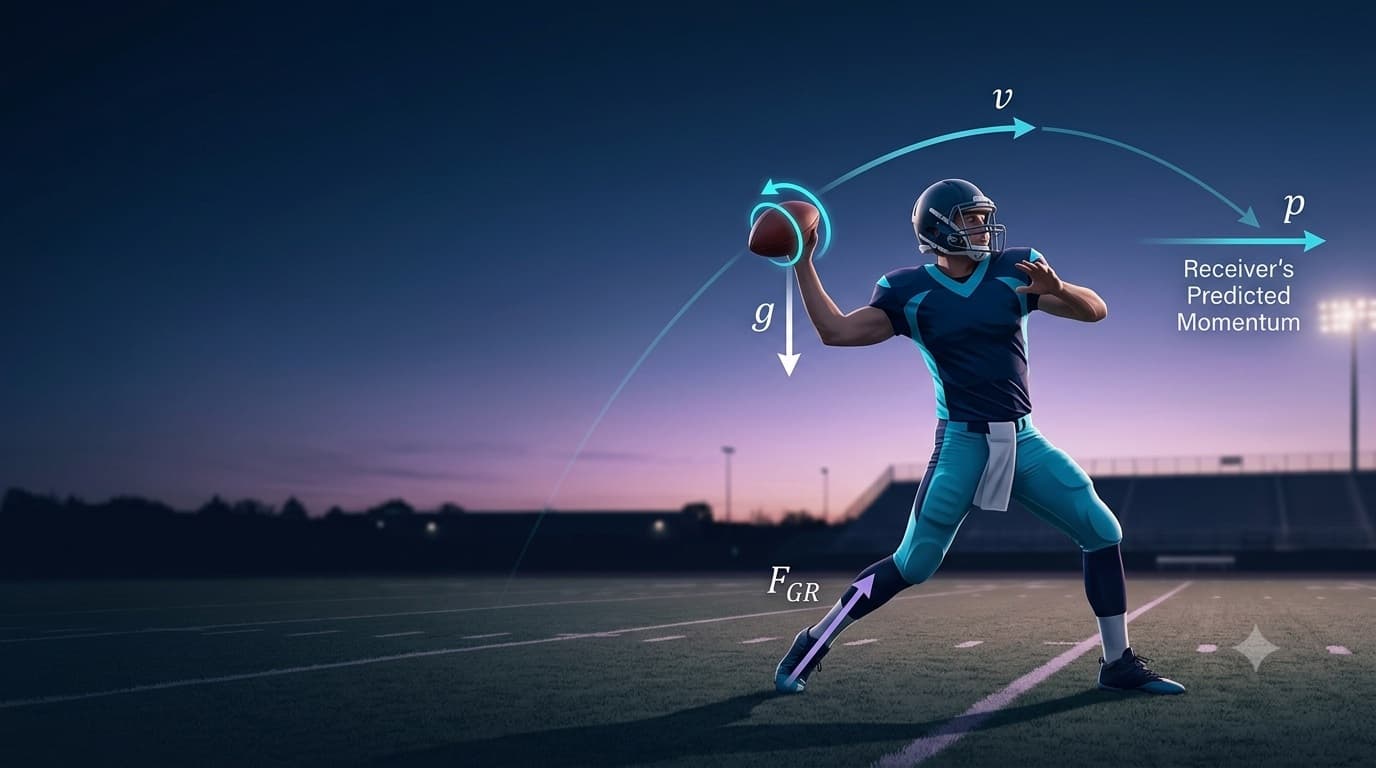
Nearly every American football play is a small laboratory in motion. A quarterback accelerates the ball with a force from the hand and arm. After release, the ball follows a curved flight shaped by gravity and air. Its spiral changes how it responds to aerodynamic forces. At the same time, receivers accelerate, defenders change direction, linemen exchange forces with the ground and one another, and a runner tries to preserve useful speed and balance through contact.
No player solves equations in the middle of a play. Training, technique, anticipation, and coaching let athletes use these physical principles intuitively. Physics does not determine the outcome by itself, either: skill, decisions, assignments, field position, and the actions of 21 other players all matter. Physics supplies the constraints. Players and coaches work inside them.
The models below are deliberately simplified. They are useful because they isolate one idea at a time, but a person is not a rigid block and a football is not a point mass. Real football adds moving joints, changing contacts, muscular forces, deformation, air resistance, wind, and interaction with the ground.
1. Newton's Laws on the Football Field
Newton's three laws of motion organize much of the physics in football.
First law: inertia
Newton's first law says that an object remains at rest or continues with constant velocity unless a net external force changes that motion. A football on a tee stays there until it is kicked. A runner moving downfield would continue in the same direction at the same speed if no net force acted, although that ideal situation never occurs on a field.
Inertia is resistance to a change in velocity. Mass is a measure of inertia; velocity is not. A fast player has momentum, but it is the player's mass—not the speed—that measures inertia. Making a sharp cut requires a net sideways force because the runner's velocity must change direction.
Second law: force and acceleration
For an object whose mass is effectively constant, Newton's second law is
The arrows remind us that force and acceleration have direction. For the same mass, a greater net force produces greater acceleration. For the same net force, a larger mass produces less acceleration. A running back leaving the backfield, a defensive lineman coming out of a stance, and a ball accelerated by a quarterback's hand all illustrate this relationship.
The word net matters. Gravity, normal forces, friction, air resistance, and contact forces may act at once. The acceleration follows their vector sum, not any single force in isolation. Human movement is more complicated still because muscles change forces from moment to moment and body segments rotate relative to one another.
Third law: action and reaction
When a player's cleat pushes backward and downward on the turf, the turf pushes forward and upward on the player. These forces are equal in magnitude and opposite in direction, but they act on different objects. They therefore do not cancel on the player.
The same interaction-pair reasoning applies when a player jumps, when two linemen make contact, and when a defender contacts a ball carrier. To predict one player's acceleration, draw a free-body diagram for that player and include only the forces acting on that player.
2. Momentum: Why Mass and Speed Both Matter
Linear momentum is mass multiplied by velocity:
Because velocity has direction, momentum does too. A heavier player can have the same momentum as a lighter, faster player. Using clearly hypothetical values:
| Situation | Mass | Speed | Momentum magnitude | What it suggests |
|---|---|---|---|---|
| Runner A | 75 kg | 8 m/s | 600 kg·m/s | Lower mass is offset by higher speed |
| Runner B | 100 kg | 6 m/s | 600 kg·m/s | Higher mass is offset by lower speed |
| Runner C | 90 kg | 4 m/s | 360 kg·m/s | Less momentum in this simplified comparison |
Momentum is valuable for analyzing collisions and changes of motion, but it does not tell us that the player with the larger momentum automatically “wins” a tackle. Angle, leverage, balance, grip, timing, body position, contact location, and forces exchanged with the ground all affect what happens. Momentum is one system property, not a score for football effectiveness.
It is also important not to confuse momentum with force. Momentum describes motion at an instant. A net force acting over time changes that momentum.
3. Impulse and Tackling
Impulse is the change in momentum. For a roughly constant average force during a time interval,
Stopping a runner, redirecting a runner, throwing a pass, and catching a ball all require impulse. A defender who changes a runner's direction changes the runner's momentum even if the runner's speed after contact happens to be similar, because momentum is a vector.
The impulse equation also explains why a receiver often moves the hands and arms with an incoming ball while securing it. For the same change in the ball's momentum, increasing the stopping time lowers the average force. A rigid stop over a very short interval produces a larger average force than a more gradual stop.
This physics description is not tackling instruction. Safe participation and proper technique must be taught by qualified coaches under the rules and safety standards that apply to the athlete. The model explains how momentum changes; it does not say how to hit harder or assess injury risk. The site's impulse and momentum lesson develops the relationship more formally.
4. Energy: Where Football Motion Comes From
The translational kinetic energy of a simplified moving object is
Momentum and kinetic energy are related to motion, but they are not interchangeable. Momentum depends linearly on speed, while kinetic energy depends on speed squared. If mass stays constant, doubling speed doubles momentum but quadruples kinetic energy.
That does not mean kinetic energy alone predicts who succeeds on a play. Direction, control, balance, and how forces are applied remain essential. It does show why speed changes can have a strong effect on the energy associated with motion.
The energy chain begins before the snap. Chemical energy stored and supplied by the body supports muscular contraction. Muscles do mechanical work on body segments or the ball. Some of that energy becomes organized motion; some becomes thermal energy, sound, deformation of equipment and turf, and internal motion. During a pass, the quarterback transfers energy to both the ball's forward motion and its rotation. During contact, some organized kinetic energy becomes deformation, heat, sound, and rotation. The work-energy theorem provides the broader framework.
5. Projectile Motion and the Forward Pass
Once the ball leaves a quarterback's hand, its center of mass approximately follows projectile motion. The most important initial conditions are release speed, launch direction, and release height. Gravity then accelerates the ball downward, while drag, wind, and other aerodynamic forces modify the flight.
In the simplest textbook model, air resistance is ignored and gravity is constant. Horizontal motion then has constant velocity, while vertical motion has constant downward acceleration:
This separation of horizontal and vertical motion is a powerful first approximation. It helps explain short, flatter passes; higher “touch” throws; and deep passes that remain in the air longer. A quarterback leading a receiver must account for relative motion: the receiver continues moving while the ball is in flight. The useful target is where the receiver and ball can arrive together, not simply where the receiver was at release.
Trajectory is also constrained by defenders and by the route. A higher arc may clear an underneath defender but takes more time. A flatter throw arrives sooner but may offer a smaller vertical margin. The strategy of combining receiver routes is explored through passing concepts at OpenPlay Football; here, the physics question is how the chosen initial conditions and forces shape the ball's path.
The familiar statement that 45 degrees produces maximum range applies only to an ideal projectile launched and landed at the same height with a fixed initial speed and no air resistance. A football pass has an elevated release, a moving receiver, drag, rotation, timing demands, defenders, and a need to remain catchable. Therefore, 45 degrees is not a universal best throwing angle. The complete Guided Physics lesson on two-dimensional kinematics and projectile motion makes the assumptions behind the ideal model explicit.
6. Why a Football Spirals
A well-thrown football has two kinds of motion: its center of mass travels downfield, and the ball rotates about its long axis. The quarterback produces both translational motion and rotational motion during release.
Rotation gives the ball angular momentum. Angular momentum resists rapid changes to the direction of the rotation axis, so a spinning football is less prone to uncontrolled tumbling than a nonspinning one. That is part of the reason a tight spiral can maintain a useful orientation in flight.
The explanation is not solely “the gyroscopic effect.” A football is elongated, its center of pressure can differ from its center of mass, and aerodynamic forces can create torques. Rotation, angular momentum, shape, initial orientation, and airflow interact. During a good long pass, the nose can gradually change direction as the velocity direction changes; stability does not mean the ball's axis is frozen in space.
An imperfect spiral may wobble as the ball's orientation changes around its average rotation direction. Physicists can describe some of that motion using precession- and nutation-like behavior, but the details depend on the ball's mass distribution, spin, release, seams, and aerodynamics. The general principle is that greater, well-aligned spin tends to make the orientation less sensitive to small disturbing torques, not that spin removes every aerodynamic effect. See angular momentum and its conservation for the underlying rotational physics.
7. Aerodynamics of the Football
Air resistance, or drag, generally acts against the ball's motion relative to the surrounding air. Drag depends on factors including relative speed, air density, projected area, surface properties, and orientation. Because an American football is elongated rather than spherical, its effective area and airflow change substantially when its long axis tilts away from the direction of travel.
A tight spiral helps the ball retain a more consistent, aerodynamically useful orientation. It does not eliminate drag. Spin and the nonspherical shape also make the airflow more complicated than the introductory drag model used for a sphere. Without specific experimental conditions, a single drag coefficient would be misleading, so the useful lesson is qualitative: orientation and airflow matter.
Wind changes the velocity of the ball relative to the air. A headwind, tailwind, or crosswind can therefore affect passes, punts, kickoffs, and field-goal attempts. Gusts complicate the problem because the airflow may change during flight. Players respond through experience and adjustment rather than by solving a fluid-dynamics model on the field.
8. Friction, Traction, and Cleats
Running and cutting require horizontal forces from the ground. The player pushes on the surface, and the surface pushes back through contact forces. When a planted cleat does not slide, this horizontal interaction is usually modeled as static friction, even though the athlete is moving relative to the field overall. The small contact region of the planted cleat is not slipping at that instant.
In a simplified model, static friction adjusts up to a maximum value. If the required horizontal force exceeds the traction the shoe-surface interaction can supply, slipping begins. Cleat geometry, shoe material, field construction, moisture, wear, and loading all affect available traction.
Dry grass, wet grass, and artificial surfaces do not have one universal ranking that applies in every situation. Conditions and equipment matter. Rain can reduce grip and also affect ball handling, but a claim that one surface is always safer or always has a particular friction coefficient would require specific evidence.
Traction helps explain why athletes can accelerate at all: internal muscular forces alone cannot accelerate the center of mass of the whole player without an external force. The ground supplies that external force. Guided Physics covers the simplified contact models in static and kinetic friction.
9. Changing Direction: Acceleration Isn't Just Speeding Up
Velocity combines speed and direction. Acceleration is any change in velocity, so a player accelerates when speeding up, slowing down, or turning. A receiver can enter and leave a sharp cut at approximately the same speed and still experience a substantial acceleration because the velocity direction changed.
To redirect the center of mass, the ground must exert a net force with a sideways component. The athlete plants a foot, leans, and organizes the body so the ground reaction force changes the path of the center of mass without exceeding available traction. A sharper turn at a higher speed demands a larger acceleration than a broad turn at a lower speed.
Route running is therefore physics plus technique and decision-making. Foot placement, balance, body control, timing, and the ability to disguise intentions determine how effectively a receiver uses the available forces. Physics explains why a direction change takes time and force; it does not select the route.
10. Center of Mass, Balance, and Leverage
The center of mass is the mass-weighted average position of a body or system. For a standing person it lies somewhere within the torso region, but it moves as the arms, legs, and trunk change position. Balance depends partly on how the center of mass relates to the base of support and on whether contact forces can prevent unwanted translation and rotation.
Lowering the body can sometimes improve stability by lowering the center of mass and widening the effective base of support, but “low man always wins” is not a law of physics. A very low position may reduce mobility or place forces in an unhelpful direction. Actual leverage depends on geometry, points of contact, force direction, body position, moment arms, and the forces each player can exchange with the ground.
Torque measures the tendency of a force to produce rotation:
Here, is the distance from the chosen axis to where the force is applied, and is the angle between the position vector and force. A force directed through the center of mass produces no torque about that center in the simplest model. The same-sized force applied off-center can rotate the body. Real athletes are articulated, actively controlled systems, so the location and direction of contact can change continuously. The related lessons on center of mass and torque and rotational dynamics explore those ideas more deeply.
11. Blocking as a Force-and-Leverage Problem
Blocking combines foot-ground interaction, momentum, force direction, balance, and torque. A blocker's goal is not always to move a defender far backward. Often the useful result is to alter the defender's path, delay access to a gap, or preserve a lane for a fraction of a second.
That distinction matters physically. A force with a sideways component may redirect a defender without producing much backward displacement. Contact away from a player's center of mass may create rotation. Continued traction lets either player adjust forces and restore balance. Initial momentum matters, but so do the directions of the forces after contact.
The assignment depends on the play and on where defenders line up. A defender's alignment changes angles, contact timing, and which movement paths are available; OpenPlay Football's guide to defensive fronts supplies that strategic context. This physics discussion remains about the forces and rotations that occur once players move and interact, not about dangerous contact technique.
12. Running Plays: Physics Becomes Geometry and Strategy
A running play brings mechanics into a moving geometric system. Players accelerate along planned paths, blockers try to influence access to space, defenders react, and the ball carrier chooses among openings that can appear and close quickly. Momentum, leverage, angles, timing, and spacing operate together.
An inside run generally attacks a space between interior blockers. An outside run initially threatens a wider area. A gap is a named space between offensive players, and a cutback lane is an opening that develops away from the runner's initial path. A pulling blocker moves laterally or behind teammates before approaching a different part of the formation. These labels describe strategy; the physics describes the acceleration, force, and timing required to execute the movement.
For example, a blocker who redirects a defender by a small distance at the right time may create enough room for the runner's center of mass to pass. The displacement can be modest while the strategic effect is large. Conversely, a large force applied in an unhelpful direction may not create a usable lane.
OpenPlay Football's introduction to running plays and blocking paths shows how assignments and play development organize these physical interactions. Guided Physics answers why changing a path requires force; the football resource shows where each player is trying to go.
13. The Physics of Receiving a Pass
Catching depends on relative motion. The important velocity at contact is the ball's velocity relative to the receiver, not only its velocity relative to the field. A receiver moving in roughly the same direction as the ball may experience a smaller relative speed than a stationary receiver would.
The receiver must predict a meeting point from visual information about the ball's trajectory while continuing to run. The ball drops under gravity, slows because of drag, and may move in wind. The receiver's own velocity and possible acceleration change the geometry from moment to moment.
At the catch, the ball's momentum relative to the receiver must be brought toward zero. Moving the hands and arms with the ball can extend the stopping time and reduce average force for the required impulse. That is only part of catching: grip, coordination, anticipation, visual tracking, body position, and practiced technique are equally real parts of the task.
14. Kicking and Punting
A kick begins with impulse. During a brief contact, the foot exerts a force on the ball and changes its momentum. The resulting launch speed and direction, together with spin and aerodynamic forces, shape the flight.
Field goals are projectile problems with constraints. The ball must clear a crossbar and pass between uprights while defenders may affect the available launch path and timing. The ball begins above the ground but not at the same height at which success is judged, and drag and wind matter. The idealized 45-degree result therefore does not prescribe a field-goal launch angle.
Punts and kickoffs have different strategic objectives. A punt may trade some horizontal distance for hang time, placement, or a reduced return opportunity. A kickoff may prioritize distance, location, or a particular type of flight. In each case, “maximum range” is not the only optimization target.
Spin affects orientation and aerodynamic behavior. Wind changes relative airflow, while the exact contact can introduce both forward and rotational motion. The flight can be approximated with projectile equations, but predicting it precisely requires aerodynamics and reliable initial conditions.
15. Collisions: More Complicated Than Two Objects in a Textbook
Introductory collision problems often use two point masses or rigid objects on a frictionless surface. A football collision is not that. Human bodies have many joints; muscles remain active; padding and tissue deform; contact points move; bodies rotate; feet interact with the ground; and other players may join the interaction.
Momentum conservation still applies to an appropriately defined isolated system. The difficult phrase is appropriately defined. If the system contains two players but not Earth, forces from the ground create external impulse, so the two-player momentum need not remain constant. If the time interval is extremely short, external impulse may sometimes be small enough for a useful approximation—but that assumption must be checked rather than declared.
Kinetic energy is generally not conserved in such a collision. Energy can become deformation, thermal energy, sound, and internal motion. Even if total momentum of a carefully chosen larger system is conserved, the final velocities depend on complex contacts and rotations. Textbook formulas can illuminate pieces of the event, but they cannot precisely predict a real tackle. The elastic and inelastic collisions lesson explains what the ideal categories do and do not assume.
16. Air Temperature, Weather, and the Ball
Weather changes several parts of the physical problem at once. Wind changes the ball's velocity relative to the air and can move a pass or kick away from its still-air path. Air density varies with atmospheric conditions, which changes aerodynamic forces. Temperature can affect air density and the behavior of materials, but the effect on a particular play cannot be reduced to one universal percentage.
Rain introduces water at the ball-hand interface and can change shoe-surface traction. A wet ball may be harder to grip consistently, while wet turf may change how much horizontal contact force is available. The outcome depends on the ball, gloves, footwear, surface, maintenance, and the actual conditions.
Physics is especially useful here for rejecting simple myths. “Cold always makes the ball travel this much less” or “one surface always provides more grip” leaves out too many variables. A careful statement identifies the mechanism—air density, wind, material response, or traction—then asks what evidence applies to the particular conditions.
17. Reaction Time Isn't the Same as Physics—But Physics Sets the Clock
Reaction and decision-making involve perception, physiology, cognition, experience, and anticipation. They are not explained by mechanics alone. Yet mechanics determines the time window in which those processes operate.
A pass rusher has a finite travel time to reach the quarterback. A thrown ball has a finite flight time. A defender closes a separation distance at a relative speed. A receiver's cut requires time to generate the forces that redirect motion. These physical intervals constrain how long a player has to recognize information and act.
Anticipation can matter because waiting to observe the completed motion may use too much of that interval. Coaches and players study patterns to make earlier, better-informed decisions. OpenPlay Football's guide to reading a defense addresses that decision layer; physics supplies the travel times, accelerations, and trajectories that make the clock unavoidable.
18. From Physical Principles to Football Strategy
Physics tells us how objects accelerate, how forces change momentum, how projectiles move, how off-center forces cause rotation, and how traction enables a cut. Football strategy asks a different set of questions: Where should players line up? Which defender should be influenced? Where should a receiver run? What should the quarterback read? Which assignment can create a lane? How should an offense respond to a defensive structure?
Physics establishes constraints and possibilities. Strategy determines how teams exploit them.
A route combination is not a law of projectile motion, but it creates the locations and timing a throw must serve. A blocking scheme is not Newton's second law, but its assignments arrange the force interactions that may open space. A defensive call is not a momentum equation, but it places players where they can use acceleration and angles.
Readers who want to move from the physics of movement to formations, assignments, running plays, passing concepts, and defensive structures can explore the OpenPlay Football Playbook. Guided Physics remains the place to ask why the motion behaves as it does; the playbook shows how a team organizes that motion.
19. Physics Concepts at a Glance
| Physics concept | Football example | Core idea |
|---|---|---|
| Newton's first law | Runner continuing forward | Motion changes when a net external force acts |
| Newton's second law | Player accelerating | Net force, mass, and acceleration are related |
| Newton's third law | Cleat pushing against turf | Interaction forces act on different objects |
| Momentum | Moving ball carrier | Momentum depends on mass and velocity |
| Impulse | Catching or stopping motion | Force acting over time changes momentum |
| Kinetic energy | Fast-moving player | Kinetic energy depends strongly on speed |
| Projectile motion | Forward pass | Gravity curves the flight after release |
| Angular momentum | Spiral pass | Rotation helps stabilize orientation |
| Friction | Cutting on turf | Traction makes horizontal ground force possible |
| Torque | Off-center contact | Force location and direction affect rotation |
| Center of mass | Balance during contact | Mass distribution affects stability and motion |
20. Example Physics Questions
- Two runners have different masses and speeds. Which has more momentum? Multiply each mass by its velocity, keeping direction in mind. A lighter runner can have more, less, or equal momentum depending on speed.
- Why does doubling speed affect kinetic energy more dramatically than momentum? Momentum contains , while kinetic energy contains . At fixed mass, doubling speed multiplies momentum by two and kinetic energy by four.
- Why does a receiver move with the football while catching it? Extending the stopping time allows the same momentum change with a smaller average force.
- Why does changing direction count as acceleration? Velocity includes direction. A change in direction is a change in velocity even when speed stays nearly constant.
- Why isn't 45 degrees necessarily the best angle for a quarterback? The 45-degree result assumes equal launch and landing heights, no drag, fixed speed, and maximum range as the only goal. A pass has different constraints.
- Why does the ground matter when a player accelerates? The player pushes on the ground, and the ground supplies the external reaction force that accelerates the player's center of mass.
- Why can't momentum alone predict a tackle? Contact angle, torque, balance, leverage, timing, ground forces, and deformation all affect the result.
- Why does rotation help a football hold a useful orientation? Angular momentum makes the spin axis resist rapid changes, while the ball's shape and airflow determine the aerodynamic torques acting on it.
21. Key Takeaways
- American football provides connected, real-world examples of classical mechanics.
- Newton's laws connect the net forces on players and the ball to changes in motion.
- Momentum describes motion; impulse describes how force acting over time changes it.
- Kinetic energy depends on speed squared, but energy alone does not determine success.
- Projectile motion provides a first model for passes and kicks, while real flight adds drag, spin, wind, and tactical constraints.
- Angular momentum, shape, and aerodynamics work together in a spiral pass.
- Frictional traction lets players accelerate, stop, and change direction through forces from the ground.
- Torque and center of mass help explain rotation, balance, and leverage.
- Real players are active, articulated bodies, so idealized textbook models must be used with care.
- Physics explains the physical limits of the game. Strategy determines how a team operates within them.
For readers interested in that strategic side—formations, assignments, plays, and decisions—OpenPlay Football is a natural next step.