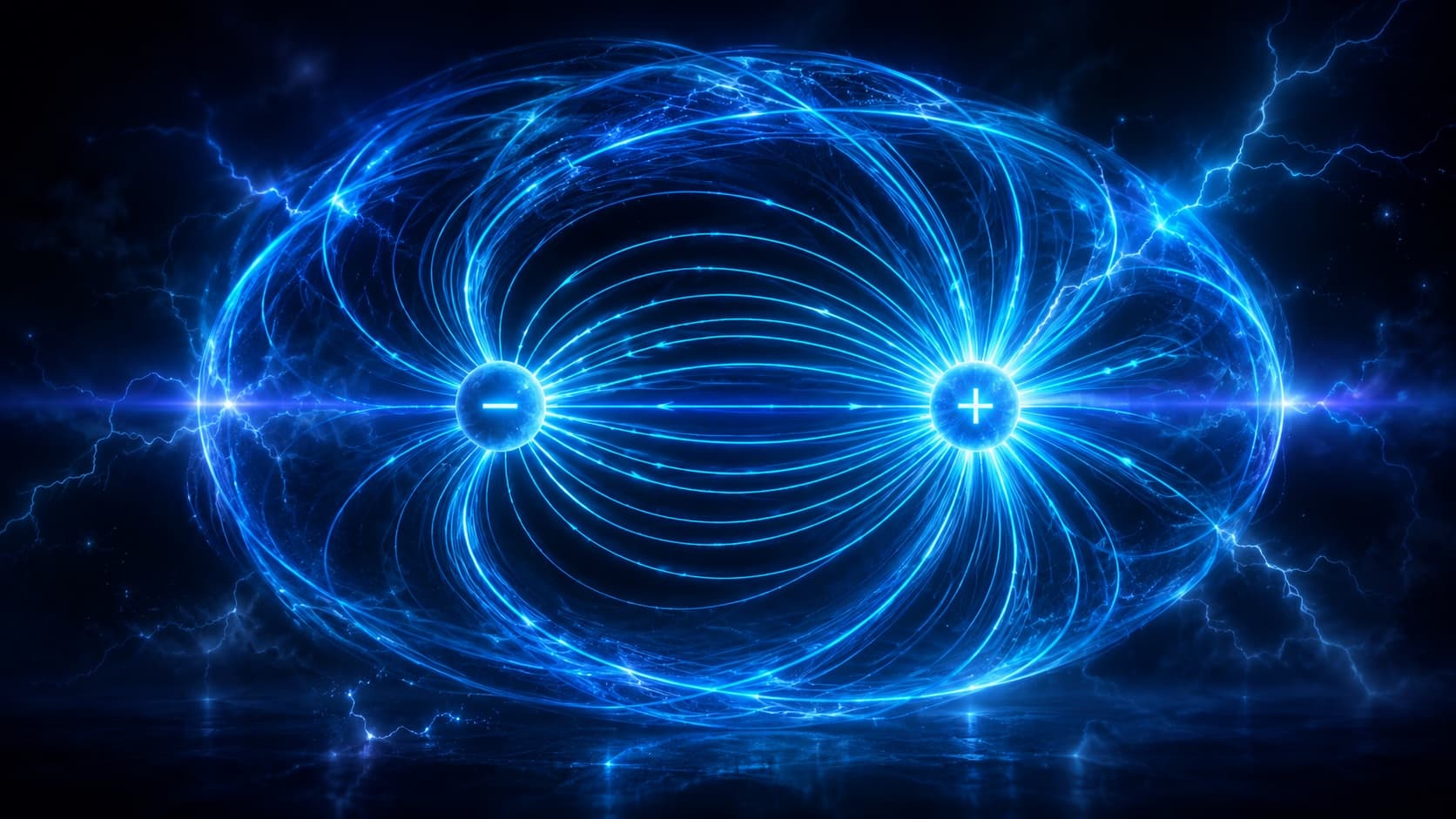
Coulomb's law and the electric force
PHYS 301 · Electrostatics
Coulomb's law describes the force between electric charges. This lesson explains charge, inverse-square forces, superposition, and how electric forces compare with gravity.
Key equations
e=1.602\times 10^{-19}\ CF=k_e\frac{|q_1q_2|}{r^2}k_e=\frac{1}{4\pi\epsilon_0}k_e\approx 8.99\times 10^9\ N\,m^2/C^2\vec{F}_{2\leftarrow 1}=k_e\frac{q_1q_2}{r^2}\hat{r}_{2\leftarrow 1}\vec{F}_{net}=\sum_i \vec{F}_iF_x=\sum_i F_{ix}F_y=\sum_i F_{iy}F_g=G\frac{m_1m_2}{r^2}Learning objectives
- Define electric charge and charge conservation.
- Apply Coulomb's law to point charges.
- Use vector form to determine force direction.
- Apply superposition to multiple electric forces.
- Compare electric and gravitational inverse-square forces.
Electric charge
Electricity begins with electric charge. Charge is a fundamental property of matter, just as mass is. There are two kinds of electric charge, called positive and negative. Like charges repel, and opposite charges attract.
Charge is measured in coulombs, written . The elementary charge has magnitude
A proton has charge , and an electron has charge . Ordinary objects often contain enormous numbers of positive and negative charges, but they usually appear neutral because the amounts balance.
Charge is conserved. In an isolated system, the total electric charge does not change. Charges may move from one object to another, but they are not created or destroyed in ordinary processes.
Coulomb's law
For two point charges and separated by distance , Coulomb's law gives the magnitude of the electric force:
F=k_e rac{|q_1q_2|}{r^2}
The constant is Coulomb's constant:
k_e= rac{1}{4piepsilon_0}
where is the permittivity of free space. Numerically,
The force points along the line connecting the charges. If the charges have the same sign, the force is repulsive. If they have opposite signs, the force is attractive.
Vector form
The vector form of Coulomb's law is especially important in three-dimensional problems. The force on charge 2 due to charge 1 may be written
ec{F}*{2leftarrow 1}=k_e rac{q_1q_2}{r^2}hat{r}*{2leftarrow 1}
where is a unit vector pointing from charge 1 toward charge 2. The sign of determines whether the force points along or opposite this unit vector.
Vector notation prevents confusion when charges are not arranged on a single line.
Superposition of forces
Electric forces obey superposition. If several charges act on a charge , the net force is the vector sum of the individual forces:
ec{F}_{net}=sum_i ec{F}_i
Each force is calculated as though the other charges were absent, then the vector forces are added.
This principle is powerful but requires careful geometry. In two or three dimensions, components are usually the safest method:
and similarly for .
Comparison with gravity
Coulomb's law resembles Newton's law of gravitation:
F_g=G rac{m_1m_2}{r^2}
Both are inverse-square laws. Both act along the line joining two objects. Both can be described by fields.
But there are major differences. Gravity is always attractive, while electric force can attract or repel. Electric force is also enormously stronger than gravity at the particle scale. The reason ordinary matter is not dominated by huge electric forces is that positive and negative charges often nearly cancel.
Point charges and idealization
Coulomb's law in its simplest form applies to point charges, meaning charges whose size is negligible compared with their separation. Real charged objects can often be approximated as point charges if observed from far away.
For extended charge distributions, the total force can be found by adding contributions from small charge elements. In calculus form, this becomes an integral.
Units and signs
Always keep signs separate from magnitudes. The magnitude formula uses . Direction must be determined physically or by vector form. A positive force value in one-dimensional notation depends on your chosen coordinate axis; it does not automatically mean repulsion.
The big idea
Coulomb's law is the starting point of electrostatics. It says electric charges exert inverse-square forces on one another, with direction determined by charge signs and geometry. Together with superposition and vector addition, Coulomb's law allows the force from any static arrangement of point charges to be calculated in principle.
Sign in to track your progress.
Ask your AI physics guide
Ask anything about Electricity and Magnetism — Coulomb's law and the electric force, or choose a suggested question below.
AI responses are educational and may not be perfectly accurate. Press Enter to send, Shift+Enter for new line.