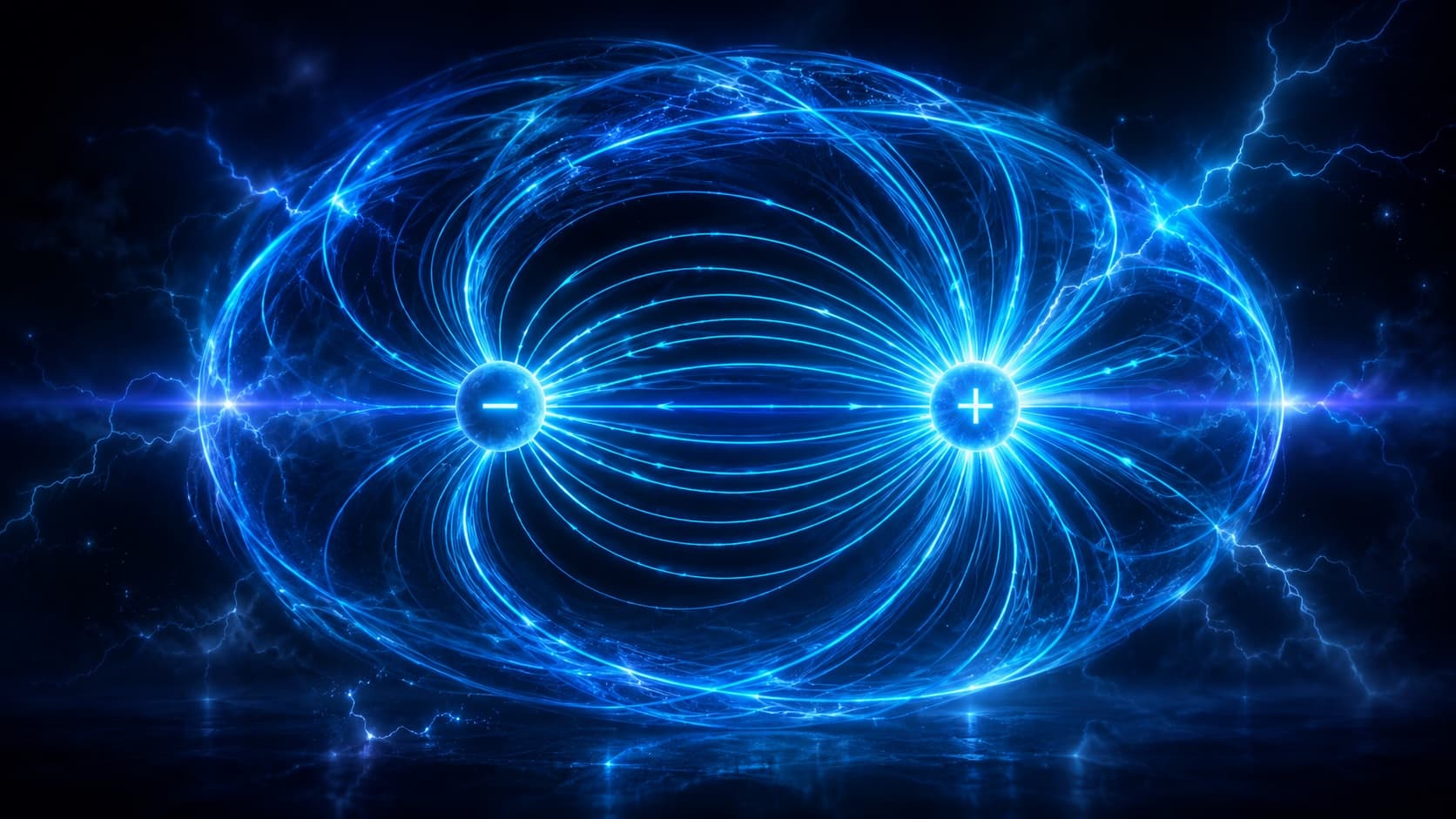
Gauss's law
PHYS 301 · Electrostatics
Gauss's law relates electric flux through a closed surface to enclosed charge. This lesson develops electric flux, symmetry, Gaussian surfaces, and applications.
Key equations
\Phi_E=\vec{E}\cdot\vec{A}=EA\cos\theta\Phi_E=\int \vec{E}\cdot d\vec{A}\oint \vec{E}\cdot d\vec{A}\oint \vec{E}\cdot d\vec{A}=\frac{Q_{enc}}{\epsilon_0}E(4\pi r^2)=\frac{Q}{\epsilon_0}E=\frac{1}{4\pi\epsilon_0}\frac{Q}{r^2}E(2\pi rL)=\frac{\lambda L}{\epsilon_0}E=\frac{\lambda}{2\pi\epsilon_0 r}2EA=\frac{\sigma A}{\epsilon_0}E=\frac{\sigma}{2\epsilon_0}Learning objectives
- Define electric flux through open and closed surfaces.
- State Gauss's law in integral form.
- Explain the meaning of enclosed charge.
- Choose useful Gaussian surfaces based on symmetry.
- Apply Gauss's law to point, line, and sheet charge distributions.
Electric flux
Gauss's law is one of the most powerful statements in electrostatics. It begins with electric flux, a measure of how much electric field passes through a surface. For a flat surface in a uniform electric field,
Phi_E= ec{E}cdot ec{A}=EAcos heta
The area vector ec{A} has magnitude equal to the area and direction perpendicular to the surface. The angle is between the electric field and the area vector.
For a curved surface or nonuniform field, flux is calculated by an integral:
Phi_E=int ec{E}cdot d ec{A}
Closed surfaces
Gauss's law uses closed surfaces, sometimes called Gaussian surfaces. A closed surface completely encloses a volume, like a sphere, cylinder, or box. For a closed surface, area vectors point outward.
Flux through a closed surface is written
oint ec{E}cdot d ec{A}
The circle on the integral sign reminds us the surface is closed.
Gauss's law
Gauss's law states
oint ec{E}cdot d ec{A}= rac{Q_{enc}}{epsilon_0}
where is the net charge enclosed by the surface. Charges outside the surface may affect the electric field at points on the surface, but they do not contribute to net flux through the closed surface.
This law is always true in electrostatics and remains part of Maxwell's equations in general electromagnetism.
Meaning of the law
Positive charge acts as a source of electric field, producing net outward flux. Negative charge acts as a sink, producing net inward flux. If a closed surface encloses no net charge, the net flux is zero, though the electric field on the surface may not be zero.
Flux counts field lines crossing outward minus field lines crossing inward.
Gaussian surfaces and symmetry
Gauss's law is most useful for calculating electric fields when symmetry allows ec{E} to be factored out of the flux integral. Good cases include spherical symmetry, cylindrical symmetry, and planar symmetry.
The Gaussian surface should match the symmetry of the charge distribution. Use a sphere for a point charge or uniformly charged sphere, a cylinder for a long line of charge, and a pillbox for an infinite sheet of charge.
Point charge from Gauss's law
For a point charge , choose a spherical Gaussian surface of radius . The field has the same magnitude everywhere on the sphere and points radially outward, parallel to d ec{A}. Then
oint ec{E}cdot d ec{A}=E(4pi r^2)
Gauss's law gives
E(4pi r^2)= rac{Q}{epsilon_0}
so
E= rac{1}{4piepsilon_0} rac{Q}{r^2}
This recovers Coulomb's law field.
Infinite line of charge
For an infinite line with linear charge density , choose a cylindrical Gaussian surface of radius and length . The flux through the curved side is , and the end caps contribute zero because the field is parallel to them. The enclosed charge is :
E(2pi rL)= rac{lambda L}{epsilon_0}
Thus
E= rac{lambda}{2piepsilon_0 r}
Infinite sheet of charge
For an infinite sheet with surface charge density , use a pillbox crossing the sheet. The field is perpendicular to both faces and equal on both sides:
2EA= rac{sigma A}{epsilon_0}
so
E= rac{sigma}{2epsilon_0}
The big idea
Gauss's law relates electric flux through a closed surface to enclosed charge. It is always true, but it becomes a calculation tool when symmetry makes the flux integral simple. It reveals electric charge as the source or sink of electric fields and prepares the way for Maxwell's equations.
Sign in to track your progress.
Ask your AI physics guide
Ask anything about Electricity and Magnetism — Gauss's law, or choose a suggested question below.
AI responses are educational and may not be perfectly accurate. Press Enter to send, Shift+Enter for new line.