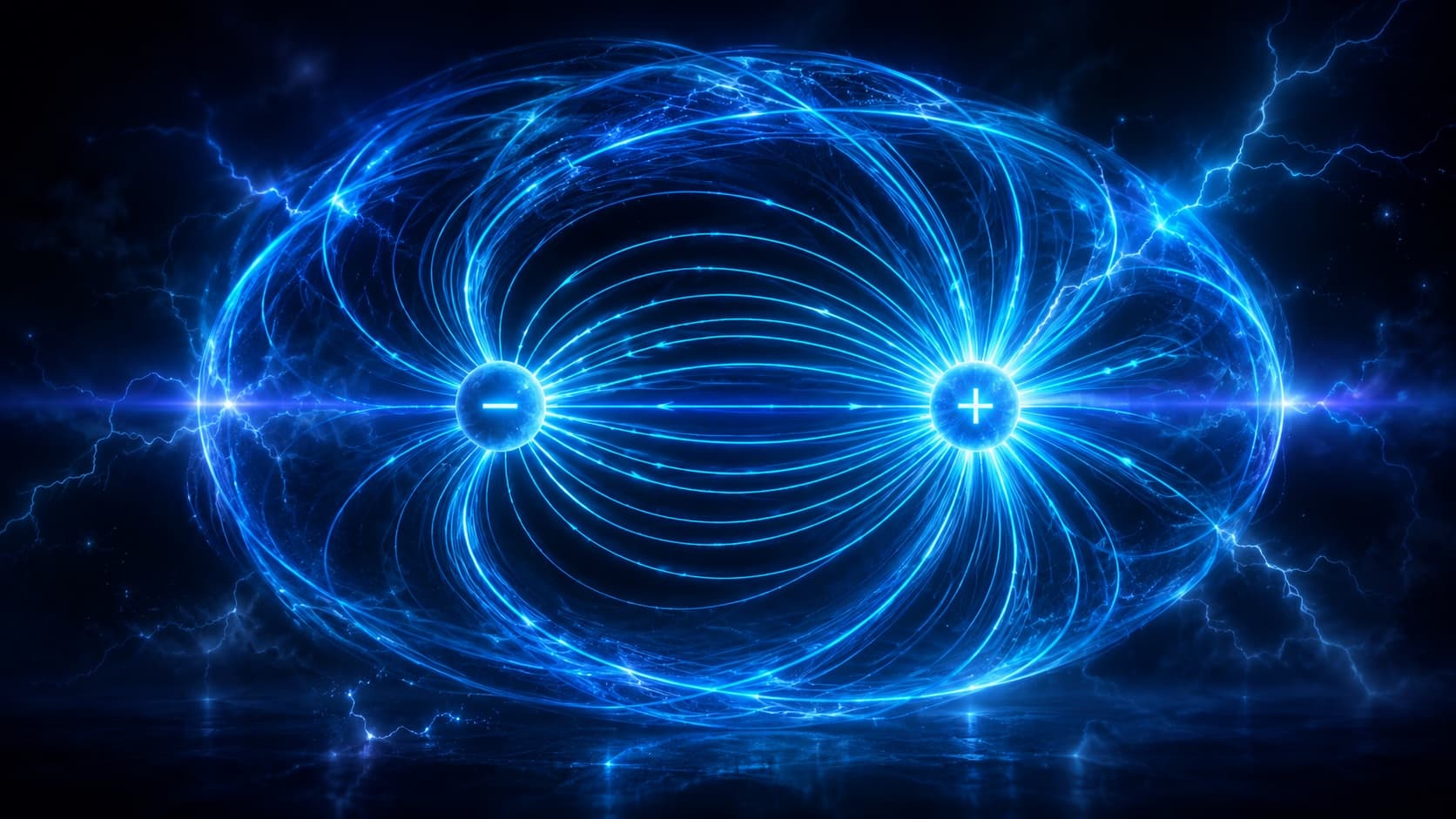
Poynting vector and radiation
PHYS 301 · Maxwell's Equations
Electromagnetic fields carry energy and momentum. This lesson introduces field energy density, the Poynting vector, intensity, radiation pressure, and electromagnetic radiation.
Key equations
u_E=
rac{1}{2}epsilon_0E^2u_B=
rac{B^2}{2mu_0}u=
rac{1}{2}epsilon_0E^2+
rac{B^2}{2mu_0}
ec{S}=
rac{1}{mu_0}
ec{E} imes
ec{B}W/m^2I=langle S
angleI=
rac{1}{2}cepsilon_0E_0^2E_0=cB_0I=
rac{1}{2}
rac{c}{mu_0}B_0^2p_{rad}=
rac{I}{c}p_{rad}=
rac{2I}{c}I=
rac{P}{4pi r^2}Learning objectives
- Write electric and magnetic field energy densities.
- Define and interpret the Poynting vector.
- Calculate average intensity of a sinusoidal electromagnetic wave.
- Describe radiation pressure and electromagnetic momentum.
- Explain how accelerating charges produce radiation.
Energy in electromagnetic fields
Electric and magnetic fields store energy. The electric field energy density in vacuum is
u_E= rac{1}{2}epsilon_0E^2
The magnetic field energy density is
u_B= rac{B^2}{2mu_0}
The total electromagnetic energy density is
u= rac{1}{2}epsilon_0E^2+ rac{B^2}{2mu_0}
For an electromagnetic plane wave in vacuum, the electric and magnetic contributions are equal on average and instantaneously.
The Poynting vector
The Poynting vector describes electromagnetic energy flow:
ec{S}= rac{1}{mu_0} ec{E} imes ec{B}
Its direction is the direction energy travels. Its magnitude has units of power per area, or intensity:
For a plane wave, ec{E} and ec{B} are perpendicular, and ec{S} points in the propagation direction.
Intensity of an electromagnetic wave
The instantaneous energy flow varies in time for a sinusoidal wave. The average intensity is the time average of the Poynting vector magnitude:
angle$$ For a sinusoidal plane wave in vacuum, $$I= rac{1}{2}cepsilon_0E_0^2$$ Using $E_0=cB_0$, this can also be written in terms of magnetic field amplitude: $$I= rac{1}{2} rac{c}{mu_0}B_0^2$$ ## Radiation pressure Electromagnetic waves carry momentum as well as energy. When light is absorbed or reflected by a surface, it exerts pressure. For complete absorption at normal incidence, $$p_{rad}= rac{I}{c}$$ For perfect reflection, $$p_{rad}= rac{2I}{c}$$ Radiation pressure is usually small in everyday situations but important in astronomy, laser physics, optical tweezers, and solar sails. ## Point source spreading If a source radiates power $P$ uniformly in all directions, intensity at distance $r$ is $$I= rac{P}{4pi r^2}$$ This inverse-square law follows from energy spreading over the surface of a sphere. Real antennas and light sources may radiate directionally, producing different angular intensity patterns. ## Accelerating charges radiate Electromagnetic radiation is produced by accelerating charges. A charge oscillating in an antenna emits radio waves. Electrons changing motion in atoms emit light. Thermal motion of charges in matter produces thermal radiation. A charge moving at constant velocity does not radiate in the same way; acceleration is essential. ## Antennas An antenna converts electrical signals into electromagnetic waves and vice versa. In a transmitting antenna, charges oscillate, producing time-varying fields that propagate outward. In a receiving antenna, an incoming electromagnetic wave drives charges, inducing an electrical signal. Antenna size is often related to wavelength. Efficient antennas commonly have dimensions comparable to a significant fraction of $lambda$. ## Conservation of electromagnetic energy Energy conservation for fields and charges is expressed by Poynting's theorem. In simplified meaning, it says that decrease of field energy in a region equals energy flowing out plus work done on charges. The Poynting vector is the field energy flux. This field-energy view is essential in understanding circuits too: energy often flows through electromagnetic fields around wires, not inside electrons as little packets of stored energy. ## The big idea Electromagnetic fields carry energy, momentum, and power flow. The Poynting vector $ ec{S}= ec{E} imes ec{B}/mu_0$ gives the direction and rate of energy transport. Radiation pressure, inverse-square spreading, antennas, and light intensity all follow from the reality of electromagnetic field energy.Sign in to track your progress.
Ask your AI physics guide
Ask anything about Electricity and Magnetism — Poynting vector and radiation, or choose a suggested question below.
AI responses are educational and may not be perfectly accurate. Press Enter to send, Shift+Enter for new line.